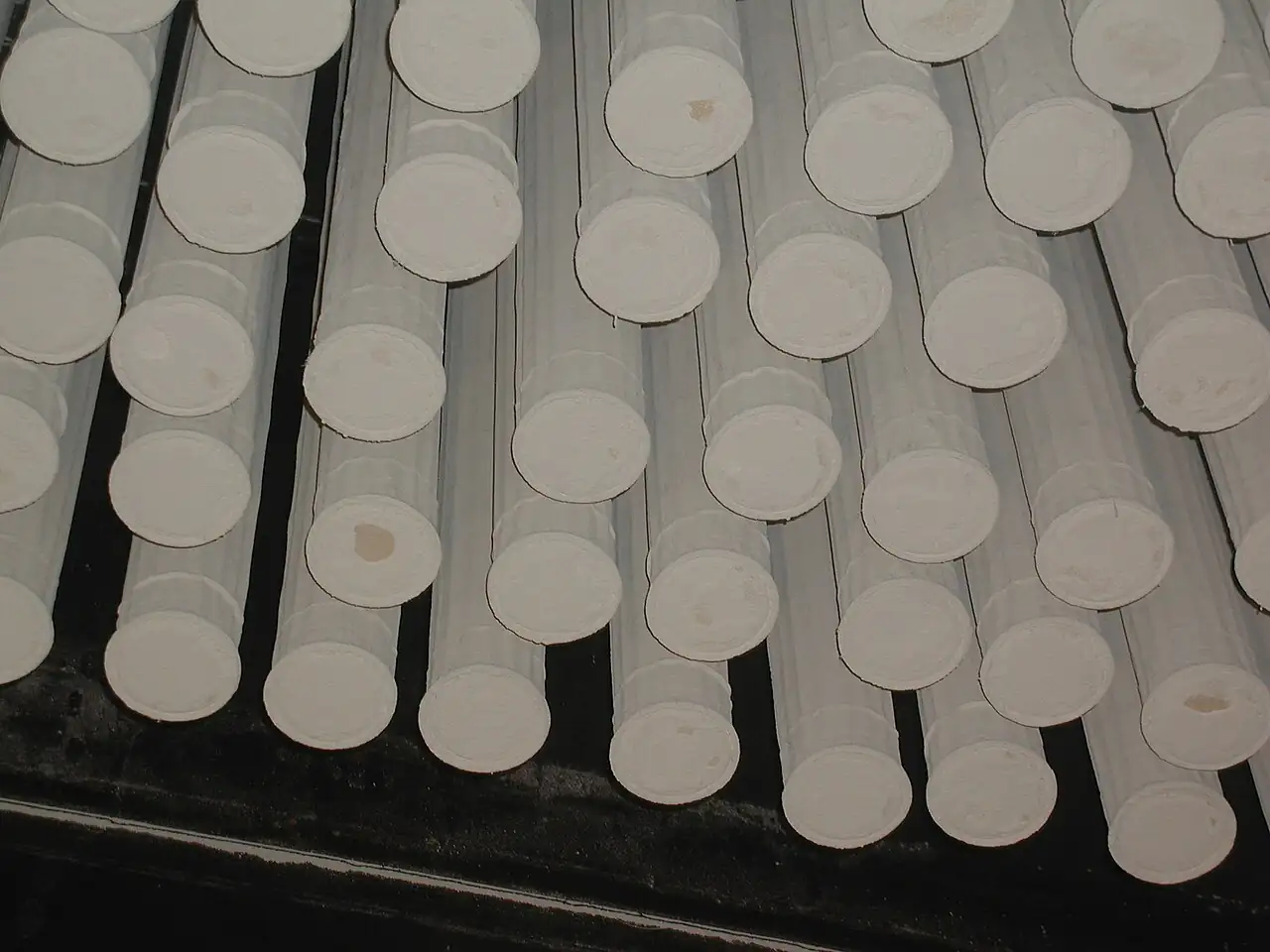
A fluid bed dryer is a machine that dries, and often cools, particulate solids by suspending them in an upward stream of hot gas: air or inert gas blown through a distributor plate lifts the particle bed into a fluid like state in which every particle is washed by the gas, moisture leaves fast and uniformly, and the dried product overflows a weir or leaves through a rotary airlock at the discharge end. Static and vibrating designs are the two production forms, and integrated cooling sections, classifying zones, and spray injection options extend the same machine from simple drying into granulation and coating. GEA's fluid bed technology pages and ANDRITZ's fluid bed dryer and cooler line are representative catalogs, and Carrier's vibrating fluid bed pages represent the vibrating class.
This page is written for the engineer specifying a fluid bed dryer for chemicals, minerals, polymers, food, or pharmaceutical powders and granules. It works through how fluidization governs heat and moisture transfer, which bed types fit which particle behaviors, the parameters on vendor data sheets, and the selection factors and RFQ language that decide whether the installed machine meets its moisture and capacity guarantees without losing the product to the dust collector.
The decision concentrates in five places: the feed's particle size, density, and moisture, the product moisture and temperature it must reach, the fluidization velocity and bed depth the particles tolerate, the inlet gas temperature and heat source the product allows, and the dust collection that keeps the yield. Get those right and the bed area, fan, and heater sizes follow.
Chapter 1 / 06
What a Fluid Bed Dryer Is and What Is Being Decided
The industrial machine this page describes is a vessel, most often rectangular in production form, whose bottom is a perforated distributor plate over a plenum. A centrifugal fan pushes heated gas through the plenum and the plate into the bed of solids above it; when the gas velocity passes the particles' minimum fluidization velocity, the bed expands, bubbles, and behaves like a boiling liquid, with intense mixing and every particle exposed to the gas. Wet feed enters at one end through a rotary airlock or a feeder, travels across or down the fluidized bed in minutes of residence, and dry product discharges over an adjustable weir or through a discharge port, while the gas, carrying evaporated moisture and the finest particles, leaves the top of the vessel through ducts to a dust collector.
What is being decided when a fluid bed dryer is purchased is a moisture guarantee at a capacity, delivered at a yield. The buyer is purchasing a product moisture, often to a fraction of a percent, at a feed rate, with a stated loss to the dust collection system and a stated product temperature at discharge, and on pharmaceutical and food duties, a stated containment and cleaning regime. Everything on the vendor data sheet, bed area, fluidization velocity, inlet temperature, residence time, fan power and static pressure, exists to support those guarantees, and the five decisions this page works through determine whether the machine holds them across the feed's natural variation.
The fluid bed dryer occupies a specific place in the convective drying landscape and its boundaries matter. It is not a rotary dryer: the rotary machine tumbles solids through a rotating drum in a stream of hot gas, with the particles sliding on the shell rather than suspended, and this site's rotary dryer page states plainly that it is not a fluid bed machine. It is not a spray dryer: the spray machine dries a liquid feed, atomized into droplets in a hot gas chamber, producing particles from solution or slurry rather than drying solids that already exist; this site's spray dryer page treats standalone fluid beds as downstream and neighboring duty, not as itself. When the feed is a wet cake, a granule, a crystal, or a pellet, and the product is that same solid dried, the fluid bed is the machine this page buys.
Different buyers buy the same machine for different reasons. A polymer plant buys a large static bed to dry resin pellets by the ton per hour with an integrated cooler and pneumatic transfer to silos. A mineral processor buys a heavy duty bed to dry sand, limestone, or ore concentrate with robust dust collection on the exhaust. A food plant buys a vibrating or static bed for cereals, granules, and seeds, with sanitation design and gentle handling. A pharmaceutical plant buys a contained bed, often batch, for granulation and drying in one suite. A chemical plant buys a continuous bed for crystals that must leave at a moisture specification without degrading. The specification language differs, but the fluidization physics is shared.
A short tour of named duties makes the machine concrete. At a polymer plant, extruded pellets from a water bath dewater on a screen, then fluidize in a hot air bed at 100 to 160 degrees Celsius inlet, drying to under 0.05 percent moisture and cooling in a second zone before air conveying to storage. At a mineral site, wet sand feeds a gas heated bed at several tonnes per hour, with a cyclone separator and a bag filter on the exhaust returning fines to the product. At a food plant, puffed cereal discharges from an extruder into a vibrating bed that dries and cools gently on a perforated tray deck. At a pharmaceutical suite, a batch bed fluidizes a wet granulation for twenty minutes under HEPA filtered air, then cools before discharge to a mill. In each duty the same five knobs appear: particles, moisture target, velocity, temperature, and dust.
The purchase is never the vessel alone, and the RFQ that forgets the gas train buys half a machine. The fan, the heater, the gas cleaning, and the feed and discharge devices are as much the product as the bed: the centrifugal fan supplies the velocity and overcomes the plate and bed pressure drop; the heater, steam coil, gas fired, electric, or hot oil, sets the inlet temperature; the dust collector and its fan carry the fines; and the rotary airlock or feeder at each end maintains the gas seal. Fluidization is a system behavior, and every component that touches the gas participates in it.
Chapter 2 / 06
How Fluidization Does the Work
Fluidization begins when the upward gas velocity exceeds the minimum fluidization velocity of the particle bed. Below it, gas percolates through a packed bed and drying is slow and uneven; above it, the pressure drop across the bed equals the bed's weight per unit area, the bed expands, and bubbles rise through it like a boiling liquid. The minimum velocity depends on particle size and density and on the gas: coarse, dense particles demand more, fine light powders less, and typical design fluidization velocities run from a fraction of a meter per second for fine powders to a few meters per second for coarse granules and pellets. Below a manageable particle band, very fine and cohesive powders refuse to fluidize without vibration or agitation, and above it, very large particles demand velocities whose fan power excludes them, which is where vibrating beds and other dryer classes take over.
The heat and mass transfer that follows is the fastest of the convective drying world. In the fluidized state every particle is surrounded by the hot gas, the film coefficients are high, and bed temperature is nearly uniform because the solids mix themselves vigorously; the drying front sits at the particle surface while it is wet, bed temperature holds near the gas's adiabatic saturation temperature, and when surface moisture is spent, the slower internal moisture diffusion period takes over with the bed temperature rising toward the gas temperature. Because the bed is isothermal, the product temperature is known and controllable, which is why heat sensitive materials that cannot tolerate a rotary drum's hot wall can dry in a fluid bed whose gas is hotter but whose solids stay cool until they are dry.
Bed depth and residence time set the machine's inventory and length. Working bed depths run roughly 100 to 500 millimeters in continuous dryers, deeper for longer residence and evaporative load, shallower for gentle or fast duty; residence time is simply bed volume divided by product flow, minutes in most chemical and mineral duties, tens of minutes where diffusion limited moistures must be chased. Continuous machines control residence with a weir height the product overflows, and multi compartment machines partition the bed so inlet temperature can fall stage by stage as the material dries, running hot where it is wet and cooler near discharge.
The gas side does the engineering. Inlet temperature ranges from 40 to 60 degrees Celsius for delicate pharmaceutical and food duty to 400 and beyond for robust minerals, set by the product's tolerance and the heat source; a steam coil delivers the moderate band, a direct gas fired heater the high band, with electric and hot oil alternatives where the product or the site demands. Distributor plates are drilled or hooded perforated plates, pitch and hole area designed for even distribution and a pressure drop typically a fraction of the bed drop to keep the fluidization uniform; plate blinding by fine, sticky material is the classic operational limit, and hooded designs and anti blinding hole patterns are the countermeasure.
Elutriation and attrition are the yield losses the design must manage. The fluidizing gas carries particles whose terminal velocity is below the gas velocity out of the bed: the freeboard above the bed lets the coarser fraction fall back, and whatever still leaves, the fines, runs to the dust collector, where a cyclone separator catches the coarse share and a bag filter the fine share, both typically returning product to the discharge wherever contamination allows. Attrition, particle breakage from the constant motion, is a product behavior the vendor must be told about, because a fragile granulate can grind itself into dust in a bed that was otherwise perfect, and the countermeasure is gentler fluidization, lower velocity, or a vibrating class of machine.
The exhaust and energy balance close the picture. Every kilogram of evaporated water carries with it the latent heat the heater supplied plus the sensible heat of the gas, and the specific gas consumption, kilograms of gas per kilogram of water, is the efficiency number that separates designs: higher inlet temperature and heat recovery on the exhaust improve it within the product's limits, and dew point transmitter instrumentation on the exhaust tracks the drying end state. Modern plants recirculate a share of the exhaust, with the humidity carried up toward the saturation the process allows, and the controls, a plc sequencing the fan, heater, feed, and discharge with temperature transmitters on inlet and bed, run the machine at the edge of its envelope rather than in the middle of it.
Chapter 3 / 06
Bed Types, Zones, and Duty Boundaries
The static fluid bed is the continuous production standard: a rectangular vessel with a plenum, a fixed distributor plate, and the bed fluidized purely by gas velocity, robust, simple, and the most energy efficient of the class. It suits materials that fluidize freely, the broad middle of the particle spectrum, and it scales from pilot beds of a tenth of a square meter to production machines of tens. Zones within a static bed are made by compartmenting the plenum: a hot drying section, a cooler section fed with ambient or dehumidified gas, and intermediate stages with falling temperatures, all in one casing with internal weirs pacing the flow.
The vibrating fluid bed adds mechanical energy to the gas: the whole deck, vessel and distributor, vibrates at low amplitude and frequency, moving the material along a gentle throw while a reduced gas velocity fluidizes or semi fluidizes it. This class suits exactly the materials static beds fail: cohesive or sticky powders that channel, fragile particles that attrition, wide size distributions that would elutriate their fines at full velocity, and slow, gentle duties like food cooling where the vibration conveys and the gas merely temperates. Carrier's vibrating fluid bed pages represent the class; the trade is mechanical complexity and a lower evaporative load per square meter against a material handling tolerance no static bed can match.
Bed type
Particle character it suits
Typical duty
Where it wins
Static continuous bed
free flowing, 0.05 to 5 mm
high rate drying and cooling
Capacity, efficiency, simplicity
Vibrating fluid bed
cohesive, fragile, wide PSD, sticky
gentle drying, cooling, tempering
Materials that defeat static beds
Batch fluid bed
pharma granules, small lots
contained granulation and drying
Validation, cleaning, lot control
Spouted bed
coarse particles over 5 mm
large particles, coating duty
Where bubbling beds cannot lift the particle
Zone and option decisions complete the type picture. An integrated cooler section, fed with ambient, chilled, or dehumidified gas, discharges product at bagging or storage temperature instead of drying temperature; a classifying section, with a widened gas velocity that elutriates a chosen fine fraction on purpose, splits oversize from undersize inside the machine; spray nozzles above or within the bed turn the dryer into a granulator or coater, building agglomerates or laying coatings while drying them, which is the fluid bed granulator of the pharmaceutical and food world. These are not separate machines but options on the same fluidization platform, selected by the duty.
Duty boundaries against the neighbors deserve plain language. When the feed is a liquid, slurry, or paste, the machine is a spray dryer, and the fluid bed that follows it in many plants is a finisher of its powder, not a substitute for it. When the duty is large lumpy or sticky pastes that tolerate a hot wall, the rotary dryer owns the tonnage end of drying, and its page says so explicitly. When the duty is a wet cake that must wash and dry in a closed batch vessel, the agitated Nutsche filter dryer owns that pharmaceutical niche. And when the duty is really cooling or gentle tempering with marginal drying, the vibrating bed with a screw conveyor or vibrating conveyor feed arrangement is often the honest machine. Within the particulate drying middle ground, free flowing and moderate in size, the fluid bed is the default the others are compared against.
Chapter 4 / 06
Key Specification Parameters
Vendor quotations revolve around a compact parameter set, and a buyer who reads them against the feed's measured behavior can compare offers on engineering terms. The table below collects the parameters that decide performance for mainstream continuous duty, with the ranges a reviewing engineer should expect across the class.
Parameter
Typical specification range
What it decides
Bed area
0.1 to 40 m2
Capacity at the chosen velocity and residence
Fluidization velocity
0.3 to 3 m/s by particle
Bed behavior, elutriation, fan power
Working bed depth
100 to 500 mm
Residence time and evaporative inventory
Inlet gas temperature
40 to 400 C by product
Drying rate and product thermal limit
Residence time
2 to 60 min continuous
Moisture target reachability
Evaporative load
kg water per hour
Heater duty and gas flow
Product moisture
guarantee band
The acceptance number
Distributor pressure drop
fraction of bed drop
Distribution uniformity and fan head
Fan power and static
duty specific
Energy cost and noise scope
Dust collection
cyclone plus bag filter
Yield and emissions compliance
Two of those numbers do the sizing work. Bed area follows from the evaporative load and the gas conditions: the gas flow the fan must deliver equals bed area times fluidization velocity, the water it can carry is set by the inlet humidity and the exhaust humidity band, and the area that closes that balance at a velocity the particles tolerate is the machine's size. Residence time then checks the moisture target: bed volume equals product flow times residence, and if the diffusion limited end moisture demands longer than the geometry gives, the design adds length or compartments rather than temperature, because temperature is usually the product's limit, not the machine's.
The remainder of the parameter set carries the guarantee's risk. Inlet temperature states the product's thermal limit compliance; distributor pressure drop states the uniformity margin, and the fan's static pressure must carry plate plus bed plus dust collector together; evaporative load states the heater's duty and the energy bill; and the dust collection scope states where the fines go and how the yield is counted. The instrumentation package, temperature transmitters on inlet, bed, and exhaust, a dew point transmitter on the exhaust where the end state matters, and pressure indications across plate and collector, is what lets the machine run at its edge safely.
Chapter 5 / 06
Selection Decision Factors and RFQ Language
Feed characterization comes first because fluidization is a particle behavior. The specification should state particle size distribution and particle and bulk density, the initial and target moisture on a defined basis, the material's stickiness or cohesion through the drying range, because many materials pass a sticky phase precisely in the middle, its fragility to attrition, and its temperature and contamination limits. Flow rate with its variation, and the upstream and downstream equipment, a weigh feeder or belt conveyor feeding, a screw conveyor or pneumatic transfer taking away, set the interface conditions the machine must accept.
Energy and environment context come second. State the heat sources available, steam pressure, gas, hot oil, or electricity, and the exhaust constraints, emissions limits, odor, and solvent character if the duty is solvent rather than water, which moves the design to closed cycle inert gas operation. The dust return philosophy, fines back to product or to waste, the noise environment for the fan, and the indoor or outdoor installation follow, and on food and pharmaceutical duty the cleaning regime and surface finish requirements arrive in the same paragraph, because they change the vessel construction more than the drying does.
Selection factor
What to specify
Common mistake
Particle behavior
PSD, densities, cohesion, fragility
Static bed bought for a powder that channels
Moisture targets
initial and final on stated basis
Diffusion limited target chased with temperature
Temperature limits
product maximum, melt or degrade
Inlet temperature set above the softening point
Heat source
steam, gas, oil, electric availability
Heater chosen the site cannot feed
Exhaust and dust
emissions limits, dust return policy
Collector sized on average, not upset, fines
Cleaning and hygiene
CIP, surface finish, containment
Industrial finish bought for food duty
Interfaces
feed and discharge equipment, silos
Airlock and transfer left out of the dryer scope
RFQ language that produces comparable offers follows from those factors and should read like a process data sheet. State the feed definition and targets, the temperature limits, the heat source, the exhaust constraints, and the installation context. Ask every vendor to state bed area and velocity at the duty, compartment arrangement with the temperature profile, residence time basis, fan flow and static with the distributor drop assumed, heater duty and control method, dust collection sizing with expected loss, and the pilot or reference data on the same material class, because fluid bed behavior is material specific enough that honest vendors quote from tests.
Guarantees and acceptance close the procurement. A defensible offer guarantees product moisture at the stated feed rate on the stated material, with a stated loss to the dust system and a stated product discharge temperature, demonstrated at commissioning over a defined run with calibrated moisture analysis. Hold every bidder to the same feed sheet, weight offers on energy per kilogram of water evaporated and total cost of ownership rather than machine price, and pilot the material if anything about its behavior is uncertain, because a week of pilot time is the cheapest insurance in this equipment class.
Air conditions belong in the basis because the machine breathes them. A dryer sized on temperate, dry ambient air loses capacity in a humid summer, when the inlet air carries more moisture before the heater ever sees it, and gains it in a cold, dry winter, when the same fan delivers a different mass of gas; altitude thins the air the fan moves and the oxygen a direct fired heater burns. The specification states the ambient design basis, humidity and temperature bands, and altitude, and asks every vendor to size on the worst drying case, which is usually the humid hot season, not the average brochure day. Dehumidified or dried air supplies appear where the product's final moisture target sits below what ambient air can reach at any temperature.
The balance of plant the RFQ must not forget: the centrifugal fan and its motor with a vfd where turndown matters, the heater and its fuel or utility train, the ducting with dampers and the expansion joints, the cyclone separator and bag filter with their discharge airlocks, the feed system with its weigh feeder or hopper scale gravimetrics, the product transfer with its screw conveyor or rotary airlock, and the control scope with the temperature transmitters and the plc that ties feed rate to exhaust humidity. On gas fired heaters the burner management and on food duty the filtered air path, with its industrial class filtration, are their own small projects that the dryer purchase must boundary explicitly.
Chapter 6 / 06
Installation, Standards, Failure Modes, and Maintenance
Installation is a duct and structure project. The vessel arrives as sections to be set on steel, the fan and heater positioned for the gas path, the dust collector and its discharge integrated, and the feed and discharge equipment tied in at both ends. Vibration isolation matters on vibrating beds, whose frames transmit their motion to everything rigidly attached, and acoustic treatment on the fan is usual indoors. Commissioning blanks the plate, checks distribution with a cold air study, heats the system, and brings feed up in steps while the moisture loop is tuned and the dust return is verified.
Standards shape the machine through the regimes it works in. Machine and pressure safety codes govern the casing and the gas train; food and pharmaceutical duties bring their hygiene design and cleanability expectations with them; emissions permits govern the exhaust and its dust loading; and explosion protection applies wherever the dust is combustible, with containment or suppression hardware and inerting options that change the machine's ventilation philosophy entirely. A buyer names the applicable regimes and the expected proofs, and the vendor's design statement maps to them, because a combustible dust duty specified without its protection philosophy is not a specification.
Failure mode
Signature
Response
Channeling and defluidization
wet channels, uneven product moisture
Velocity and plate review, agitation or vibrating class change
Temperature profile change, wall conditioning, cleaning cadence
Routine operation is trend led. Inlet, bed, and exhaust temperatures against feed rate tell the operator where the drying front sits; plate and collector pressure drops tell them whether the gas path is healthy; the exhaust dew point transmitter, where fitted, closes the loop on the end state; and product moisture on schedule verifies what the trends imply. Maintenance concentrates on the gas path and the moving ends: distributor plate inspection and cleaning at campaign changes, dust collector filter renewal, airlock seal maintenance, fan bearing service, and the heater's combustion or coil service on its own calendar.
The end state of a well specified fluid bed dryer is a machine the plant trusts with its moisture specification. The feed goes in wet and comes out at target without operator attention, the fines return to product instead of to the environment, the energy bill per kilogram of water sits at the efficient end because the controls run the edge, and the material, which is the whole point, leaves undamaged and ungraded into dust. The neighbors mark the boundaries: sprays own the liquid feeds, rotary drums own the lumpy tonnage, and this machine owns the middle of particulate drying where every particle meets the gas at once.
FAQ
What kinds of materials suit a fluid bed dryer?
Free flowing particulates in roughly the 0.05 to 5 millimeter band: crystals, granules, pellets, seeds, and powders that fluidize without channeling. Cohesive or sticky powders that refuse to fluidize, fragile materials that attrition, and very coarse particles beyond a bed's lifting reach go to vibrating beds or other dryer classes. The honest answer for any specific material comes from a pilot test, because fluidization behavior is material specific.
Static or vibrating fluid bed: which do I need?
Static beds win on capacity, energy efficiency, and simplicity for materials that fluidize freely, and they own high rate chemical and mineral duty. Vibrating beds add mechanical energy that conveys and gently agitates at reduced gas velocity, which suits cohesive powders, wide size distributions, fragile products, and gentle food duties. If your material channels or dusts in a static bed, the vibrating class is the fix; if it fluidizes cleanly, the static bed is the economy.
How hot can the drying gas be?
From about 40 degrees Celsius for delicate pharmaceutical and food duty to beyond 400 for robust minerals like sand and limestone. The limit is the product's, not the machine's: the bed itself runs near the wet bulb temperature while surface moisture persists, so hot gas can dry heat sensitive materials safely, but the final drying stages and any dead spots see the full inlet temperature, and softening, melting, or degradation points set the ceiling.
How is the dust and fines handled?
The exhaust gas carries elutriated fines out of the freeboard to a dust collector, typically a cyclone separator catching the coarse share followed by a bag filter for the fine share, with the collected material returned to the product stream wherever contamination allows. The collector is sized for upset fines loading, not the average, and the discharge airlocks on both stages are part of the gas seal. Yield loss to the system is a specified number, not an accident.
Can the machine cool as well as dry?
Yes, integrated cooling zones are standard: a later compartment fed with ambient, chilled, or dehumidified gas brings the product down to bagging or storage temperature in the same casing, with its own plenum section and gas handling. On polymer and food duties the cooler is rarely optional, because product leaving at drying temperature would cake in storage or degrade in packaging.
What heat sources can a fluid bed dryer use?
Steam coils for the moderate temperature band where plant steam exists, direct or indirect gas firing for high temperatures and large duties, hot oil coils where steam pressure is insufficient and open flame is unwelcome, and electric heaters for small, clean, or pharmaceutical installations. The choice follows the product's temperature band and contamination tolerance and the site's utility balance, and the heater control quality matters as much as its duty.
What makes a fluid bed defluidize or channel?
Gas velocity falling below the bed's minimum, cohesion and stickiness through a wet phase, fines packing the distributor plate, or feed surges that wet one region. The symptoms are wet channels, uneven product moisture, and rising plate pressure drop. The remedies are velocity and plate design, agitation or a vibrating class of machine for cohesive materials, and feed moisture and rate control upstream, because most channeling events start in the feed, not the bed.