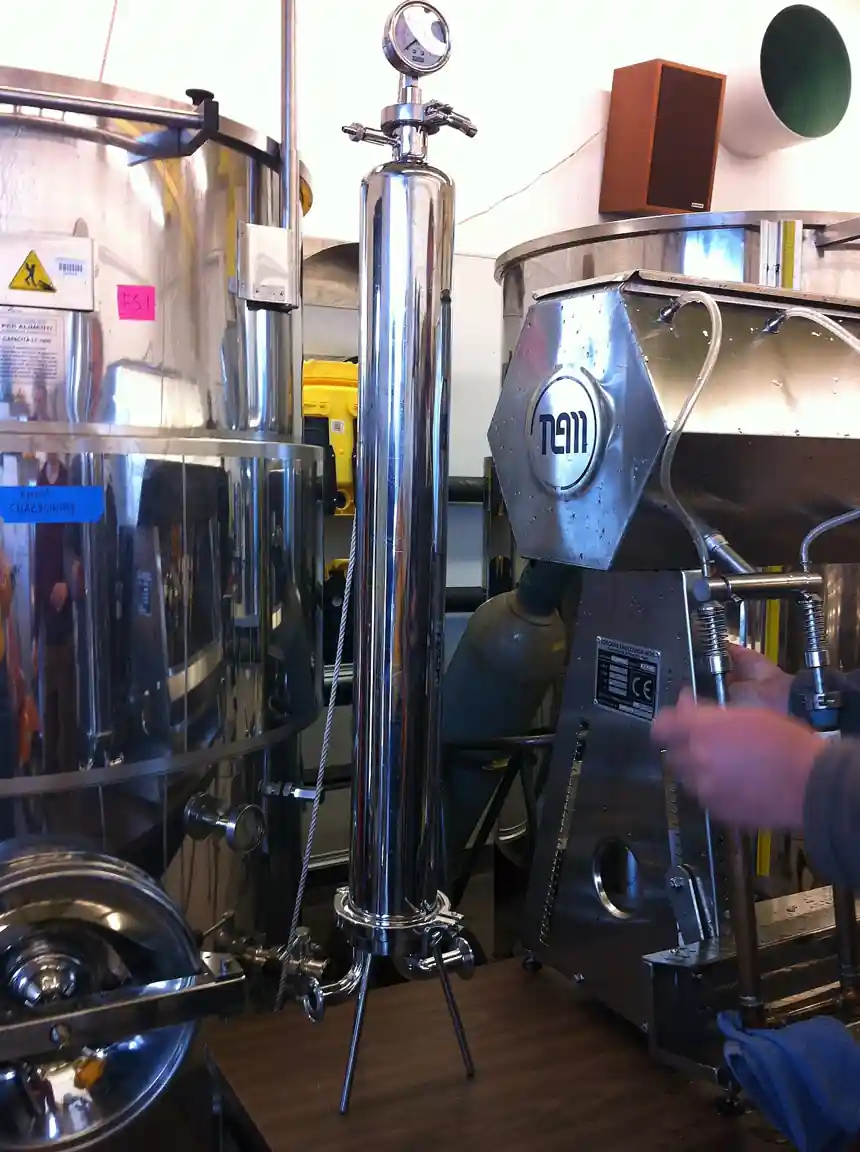
A candle filter is a vertical pressure vessel packed with many suspended vertical filter elements, the candles, on which filtration happens: slurry pumped into the vessel deposits a thin cake, typically five to twenty-five millimeters, on each candle's surface, the filtrate passes through the media into the candle core and out the top, and when the batch is filtered the same machine washes the cake, dries it with pressurized gas, and discharges it, dry by blowback into a hopper or as slurry through a bottom valve, all without opening the vessel. Between batches, a small heel of liquid held in the vessel refilters continuously, so even the residual slurry leaves clear. BHS-Sonthofen CF and DrM FUNDABAC machines are representative of the industrial class, and this page treats the complete system, vessel, candles, valves, and controls, as the purchasing object.
This page is written for the engineer specifying a candle filter for fine catalyst or crystal recovery, product polishing, or clarifying duty on difficult slurries. It works through what the machine does and what is actually being bought, how the cake and the elements do the work, which design choices such as element media, cake thickness, and discharge mode separate one offering from another, the parameters that recur on vendor data sheets, and the selection factors and RFQ language that decide whether the filter delivers its clarity and cake quality at the plant's batch rhythm.
The decision concentrates in five places: the slurry and its solids, particle size, concentration, and filterability, because they write every downstream number; the element media, sintered metal, mesh, polymer, or ceramic, with precoat and filter aid strategy, which sets clarity and blinding behavior; the filtration area and cake thickness that size the batch; the wash, dry, and recovery duty, because washing quality and heel recovery are where these machines earn their price; and the discharge and batch logistics, dry or slurry, that tie the filter to the plant's rhythm. Get those right and the cycle runs clean.
Chapter 1 / 06
What a Candle Filter Is and What Is Being Decided
The machine this page describes is a cylindrical pressure vessel, vertical, with a tube sheet or suspension grid near the top from which the candles hang in ranks, tens to hundreds of them, each a vertical tube of filter media, sintered metal, wire mesh on a support, polymer fabric, or porous ceramic, closed at the bottom and open to a filtrate collection header at the top. Slurry pumps in under pressure through a feed valve, liquid pushes through the cake and media into the candle cores and up to the filtrate outlet, and solids build on the outside of each candle as a uniform thin cake; gas sparging keeps the vessel's contents agitated during filling so the cake forms evenly. When filtration ends, wash liquid displaces and washes the cake, gas dries it, and discharge, a sudden gas blowback through the candles drops the dry cake into the vessel's cone and out a bottom valve, or a slurry valve reslurries and flushes it.
What is being decided when a candle filter is purchased is a clarity and cake statement at a batch rhythm. The buyer is purchasing filtrate clarity to a stated specification, often part-per-million or sub-micron, a cake washed to a stated impurity level and dried to a stated residual moisture in dry discharge, and the whole cycle fitting a stated time so the plant's batch schedule holds. Everything on the vendor data sheet, filtration area, cake thickness, vessel volume, cycle stages, exists to support that statement, and honest vendors size from filterability tests on the actual slurry rather than by copying the last project.
The candle filter sits in the pressure-filtration family with well-defined neighbors that this encyclopedia treats separately. It is not the pressure-leaf-filter, its close cousin with vertical or horizontal leaf plates instead of candles, nor the nutsche-filter, the agitated bottom vessel of batch filtration, nor the plate-and-frame filter press, all of which this site keeps on their own pages; the candle's distinction is the vertical element's thin cake, its automatic closed discharge, and its heel-refiltration, which together make it the fully enclosed, high-clarity choice. It is not the rotary-vacuum-filter, continuous vacuum duty's machine, nor the vacuum-belt-filter of continuous washing, nor the industrial-filter class generally, nor the self-cleaning-filter of guard duty in lines, nor the bag-filter of dust collection, though that name collision is common. Downstream of its dry discharge, a screw conveyor or gravity chute moves cake; upstream, a centrifugal pump or the process itself delivers slurry.
Different buyers buy the same machine for different slurries. A chemicals plant recovers fine catalyst from product liquor, precious metals and nickel among them, where the cake is the value and dry discharge recovers it completely. A pharmaceutical plant clarifies or washes crystals in closed, validated duty, no operator exposure, no open handling. A refinery or fuels line polishes slurries where clarity is everything and cake small. A wastewater or precipitations train recovers metal hydroxides. An ink or pigment plant washes color to specification. The solids' value, cake or liquor, and the wash requirement write the specification; the machine concept does not change.
The economics deserve their own paragraph because candle filters are bought with closure and washing money. Against an open nutsche or filter press, the closed candle machine buys containment, solvent and vapor recovery, no operator exposure, and clean-in-place, at higher capital; against a centrifuge, it buys fine solids and cake washing that centrifuges cannot reach, at lower mechanical drama. Washing is the quiet earner: a thin cake washes fast and near-completely where thick cakes channel and trap, and displacement washing with the batch's own vessel saves wash liquor by design. The batch rhythm, filter, wash, dry, discharge, is a schedule the plant pays to keep, and the cycle-time guarantee is as commercial as the clarity.
A short tour of named duties makes the machine concrete. At a catalyst recovery duty, reactor slurry feeds the candle filter, cake builds to ten millimeters, wash liquor displaces and rinses, gas dries to low residual moisture, and blowback drops the precious cake to a sealed hopper on a screw conveyor. At a pharmaceutical crystallization, mother liquor filters from fine crystals, the cake washes to purity, and discharge reslurries to the dryer, a paddle dryer in some plants and a spray dryer in others taking the concentrated slurry, while free-flowing dry cakes from metal-duty machines ship straight to a rotary dryer or calciner when the process asks for more. At a polish duty on fuel oil, a precoat of filter aid holds sub-micron clarity with a tiny heel discharge. Each duty names the same knobs, area, thickness, wash, and cycle time, with numbers that scale while the cake physics never changes.
Chapter 2 / 06
How Cake, Elements, and Pressure Do the Work
Filtration is pressure-driven cake building. Pump pressure, a few bar, pushes liquid through the growing cake and the media; the cake itself becomes the finest filter layer, especially with a precoat or body-feed of filter aid, diatomite or perlite, and the media's job is to hold that layer, not to be the filter alone. Cake growth follows the slurry's solids and time, and thin cakes are deliberate: low flow resistance through a thin cake keeps the batch's average rate high, and the thin cake is what washes and dries quickly afterward. The cycle's filtration stage ends on a cake thickness measured by filtrate totalized, pressure drop, or both.
Sparging keeps the cake honest. Compressed gas, sparged into the vessel during filling and filtration, agitates the slurry gently so solids stay suspended and every candle sees the same concentration; without it, solids classify, the vessel's lower candles cake heavy and upper candles starve, and the batch loses uniformity. The same sparge system reslurries for discharge in slurry-out designs and gas-scours the vessel between batches. Sparge gas consumption and pressure are part of the machine's utilities statement, and its control, sequencing with the cycle, is part of the vendor's scope rather than an afterthought.
Washing and drying deliver the cake's quality. Displacement wash pushes mother liquor out of the cake's pores with clean liquor, heated where the duty wants it in a small shell-and-tube heat exchanger on the wash header, efficient because the thin cake's voids flush in a few bed volumes; wash quantity, pressure, and staging are the design variables, and wash clarity or cake impurity analysis proves the result. Gas drying then displaces the wash liquor, pressurized gas, nitrogen or air by the product's flammability, blowing through the cake until residual moisture meets spec; the dried cake's final state, free-flowing or pasty, follows the solids' character and the drying stage's discipline. Both stages reuse the same vessel, valves, and pressure, which is the machine's economic geometry.
Heel and residual filtration are the candle machine's signature. Between batches, a heel of liquid remains in the vessel's lower volume, kept agitated by sparging; as the next batch feeds, that heel refilters through the already-caked candles, so nothing muddy leaves the vessel even at start and end, and the residual volume after discharge refilters the same way. The filtrate valve's logic, totalizing and switching by clarity or turbidity where instrumented, closes the loop. This is what buys the high-clarity reputation, and a buyer comparing candle and leaf machines should compare residual handling explicitly.
Discharge closes the cycle. Dry discharge: with the vessel drained and cake dried, a sharp gas blowback through the candles' cores flexes or shocks the cake off the elements, drops it into the cone, and a bottom valve, often a spherical or gate design on abrasive duty, lets it out to hopper or conveyor, the whole step seconds long and closed. Slurry discharge: the vessel refills partially, sparging resuspends the cake, and the slurry pumps or drains out to the next process. Both are automatic, sequenced by the control system through valves that see abrasive, hot, or solvent service, and the discharge valve's quality is a known lifecycle item.
Element media is the wear-and-clarity heart. Sintered stainless candles serve hot, corrosive, catalyst-class duty at the highest cost and longest life; wire mesh on perforated supports washes and rebuilds cheaply for coarser clarity; polymer fabric socks over supports are the low-cost consumable for benign duty and single-use campaigns; porous ceramic candles take aggressive chemistry and fine retention in specific classes. Media choice follows clarity target, chemistry, temperature, and the blinding behavior of the solids, and pilot testing on the real slurry, with the real precoat strategy, is the only honest basis for the choice and for the cycle numbers sold with it.
Chapter 3 / 06
Filter Types, Duty Positions, and Machine Boundaries
Within the candle class, the element and vessel arrangements name the variants. Standard vertical multitube vessels with suspended candles are the DrM FUNDABAC and BHS CF pattern; leaf-style vertical elements in the same closed-vessel logic fill the family's adjacent designs that this page folds in as variants rather than separate machines; and heated jackets, pressure ratings, and hygienic finishes adapt the same core to hot, solvent, and GMP duty. Sizes run from laboratory vessels of a fraction of a square meter to production machines with hundreds of square meters of area and hundreds of candles.
Duty positions name the machine's contracts. In catalyst and precious metals recovery, the cake is the product and dry discharge with full recovery, no heel loss of value, is the specification. In pharmaceutical crystallization, the filter closes the batch train between reactor, often a jacketed reactor, and dryer, with validation and containment as requirements. In chemical precipitations and hydrometallurgy, pregnant liquor clarity and wash efficiency define the duty. In fuels and lube polishing, a precoat duty with minimal cake, clarity is everything and disposal trivial. In each position the interface list differs, slurry feed and wash supply, discharge to conveyor or dryer, vent to scrubbing or recovery, but the machine and its cycle stay the same.
Adjacent machines mark the boundary. The candle filter is not the pressure-leaf-filter of the same closed-vessel family, which uses flat leaves and suits some of the same duties with different cake behavior; not the nutsche-filter, the open or closed agitated pan of batch filtration; and not the filter press of plate-and-frame duty, each with its own page. It is not the continuous machines, rotary-vacuum-filter and vacuum-belt-filter, whose through-flow logic suits steady feeds rather than batches, nor the industrial-filter general class, nor the self-cleaning-filter guard machines of pumped lines. Upstream, a slurry pump or the process delivers feed; a centrifugal pump or a nitrogen header supplies wash and gas; downstream, dry cake moves on a screw conveyor and wash filtrates go to recovery or, where volatile, to a wet-scrubber or condensing train; in solvent duty an oil-water-separator handles condensed organics from the vapor system.
Instrumentation and control complete the machine as operated. The cycle, feed, filter, wash, dry, discharge, heel, runs on valve sequencing with feedback from filtrate flow totalizers, pressure transmitters on vessel and feed, clarity or turbidity instruments on filtrate where the duty warrants, and level instruments on the vessel; a control valve on feed rate and a variable frequency drive on the feed pump shape the cake-building profile in refined plants. The control package, its sequence logic and interlocks, discharge and blowback especially, is part of the purchased machine, and the RFQ should state the plant's control system interface rather than discover it at commissioning.
Materials and construction classes follow the chemistry. Vessels are stainless, duplex, or lined steel by the slurry's corrosion, code-stamped as pressure vessels; candles and internals match, with sintered alloy or ceramic elements in aggressive duty; valves are abrasion and solvent-rated, the discharge valve especially; and jackets, when the duty wants them, make the vessel a heated pressure part. Seals and gaskets follow the chemistry and the hygiene class, and every wetted material appears in the specification with its basis, because a candle filter is a chemistry machine as much as a mechanical one.
Chapter 4 / 06
Key Specification Parameters
The vendor data sheet for a candle filter centers on area, cake, cycle, and clarity, and each number carries a duty consequence. The table below lists the parameters that recur across manufacturers' catalogs from lab machines to production vessels, with typical ranges a buyer will see. Values for a specific project come from filterability testing on the actual slurry, and the ranges here are orientation, not a substitute for that work.
Parameter
Typical catalog range
What it decides
Filtration area
0.2 to 200 m2
Batch size; cycle time; machine class
Candle length and count
1 to 2.5 m; tens to hundreds
Area packaging; cake uniformity
Design pressure
6 to 10 bar class typical
Driving force; vessel class
Cake thickness
5 to 25 mm
Batch capacity; wash and dry speed
Filtration rate
duty specific per m2 per h
Cycle time; pump and area match
Filtrate clarity
to sub-micron with precoat
Media and precoat strategy
Wash ratio
a few bed volumes of cake
Impurity target; wash liquor cost
Drying gas
nitrogen or air, solvent dependent
Residual moisture; inerting basis
Residual moisture, dry cake
tens of percent to under 5
Discharge handling; downstream dryer
Element life
thousands of cycles by media
Wear budget; rebuild cadence
Cycle time
tens of minutes to hours
Batch rhythm; plant throughput
Three of these numbers deserve the buyer's suspicion when they arrive without a basis. Filtration rate quoted without the slurry's filterability test and precoat strategy is a brochure number. Residual moisture quoted without the drying stage's gas quantity and time hides the cycle cost. Element life quoted without the solids' abrasiveness is a placeholder. An RFQ that demands the pilot data behind each figure, on the actual slurry with the actual media, separates engineered offers from assembled ones.
Materials and construction follow chemistry and closure. Vessels are code pressure vessels in the alloy the slurry writes; candles are the media class chosen for clarity, chemistry, and life; the discharge valve is the machine's most abused component, abrasion-rated and quickly serviceable; and jackets, hygienic finishes, and explosion-proof instrumentation adapt the core to hot, GMP, and solvent duty. Every element, gasket, and wetted surface has a maintenance expectation, and the vendor should state the element rebuild philosophy, on-site or exchange, because that is the operating cost the buyer actually buys.
Chapter 5 / 06
Selection Decision Factors and RFQ Language
Selection starts with the slurry, not the catalog. Particle size distribution, solids concentration, filterability from test data, the solids' value, cake or liquor, and the wash requirement decide whether the candle class is right against leaf, nutsche, or press alternatives, and then the media, precoat, and cycle. Filterability testing on the actual slurry, through the whole cycle including wash and dry, is the honest basis, and vendors offer pilot filter programs precisely so the numbers sold are numbers measured.
The duty position decides the machine's refinement. Catalyst and metals recovery wants full-heel refiltration and complete dry discharge; pharmaceutical duty wants containment, clean-in-place, and validation documentation; polishing duty wants precoat strategy and cheap element renewal; precipitations want wash efficiency and vessel chemistry. Discharge logistics tie the filter to the plant, dry cake to conveyor or container, slurry to the next vessel, and the batch rhythm, filter time against wash and dry, sizes the plant's campaign. The buyer should state the batch schedule the machine must fit rather than let a vendor's cycle-time assumption set the plant's rhythm.
The table below organizes the decision into the factors that recur across projects, with the questions the buyer should be able to answer before the RFQ goes out. Each row is a place where an incomplete answer becomes an underspecified machine and a clarity or schedule argument later.
Decision factor
What the buyer must state
Consequence if left open
Slurry and solids
PSD, concentration, filterability data, solids value
Media and area guessed; cycles miss
Clarity and cake spec
Filtrate clarity target; cake purity and moisture
Under-bought washing; product misses
Duty position
Batch or campaign rhythm; containment or GMP needs
Machine class mismatched to plant
Media and precoat
Element class intent; filter aid strategy
Blinding and element cost surprise
Discharge
Dry or slurry; downstream conveyor or vessel
Interface disputes; value lost in heel
Chemistry and safety
Corrosion, solvent, inerting basis
Materials and explosion scope wrong
Utilities
Gas, wash supply, vent treatment interfaces
Vent and recovery disputes late
RFQ language for a candle filter should name the slurry and the cycle it must fit. A workable specification states: the slurry with particle size, solids concentration, liquid chemistry, temperature, and filterability data or a pilot program expected; the filtrate clarity target and the cake specification, wash purity and residual moisture; the batch or campaign rhythm the cycle must fit, with design solids throughput; vessel and element materials for the chemistry with pressure rating and jacket needs; element media class with expected life and rebuild philosophy; discharge mode with downstream interface named; utilities, gas, wash liquor, and vent treatment scope with inerting basis; instrumentation and control scope with the plant system interface; and the acceptance basis, a witnessed cycle on the actual slurry meeting clarity, cake, and cycle time. Naming the interface equipment, the slurry pump on feed, the screw conveyor or dryer on discharge, lets vendors bid the connections correctly.
Chapter 6 / 06
Installation, Standards, Failure Modes, and Maintenance
Installation is vessel, piping, and sequence work. The vessel sets on its skirt or legs with the filtrate header, feed, wash, gas, and discharge piping; the control system's valve sequence loads and proves; and commissioning runs water first, verifying the cycle's logic and the blowback and discharge behavior, then slurry in steps toward the witnessed acceptance cycle. Operator training on the cycle and its instruments matters as much as the mechanical work, because the machine's product, clarity and cake, is made by the sequence as much as the steel.
Standards for candle filters are pressure-equipment and industry practice rather than a single machine standard. Vessels follow the pressure equipment code of the jurisdiction with the corrosion and chemistry allowances of the service; hygienic duty adds its documented discipline where applicable; and solvent and dust hazards bring area classification and inerting practice with them. There is no single international candle filter standard governing the machine end to end, so the RFQ must name the applicable pressure, mechanical, and safety codes and the vendor's manufacturing standards for elements, vessel, and valves. Edition references should be verified current at purchase rather than copied from an old specification.
The recurring failure modes are media-and-valve patterns with honest symptoms. Element blinding, from fines penetrating the media or precoat failure, shows as rising pressure drop and falling rates, caught by cycle trending and cured by cleaning, precoat correction, or element renewal; element damage, torn socks or cracked sinter, shows as clarity breakthrough and is found by per-candle testing at service; the discharge valve wears on abrasive cake, leaking or hanging, and is rebuilt on schedule; sparge systems foul and lose agitation, showing as uneven cake and heel muddiness; and seal and gasket leaks on the closure follow the chemistry's attack. The systemic risk is a mis-sequenced cycle, a wash or blowback run at the wrong pressure, which is why the interlocks are safety systems and proof-tested as such.
Maintenance planning is cycle-count driven. The table below lists the recurring items with the typical cadence a plant will schedule, assembled from common practice; the real schedule follows the slurry's abrasiveness and the campaign's intensity and should be reset from the first year's data.
Item
Typical action
Typical cadence
Elements
Trend pressure drop and clarity; test, clean, renew at limit
Per campaign to annual
Discharge valve
Inspect seats, rebuild abrasion-rated trim
Quarterly to annual
Sparge system
Verify gas flow and agitation pattern
Monthly
Instrumentation
Calibrate pressure, level, clarity instruments
Quarterly
Seals and gaskets
Inspect closure seals, renew per chemistry
Each opening to annual
Vessel and internals
Internal inspection, thickness survey
Code inspection cycle
Sequence interlocks
Proof-test cycle logic and blowback interlocks
Semi-annual
Long-term care keeps the clarity honest as the process drifts. Catalyst ages and fines distributions shift, crystallization changes with the seasons, and the precoat strategy that held clarity at commissioning slowly fails; periodic clarity audits and element condition testing against the acceptance basis restore the truth before product does it for them. Media upgrades, better sinter alloys or polymer weaves, drop into existing vessels and extend element life, and control retrofits, better instrumentation on filtrate quality, pay back on wash savings alone. The plant that treats the filter as a measured instrument, audited every campaign, is the plant whose filtrate runs clear in year ten.
FAQ
What is the difference between a candle filter and a pressure leaf filter?
Both are closed pressure-vessel batch filters, but their elements differ and the difference propagates. Candle filters hang vertical tubes and build thin, uniform cakes, wash and dry them quickly, refilter the heel continuously, and discharge dry or slurry fully automatically; they suit fine solids, high clarity, and wash-critical duty. Leaf filters stack flat leaves, which build thicker cakes, suit higher cake loads and some solids classes better, and wash and discharge with different economics. The families overlap heavily, and the honest choice runs pilot cycles on the actual slurry on both machines before the capital is committed.
How does dry cake discharge work in a candle filter?
By gas blowback. After filtration, washing, and gas drying, with the vessel drained, the control sequence reverses pressurized gas briefly through the candle cores; the sudden outward pulse flexes the media and shocks the dry cake off the elements, the pieces fall into the vessel's cone, and a bottom valve discharges them to a hopper or conveyor. The whole step takes seconds, the vessel never opens, and operators never touch the cake. Slurry discharge is the alternative, resuspending the cake with sparging and pumping it out as concentrate.
What is heel filtration and why does it matter?
The heel is the small liquid volume that remains in the vessel's bottom between batches, kept agitated by gas sparging. As the next batch feeds, that heel, which carries the muddiest start and end of the cycle, refilters through the already-caked candles before any filtrate leaves the vessel, so nothing cloudy escapes even at the cycle's edges, and the residual volume left after discharge is recovered the same way. Heel refiltration is a large part of why candle filters carry their high-clarity reputation, and it is also how valuable solids are kept out of the drain, which matters when the cake is platinum.
When should a candle filter use precoat or filter aid?
When the solids are fine, slimy, or poorly filterable. A precoat, a thin layer of diatomite or perlite deposited on the candles before slurry feeds, creates a fine, non-blinding surface layer that protects the media and delivers sub-micron clarity; body-feed, metering aid into the slurry itself, keeps the cake porous as it builds. Both are standard practice on polish and catalyst duties; both cost consumable and disposal; and both belong in the pilot program, because precoat strategy and cycle numbers are sold together and a filter quoted without its aid strategy is half an offer.
What element media should a candle filter use?
Match the media to chemistry, clarity, and life. Sintered metal, stainless or alloy, serves hot and corrosive catalyst-class duty at the highest cost and longest life, cleanable and rebuildable; wire mesh on supports is economical and suits coarser clarity with easy renewal; polymer fabric candles are the low-cost consumable class for benign chemistry and single-campaign use; porous ceramic handles aggressive chemistry and fine retention in specific classes. Blinding behavior on the actual solids decides as much as chemistry, which is why the pilot test runs the real media, not a representative coupon.
Can a candle filter wash and dry cake effectively?
Yes, and that is half its value. The thin cake, millimeters to a couple of centimeters, washes by displacement in a few bed volumes, with wash liquor pushed through the cake in place, efficient where thick cakes channel and trap; multistage washes and reslurry washes are available for the hardest purity targets. Gas drying then displaces the wash liquor through the same thin cake, reaching residual moistures that let the cake discharge free-flowing. Wash and dry happen in the closed vessel with the same pressure and valves as filtration, so they cost cycle time, not new machines.
What should a candle filter RFQ include?
State the slurry with particle size, concentration, chemistry, and temperature, plus the filterability data or pilot program expected; filtrate clarity target and cake specification, wash purity and residual moisture; the batch rhythm the cycle must fit with design solids throughput; vessel and element materials for the chemistry with pressure rating; element media class with expected life and rebuild philosophy; discharge mode and downstream interface; utilities, gas, wash, vent treatment, with inerting basis; instrumentation and control scope with plant-system interface; and the acceptance basis, a witnessed full cycle on the actual slurry meeting clarity, cake, and time. Naming the slurry pump on feed and the screw conveyor or dryer on discharge lets vendors bid the connections correctly.