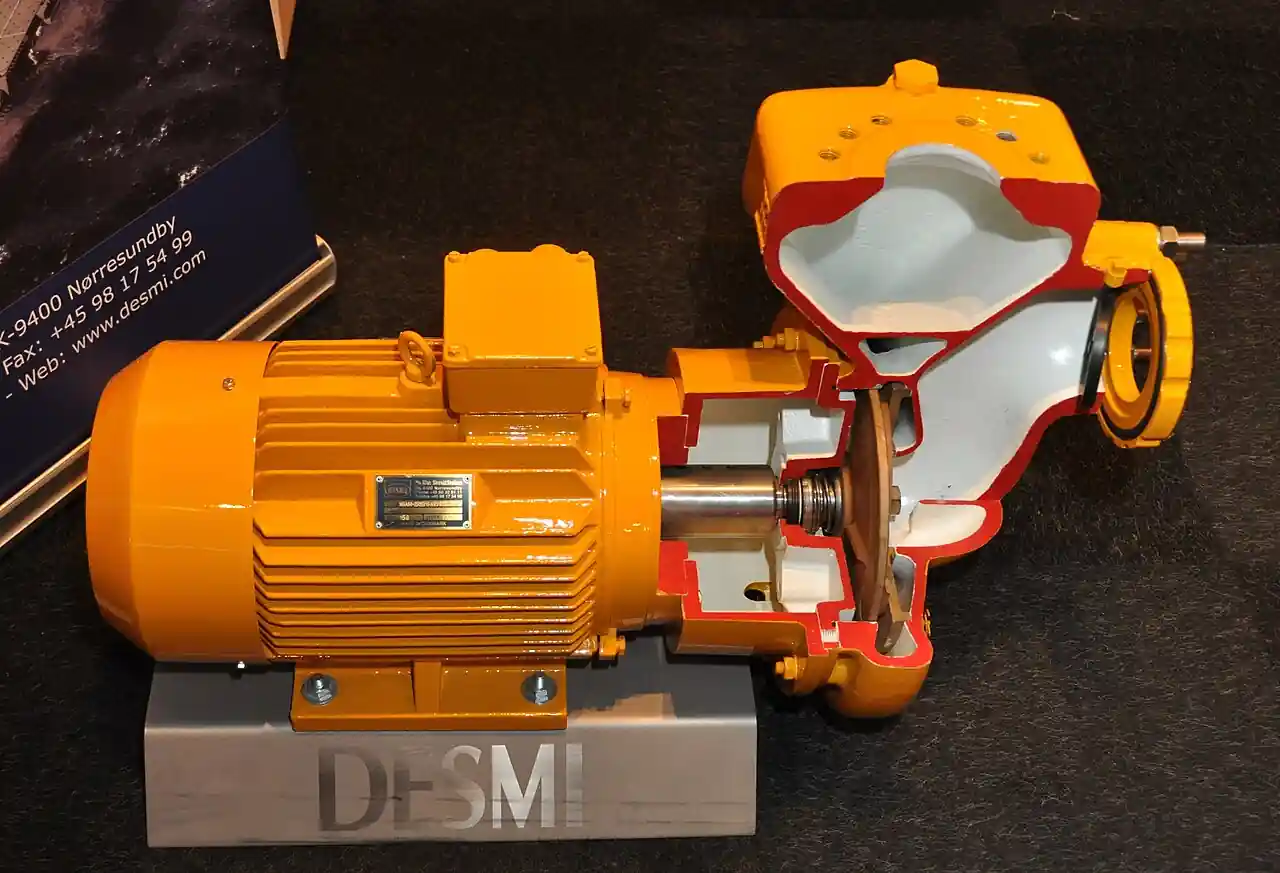
A slurry pump is a rotodynamic machine: a centrifugal pump that has been derated and armored to survive carrying solid particles in a liquid carrier. The impeller and volute are built with wider passages, thicker sections, and replaceable wet parts, and the whole hydraulic end is treated as a consumable. The pump exists because water pumps asked to move sand, ash, or ore die in weeks; the slurry variant is designed so that the parts that wear are the parts that come out, and the decision that lands on a buyer is how fast they come out.
Procurement engineers meet these machines at mine mill discharge, tailings transport, dredging, power plant ash handling, sand and gravel washing, and chemical plants moving crystallizing or scaling slurries. The specification question is never just flow and head. It is service class under ANSI/HI 12.1 to 12.6, particle sizing expressed as d50 and d80, solids concentration and specific gravity, wear material selection between high chrome white iron and elastomer, sealing architecture, and the carrier velocity that keeps the line from bedding. This page works each of those decisions in the order a defensible RFQ needs them.
This page decodes the slurry pump as a purchasing object: how ANSI/HI 12.1 to 12.6 service classes map to duty, how d50 and d80 particle data drive material and velocity decisions, which sealing architecture survives which service, and how head derating and wear parts lifecycle cost change what a quotation really says. It is written for engineers who must write a defensible RFQ, not for readers who want a marketing summary.
Chapter 1 / 06
What a Slurry Pump Is and What Is Being Decided
Start with the family resemblance. Every slurry pump on the market is a centrifugal pump at heart: a rotating impeller adds velocity energy to the fluid, and a volute or diffuser converts that velocity into pressure. What separates the slurry machine from a clean water pump is a set of deliberate compromises. Passages are widened so top size solids can pass, which costs hydraulic efficiency. Walls are thickened and every surface the slurry touches is a replaceable part: impeller, casing or shell liners, throat bushing, frame plate liner. Two to five points of best efficiency are traded away in exchange for a pump that is still pumping a year later.
What is actually being decided at purchase is therefore four commitments, not one. First, a service class assessment under ANSI/HI 12.1 to 12.6, which fixes the derating and wear allowance the design must carry. Second, a wear material split between hard metal, usually 27 percent chrome white iron, and elastomer, usually natural rubber or polyurethane. Third, a sealing architecture: gland packing with clean flush water, an expeller dynamic seal, or a slurry rated mechanical seal. Fourth, a logistics commitment to spare wet parts, because the hydraulic end is consumed by design. A quotation compared on price alone has answered none of the four.
The boundary against neighbors matters because many fluids arrive at the pump specification meeting mislabeled. A genuinely non-settling, viscous paste at moderate pressure belongs to a progressive cavity pump, which sweeps the product gently at low internal velocity. A tiny, accurate additive stream belongs to a metering pump, not to a wearing machine. Where the duty demands tens of bar on a dense, paste like tailings stream, a plunger pump takes over from rotodynamics entirely. And a magnetic drive pump, excellent for clean or slightly dirty hazardous liquids, is destroyed outright by hard solids; it should never appear on a true slurry shortlist.
Wear is the design condition, not an accident. In a slurry system the pump, the piping, and the valves are all consumed at rates set by particle size, concentration, hardness, and velocity. First cost is therefore a minority of lifecycle cost: energy at the motor and wet parts replacement dominate a ten year account.
The installed contexts also shape the chassis choice. Heavy duties at grade, such as mill discharge and tailings booster stations, use horizontal end suction pumps on frames. Pit and sump duties, such as floor sumps and tank transfer, use vertical cantilever (sump) pumps with the bearing kept out of the liquid, or a submersible pump where no deck exists above the liquid. Each context changes what the RFQ must state, from suction arrangements to lifting provisions, and chapter 3 sets out the boundaries so the layout does not get argued about at startup.
Chapter 2 / 06
How a Slurry Pump Moves Solids and Loses Head
The mechanism is unchanged from any centrifugal machine: the impeller accelerates the mixture, the volute decelerates it, and the pressure rise is the result. The difference is that the working fluid is now a two phase mixture whose density is higher than water and whose particles neither follow the water perfectly nor leave the machine politely. Solids lag the liquid through the impeller, striking the leading edges and the volute cutwater, and both the head the pump produces and the efficiency at which it produces it fall below the clear water curve printed in the catalog.
The slurry must be described numerically before any pump can be sized for it. Particle sizing uses d50, the median particle size at which half the mass is finer, and d80, the size at which eighty percent is finer, plus a top size for the largest lump allowed. Concentration is quoted as Cv, the volume percent of solids in the mixture, or Cw, the mass percent, and the two convert through the solids specific gravity. Typical solids specific gravities run near 2.65 for silica sand and above 4.5 for magnetite concentrates. Mixture density follows directly from Cv and solids SG, and absorbed power rises essentially in proportion: pumping a 40 percent by volume stream of SG 2.7 solids more than doubles the power draw of the same water flow.
Derating converts those properties into hydraulic corrections. Manufacturers publish head ratio and efficiency ratio multipliers, typically between 0.9 for light class fine slurries and 0.7 for heavy class coarse ones, that scale the clear water curve downward. A pump selected on its water curve for 60 m of head will deliver perhaps 48 to 54 m on a class 3 slurry, and the efficiency loss shows up as extra heat and motor load. The motor must be sized on mixture density at maximum credible concentration, not on water, or the first dense plug trips the overload. Datasheets that show only the water curve should be challenged; the derating basis is the datasheet.
Wear physics decides where the metal goes. Sliding abrasion, where particles sweep along a surface at a shallow angle, is the dominant mode in volutes and pipelines; impact erosion, where particles strike at a steep angle, concentrates at impeller leading edges and the cutwater. Elastomers excel against sliding abrasion from fine particles because rubber deforms and rebounds; hard metals excel against coarse impact because nothing elastomeric survives a 15 mm lump at 25 m/s. Across both regimes, wear rate rises steeply with speed, between the second and third power of peripheral velocity in most published models, which is why heavy class pumps turn at 300 to 800 rpm.
Settling behavior sets the hydraulic duty of the pipe, and the pipe duty feeds back into the pump. A settling slurry will deposit a stationary bed if the carrier velocity falls below a critical value that grows with particle size and density. Working practice designs around carrier velocities of roughly 1 to 6 m/s: about 1.5 to 3 m/s for fine industrial slurries, and 3 to 6 m/s for coarse sand and dredged solids. Below the band the line beds and blocks; above it every extra meter per second is purchased with wear and power that nobody needed to spend. The velocity decision, not the pump curve, is what actually fixes the operating point.
Chapter 3 / 06
Types, Construction, and Duty Boundaries
The horizontal end suction pump is the volume product. A backliner or split casing clamps a wear plate and shell liners around the impeller, the rotating assembly carries its own bearing frame, and the whole wet end unbolt for change-out in a shift. Discharge sizes run from DN 25 process machines to DN 750 and larger dredge and pipeline units, with per stage heads from about 10 to 100 m in heavy duty execution. Most plants standardize on one frame series per duty class so spares interchange across the fleet.
Vertical sump (cantilever) pumps suspend the impeller on a shaft that reaches down into a pit, with bearings above the liquid and no submerged seals to maintain. They excel at floor sumps, mill sumps, and tank transfer where a horizontal machine would need foot valves and flooded suction piping that plugs. Where no structure exists over the pit at all, a submersible pump with agitator takes the duty instead, trading easier installation for a motor in the slurry and a harder retrieval. The choice between them is an installation economics question: deck steel, lifting access, and cable routing against column length and shaft whirl limits.
Hard metal wet ends are the default for coarse and sharp duty. The workhorse material is 27 percent high chrome white iron, heat treated to roughly 600 to 700 HB, which grinds rather than chips under mineral attack. Weldable white iron grades allow build up repair of impellers and liners. Where the duty is corrosive as well as abrasive, acidic leach slurries below roughly pH 4, stainless steel wet ends in austenitic or duplex grades buy corrosion resistance at the price of hardness and wear life, and the RFQ must say which failure mode is being designed against, because no single material optimizes both.
Elastomer wet ends win on fine, sliding abrasion. Natural rubber is outstanding against fine silica tailings, often outlasting white iron several times over, but it carries three hard limits: continuous temperature around 80 deg C, no exposure to oils, fats, or hydrocarbons that swell and soften it, and a top size ceiling in the region of 15 mm, above which lumps cut and impact damage the elastomer. Polyurethane liners cover fine, sharp, moderately oily service and higher temperatures than natural rubber. Food and pharmaceutical solids laden fluids are a different world entirely and belong to the lobe pump and its sanitary relatives, not to a mining wet end. Mixed construction, metal impeller with rubber liners, is common and should be quoted both ways.
Sealing is the third construction axis. Gland packing with a clean external flush is simple, cheap, and tolerant, and it leaks by design; flush water quality and quantity must be engineered. The expeller (dynamic) seal uses a secondary impeller to throw solids away from the packing region and needs no flush water, but it only works at speed, so the pump must not be started or stopped dry, and it adds a parasitic power load. A slurry rated mechanical seal, usually a double arrangement with a pressurized clean flush, delivers the near zero leakage that permits and environmental rules increasingly demand, at the highest first cost and the tightest installation discipline. Each option maps to a duty class in the table below.
The duty map consolidates the boundaries into one scan before the RFQ is written; it pairs each common service with the construction that survives it and the construction that generates callbacks.
Service
Suitable construction
Construction to avoid
Fine fly ash or limestone slurry, d50 under 0.1 mm, ambient
Rubber lined wet end, gland or expeller seal
Unlined thin wall water pump castings
Fine silica tailings, high Cv, pH neutral
Natural rubber liners and impeller, white iron option for comparison
Mechanical seal without clean flush supply
Mill discharge, coarse and dense, d80 above 5 mm
27 percent chrome white iron, metal impeller, gland with high pressure flush
Natural rubber impeller (lumps cut the elastomer)
Dredged sand and gravel, topsize above 15 mm
White iron wet end, class 4 frame, low speed
Any elastomer wet end; high speed selection
Acidic leach slurry, pH below 4, fine solids
Corrosion resistant alloy or rubber where chemistry allows, engineered seal
Plain carbon steel or standard white iron (corrosion dominates)
The table below decodes the datasheet lines that decide whether a quoted slurry pump matches the duty. Each row is purchase defining; the paragraphs after the two tables explain what to demand and what a weak answer looks like.
Attribute
Typical range or options
What it decides
Discharge size
DN 25 to DN 750
Line velocity achievable, sump and foundation footprint, change-out weight
Head per stage
10 to 100 m in heavy duty execution
Number of stages and station spacing on long pipelines
Operating speed
300 to 1800 rpm by service class
Wear rate, derating depth, and impeller diameter class
Wet end material
27 percent chrome white iron 600 to 700 HB, natural rubber, polyurethane, alloys
Wear life against the actual particle size and chemistry
Impeller style
Closed, semi open, open
Efficiency, solids passage, and liner wear pattern
Sealing
Gland with flush, expeller, double slurry mechanical seal
Water consumption, leakage, start and stop discipline
Solids envelope
d50 from microns to millimetres, d80 to about 15 mm elastomer and above in metal
Service class assignment and material ceiling
Flush water
Clean, 2 to 10 bar above seal pressure
Gland and seal survival; utility demand at the site
Drive
Direct, VFD controlled, or reduced voltage starting
Velocity trim capability and start behavior against settled solids
Service class is the organizing parameter, and ANSI/HI 12.1 to 12.6 is where it is defined for rotodynamic slurry pumps. The standard sets four classes from 1 to 4 by particle size and solids concentration: class 1 covers light duty, fine, weakly abrasive slurries; class 2 and 3 step through medium and heavy fine to medium coarse duty; class 4 covers heavy coarse, strongly abrasive service with d80 above roughly 15 mm. The class a supplier assigns determines the derating applied to the water curve, the casing thickness offered, and the wear allowance priced in. Two suppliers quoting the same duty at different classes are not quoting the same pump.
ANSI/HI service class
Duty character
Typical particle picture
Example services
Class 1
Light, fine, mildly abrasive
Fine particles, low concentration
Fly ash water, lime milk, fine silt
Class 2
Medium duty, fine abrasive
Fine to medium particles, moderate Cv
Fine tailings, wash plant fines
Class 3
Heavy duty, coarse capable
Coarse fractions, high concentration
Mill discharge, coarse tailings
Class 4
Severe, coarse, strongly abrasive
d80 above about 15 mm, high Cv
Dredged sand, SAG discharge, hoisting
The standards paragraph in an RFQ should name its references explicitly. ANSI/HI 12.1 to 12.6 covers terminology, definitions, design, and application and test acceptance for rotodynamic slurry pumps, and it is the basis on which service class language means the same thing to every bidder. Materials should be stated by grade and hardness, not by trade name alone, so that a 600 to 700 HB white iron from two foundries can be compared as one specification line. Where seals matter, the flush plan nomenclature from API 682 style plans, clean external flush (plan 32) or cyclone separation from discharge (plan 31), gives suppliers an unambiguous instruction.
Datasheets must state the slurry itself in full: d50, d80, and top size; Cv and Cw; solids specific gravity; particle hardness where known; pH and chloride content; carrier liquid and temperature; and the duty cycle with start frequency. On sealing, the datasheet should carry the mechanical seal arrangement, flush plan, flush pressure, and the consequence of flush loss, including whether the expeller variant may be run at zero flow even briefly. A buyer who omits particle data has not specified a slurry pump; the supplier is forced to assume class 1 economics for a class 4 duty, and the shortfall surfaces in the wear parts invoices of the first year.
Chapter 5 / 06
Selection Decision Factors and RFQ Language
The decision sequence runs as a checklist, and each step eliminates a class of quotations before price comparison begins.
Classify the slurry: settling or non-settling; d50, d80, and top size; Cv and Cw; solids SG, hardness, pH, and temperature.
Compute mixture density and worst case absorbed power; size the motor for maximum credible concentration plus margin.
Set the design carrier velocity, 1 to 6 m/s by particle size, and check every horizontal and vertical run against it.
Assign the ANSI/HI service class and state it in the RFQ so all bidders derate identically.
Select wear materials: elastomer for fine, cool, oil free duty; white iron for coarse, sharp, or hot duty; quote both where the boundary is close.
Select sealing: gland with flush, expeller where no water system exists and dry running is excluded by procedure, or a flushed slurry mechanical seal for zero leakage.
Fix the drive: a VFD where velocity trim and soft running against wear matter, a soft starter where starts occur against settled solids or on long lines that hammer.
Price the lifecycle: wet parts per year at the stated class, labor hours per change-out, downtime cost, and energy at mixture density.
Alternatives deserve their place in the decision record rather than a silent assumption. For non-settling, viscous pastes at moderate pressure, a progressive cavity pump moves the same material at far lower internal velocity and less wear. Where the solids are soft and the plant is food or pharmaceutical grade, the sanitary lobe pump is the right machine instead of a mining wet end. Construction dewatering and emergency bypass duty belongs to the air operated diaphragm pump, which runs dry, passes gristle, and dies cheaply. Densely thickened tailings pushed to extreme pipeline pressures move to the plunger pump, which is a positive displacement discipline with its own pulsation and valve wear economics. Low flow abrasive dosing suits a peristaltic pump, whose hose is the only wet part. Each of these is a stronger answer than any rotodynamic machine inside its envelope; the slurry pump wins when the flow is high, the slurry settles, or the solids are coarse.
Velocity and derating economics carry the biggest lever in the whole selection. Running the system at the bottom of the settling band saves both energy and wear, because both scale steeply with speed, and a modest impeller trim or a small speed reduction on a VFD can halve a wear budget. The trap sits on the other side: a strainer in the slurry line itself is a bed waiting to form. A Y strainer has no place in a settling slurry pipeline; its valid home is on the clean flush water supply to a gland or seal, where it protects the one component that cannot tolerate grit.
Line valves around the pump are part of the same abrasive specification. Isolation on slurry duty is the province of the knife gate valve with hardened gate and seats, or a full bore pinch valve where tight shutoff on abrasive or corrosive slurry is needed and the elastomer sleeve is accepted as the consumable. A conventional resilient wedge is a poor survivor here and should not be quoted as an equivalent. On long discharge lines the water hammer question arrives with the check valve selection: slam resistant designs with spring or lever assisted closure protect both the pump and the pipe from the column separation that follows a power trip, and the RFQ should state the line length and profile so suppliers can comment with numbers.
Configuration (DN 100 duty)
Wet end and seal
Drive
Budget range USD
Fine tailings transfer, class 2
Rubber lined, gland with flush
Fixed speed, DOL
9,000 to 18,000
Mill discharge, class 3
White iron, gland with high pressure flush
Fixed speed, reduced voltage starter
15,000 to 30,000
Mill discharge, class 3
White iron, double mechanical seal plan 32
Fixed speed
22,000 to 40,000
Dredge sand, class 4
Heavy white iron, expeller plus gland
Slow speed, reduced voltage starter
30,000 to 60,000
Floor sump, class 2
Vertical cantilever, rubber or metal
Fixed speed
12,000 to 25,000
Class 3 with velocity trim
White iron, gland
VFD controlled
25,000 to 50,000
The budget table is for planning only; the numbers move with metal prices, duty class, and order volume, and they deliberately exclude installation, gland water systems, and spares. The RFQ block itself should read: quantity and discharge size; the full slurry data sheet per the checklist above; required flow and head at design concentration with the derating basis stated; stated ANSI/HI service class; wet end material by grade and hardness; impeller style; seal architecture with flush plan, flush pressure and quality, and dry running permissions or prohibitions; suction arrangement, stating whether suction is flooded, and if lift is unavoidable, whether a self priming pump package or a separate priming line is in the supplier scope; carrier velocity basis; drive with starter type or VFD duty; and the deliverables: wear life expectation at the stated class, wet parts price list, cross section drawing, derated performance curve, and NPSH requirement with solids allowance.
Two supporting systems change the quotation and belong in the same package. Flocculant or coagulant dosing upstream of a thickener, typically delivered by a metering pump on a skid, cuts the Cv the main pump has to carry and is frequently the highest return line item in a slurry project. And the drive decision should be made jointly with the wear budget: a VFD bought to trim velocity pays for itself in wet parts within the first or second liner change on heavy class duty, while a soft starter earns its cost at every start against a settled bed.
Chapter 6 / 06
Installation, Standards, Failure Modes, and Maintenance
Suction design decides more slurry pump fates than the pump itself. Flooded suction from a head tank or sump is the target, with a short, straight run of three to five suction diameters, no high points where air can collect, and a suction velocity held at roughly 1 to 2 m/s, below the discharge side, so the heaviest particles enter rather than stratify. NPSH available should be calculated on the mixture, with margin above the requirement, because solids raise the effective NPSH requirement of the machine. Suction lift layouts are tolerated only for clean-ish duties and, where unavoidable, are served by a dedicated priming arrangement or a self priming pump transferring from the pit, not by stretching the slurry pump beyond its suction physics. The discharge flange drilling standard, ASME or EN, must be stated at order so the site spools fit on day one.
Commissioning practice protects the first month of wear life. Flush the line with water before first slurry introduction; verify actual velocity against the 1 to 6 m/s design band with the VFD or by measured flow, not by assumption; and confirm gland water pressure and quality at the pump before the slurry arrives. Start procedure matters on expeller sealed machines: the expeller only develops its sealing head at speed, so the sequence must open the suction, start, and load the pump without periods of dry running at low speed. Where starts are frequent or lines are long, the reduced voltage start through the soft starter limits both the torque shock into the wear parts and the pressure surge into the line, and the knife gate valve isolation sequence around the pump should be written into the operating procedure rather than improvised by operators.
Failure modes in service follow a short, predictable list. Liner perforation: a shell or frame plate liner wears through and slurry tracks behind it, announcing itself as a damp streak or a casing weep long before it lets go; scheduled thickness checks catch it. Impeller washout behind the vanes and at the eye, visible as head loss and vibration, is repaired by replacement or, in weldable grades, by build up. Gland leakage that will not control usually means scored shaft sleeve or contaminated flush, and the fix is sleeve replacement plus flush filtration, not more packing turns. Expeller erosion shows as solids appearing at the packing when the pump unloads. Bearing frame contamination by washdown water or dust kills more bearings than slurry does, and motor overload on density excursions is the control system reminding everyone that power follows mixture density.
Maintenance economics are wet parts logistics. Impeller to throat bushing clearance is restored by adjustment on most frame designs, and one or two adjustment interventions recover head between change-outs; track the adjustment count per pump as a wear indicator. Rubber components have shelf lives and temperature memories; store spares cool, dark, and first in first out. Change-out planning belongs in the original RFQ: wear kit content, price, and weight; lifting provision and clearance above the pump; and the realistic labor hours. On heavy class fleets, condition monitoring pays: power trend, vibration trend, and gland water consumption moving together read out the wear curve between inspections, and sites that log them predict, rather than discover, the liner change. Neighboring line assets follow the same discipline: an isolation knife gate valve is re-faced and a duty line pinch valve re-sleeved at the same planned stops.
Auxiliary systems finish the installation. Gland and seal flush water must be reliable, clean, and 2 to 10 bar above seal pressure; the Y strainer on that flush line, unlike the slurry line, is correct and necessary, and on skids a small magnetic drive pump can circulate filtered flush fluid where no utility header exists. Discharge protection on long lines includes a properly set slam resistant check valve exercised at each shutdown. Sump and pit cleaning around the main fleet is ordinary work for a diaphragm pump or a submersible pump kept for the purpose. Coastal and washdown corrosive environments justify stainless steel fasteners and hardware on the frame and gland piping. Finally, keep the derated curve, the stated service class, and the wet parts list in the site file: the slurry standard the pump was bought against, ANSI/HI 12.1 to 12.6, is the reference the next engineer will need when the duty, or the ore, changes.
FAQ
How do I choose between hard metal and rubber wet ends?
Decide on particle size, temperature, and chemistry. Natural rubber outlasts white iron several times over on fine, sharp, cool, oil free slurries, but it is capped near 80 deg C, swells in oils and fats, and is cut by particles approaching roughly 15 mm. Use 27 percent chrome white iron at 600 to 700 HB for coarse, sharp, or hot duty, and quote both constructions where your duty sits near a boundary, comparing wet parts life rather than first cost.
What do ANSI/HI 12.1 to 12.6 service classes 1 to 4 mean on a datasheet?
They are the rotodynamic slurry pump standard's duty severity ladder, set by particle size and solids concentration. Class 1 is light, fine, mildly abrasive duty; classes 2 and 3 step up through medium and heavy fine to coarse service; class 4 is severe coarse abrasive duty with d80 above roughly 15 mm. The class fixes the derating applied to the water curve and the wear allowance priced in, so two bidders quoting different classes are not quoting the same pump.
What carrier velocity should I design to?
Work inside the 1 to 6 m/s band, chosen by particle size: about 1.5 to 3 m/s keeps fine slurries off the pipe bottom, and 3 to 6 m/s is needed for coarse sand and dredged solids. Below the band the line beds and eventually blocks; above it you pay for wear and power you did not need. State the velocity basis in the RFQ and verify it at commissioning with measured flow.
Why does my pump make less head on slurry than the catalog curve?
Because the catalog curve is clear water performance, and solids derate both head and efficiency. Manufacturers publish head ratio and efficiency ratio multipliers, typically 0.7 to 0.9 from heavy to light class, that scale the water curve down. A 60 m water curve may deliver 48 to 54 m on a class 3 slurry, and absorbed power rises with mixture density, so the motor must be sized for maximum credible concentration.
Can an expeller sealed pump run dry?
Not at low speed and not for sustained periods. The expeller is a dynamic seal that only develops its solids exclusion head when the pump is at operating speed, so start and stop sequences must load the pump promptly, and the operating procedure must prohibit throttled or dry running. If your process cannot guarantee that discipline, specify a gland with clean flush or a flushed slurry mechanical seal instead.
Gland, expeller, or mechanical seal: how do I choose?
Choose on water supply and leakage tolerance. Glands are simple and tolerant but consume clean flush water and leak by design. Expellers eliminate flush water on duties where dry running is excluded by procedure, at a small power penalty. Double slurry mechanical seals with a pressurized clean flush, typically plan 32, give near zero leakage for environmental or high duty applications, at the highest first cost and the strictest installation discipline.
How should d50 and d80 be stated in an RFQ?
State them explicitly with units, plus top size, Cv or Cw with the basis, solids specific gravity, particle hardness if known, pH, and temperature. d50 is the mass median particle size and d80 the size below which eighty percent of the mass falls; together with concentration they fix the service class, the wear material, and the derating. An RFQ without particle data forces suppliers to guess, and the guess is always optimistic.