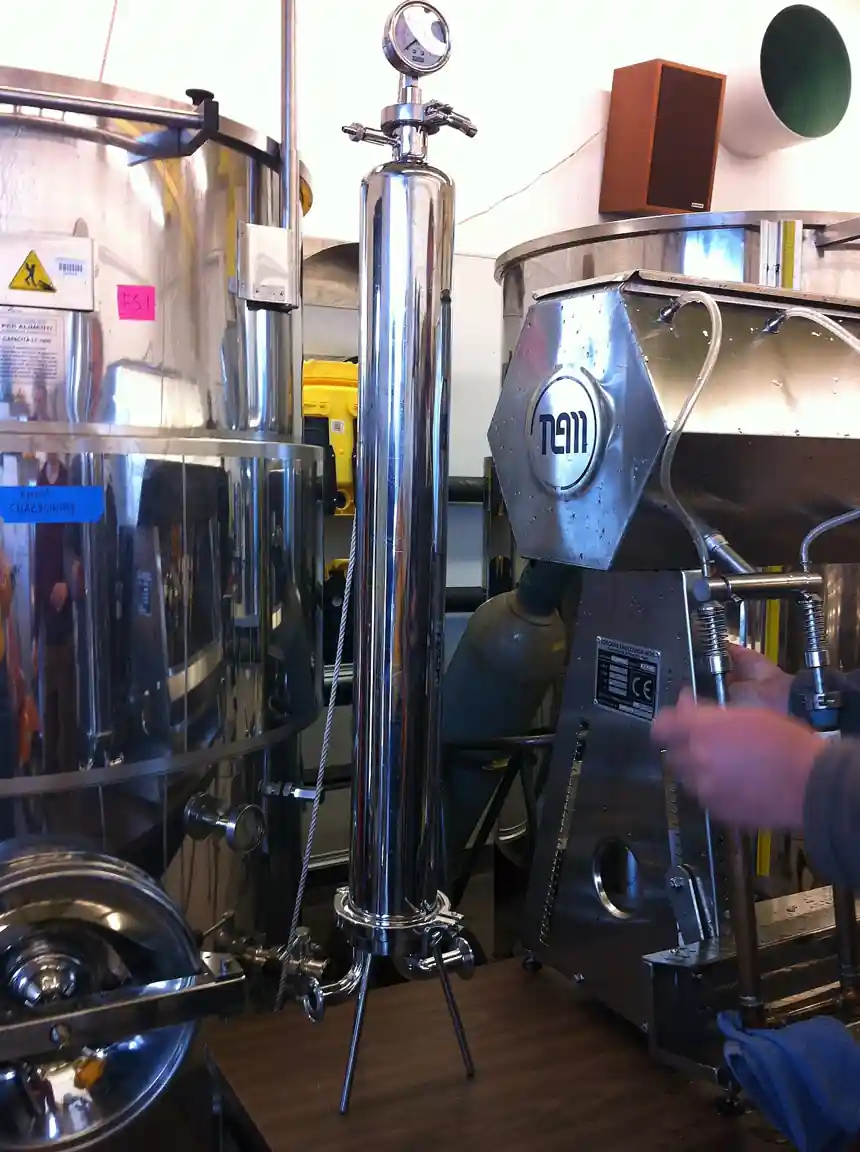
A pressure leaf filter is a pressure vessel packed with an array of filter leaves, rectangular or circular screens covered with filter cloth or a deposited precoat, through which slurry is pumped so that solids build as a cake on the leaf surfaces while clear filtrate collects inside the leaves and exits to a header. When the cake reaches its design thickness, the batch cycle ends and the cake is discharged, dry by vibration or screw conveyor in dry discharge designs, or as a slurry by wet sluicing in wet discharge designs. Amafilter's vertical pressure leaf filter lines and their Versis and MVDCD systems are representative industrial catalogs, and this page treats the complete pressure leaf system, vessel, leaves, precoat and body feed practice, pumps, and discharge, as the purchasing object.
This page is written for the process engineer specifying a pressure leaf filter for clarifying edible oils, resins and polymers, brines and chemicals, or pharmaceutical and catalyst slurries where either a sparkling clear filtrate or a recoverable dry cake is the deliverable. It works through what the machine does and what is being bought, how precoat and body feed make the separation work, which leaf and discharge configurations fit which duties, the parameters that appear on vendor data sheets, and the selection factors and RFQ language that decide whether the installed filter holds its clarity and cycle life.
The decision concentrates in five places: the slurry's solids loading and particle character, the precoat and body feed practice that builds a filterable cake, the leaf configuration and area that set batch size, the discharge method, dry or wet, that matches what happens to the cake next, and the materials and design pressure that survive the fluid and the cleaning. Get those right and the vessel diameter, leaf count, and pump sizes follow.
Chapter 1 / 06
What a Pressure Leaf Filter Is and What Is Being Decided
The machine this page describes is a batch pressure filter built around leaves. Each leaf is a flat drainage element, a wire screen or mesh support backed by an internal filtrate channel, covered with a filter medium, woven cloth, stainless mesh, or a deposited precoat layer, and connected to a filtrate manifold through its neck. Leaves stack vertically on a center manifold inside a vertical vessel, or hang in rows inside a horizontal vessel, and the vessel closes with a quick opening door or a full removable cover on davits. Slurry enters under pump pressure, solids deposit on the leaf faces, filtrate flows inward and out, and the cycle continues until cake thickness, filtrate clarity loss, or vessel pressure drop calls the end.
What is being decided when a pressure leaf filter is purchased is a filtrate clarity guarantee plus a cake handling guarantee at a stated batch rate. The buyer is purchasing filtrate clear enough for the downstream step, often measured in ppm solids or as a sparkle standard in oils, together with a cake that discharges either dry to a conveyor or bin or as a pumpable slurry, delivered batch after batch over decades of vessel life. Everything on the vendor data sheet, filtration area, leaf spacing, design pressure, cake capacity, discharge mechanism and time, materials, exists to support those guarantees, and the honest vendor sizes from a sample of the actual slurry rather than from a specific gravity assumption.
The pressure leaf filter sits in the solid liquid separation family with defined neighbors. It is not a filter press, which builds cake in chambers between plates and opens mechanically for cake drop, trading enclosed operation and floor labor against the leaf filter's enclosed batch cycle. It is not a nutsche filter, the agitated filter dryer for pharmaceutical batch duty where the cake is washed and dried in the same vessel. It is not a rotary vacuum filter, which filters continuously on a rotating drum under vacuum at atmospheric pressure. And it is not a decanter centrifuge, which separates by centrifugal force on a screw conveyor principle rather than by a filter medium. Each neighbor wins some duties; the pressure leaf filter wins enclosed, batch, precoat polished clarifications and medium cake duties.
Different buyers buy the same machine for different reasons. An edible oil refiner buys it to polish bleached oil with diatomaceous earth precoat to a sparkle that shelves the product. A resin maker buys it to clarify viscous melts where pressure is the only driving force available. A brine or chemical plant buys it to hold catalyst fines and crystals out of a product stream. A pharmaceutical plant buys a closed vertical leaf system to recover an antibiotic cake with solvent washing. A wastewater plant buys a scavenger leaf filter to polish a heavy metal hydroxide. The specification language differs, but the leaf physics is shared.
The economics deserve their own paragraph because the machine is bought on consumables and cycles, not on steel. Operating costs are filter aid consumption when precoat and body feed are used, cloth or mesh renewal, slurry pump and discharge energy, and the labor and downtime of cycle changeovers; against those stand the value of a clear filtrate that protects downstream equipment and the value of a dry cake that hauls away cheaply or a wet slurry that feeds the next process step. A buyer who compares offers on vessel price alone has compared the smallest number in the least important column, and the filtration area and cycle time basis behind each offer decides whether the plant meets its annual tonnage.
A short tour of named duties makes the machine concrete. At an edible oil refinery, bleached oil plus diatomite body feed cycles through a vertical leaf filter at 4 bar and discharges a dry spent earth cake to a conveyor. At a resin plant, a jacketed horizontal leaf filter clarifies hot molten resin through stainless mesh with no precoat, discharging wet. At a catalyst plant, a vertical leaf filter recovers precious metal catalyst fines with deep precoat, and the cake goes to assay rather than to disposal. At a chemical plant, a brine clarifying leaf train holds a 0.5 ppm solids guarantee downstream of a crystallizer. Each duty names the same knobs, area, precoat, cake thickness, discharge, and materials, with numbers that differ while the leaf barely changes.
Chapter 2 / 06
How the Leaves and the Cake Do the Work
The separation mechanism is cake filtration: once a first layer of solids or precoat bridges the medium, that layer becomes the true filter, and the medium merely supports it. Particle capture happens in the cake's pore structure, not on the cloth face, which is why filtrate clarity improves after the first minutes of a cycle and why the precoat practice matters so much. The driving force is the pump pressure difference across the leaf, typically 1.5 to 6 bar in practice, and the filtration rate falls as the cake thickens and compresses, following the classic constant pressure decline: the operator runs until the rate falls or the design cake thickness is reached.
Precoat and body feed are the two dosing decisions that make difficult slurries filterable. Precoat deposits a thin layer of filter aid, diatomaceous earth or perlite, on the leaves before slurry is admitted, giving an immediate fine pore structure that catches slimy or fine solids and protects the cloth. Body feed doses filter aid continuously into the slurry so the growing cake stays permeable, keeping the filtration rate from collapsing as solids compress; the dose, commonly a weight ratio to solids between a few percent and several times the solids weight, is tuned by leaf test until the cycle curve holds. A pressure leaf filter specified without leaf test data on the actual slurry is a machine sized by hope.
Cake washing and drying extend the batch cycle where the cake itself is the product or must be decontaminated. Displacement washing pushes mother liquor out of the cake with wash liquid or solvent, then blow or press steps dewater it, and in dry discharge designs a final air or gas blow sets the cake on the leaves ready for vibration. Because the cake sits on vertical leaves in a closed vessel, wash ratios are respectable and solvent recovery is closed, which is precisely why pharmaceutical and solvent duty buyers prefer the enclosed leaf filter over open presses. Wash efficiency and cake moisture should be quoted from test data at the design cake thickness, not from brochure curves.
Discharge is where the configurations divide their personalities. In dry cake discharge, the vessel drains and a pneumatic vibrator, or a rotating scraper or screw in some designs, walks the cake off the leaves and out a bottom port to a conveyor or bin, yielding a handleable cake at the cost of a mechanism and its abrasion on the medium. In wet discharge, sluice nozzles spray filtrate or wash water across the leaves and the cake falls as a slurry to a bottom outlet for pumping away, gentler and simpler but adding a slurry stream to dewater downstream. Horizontal vessels favor dry discharge by gravity assist; vertical vessels offer both, with dry discharge the majority choice in edible oil and chemicals.
The leaves themselves are engineered items. A leaf is a drainaged screen or perforated plate with spacer wires, welded into a frame with a filtrate neck, covered by the medium clipped or sewn on; stainless mesh media serve hot and solvent duty, woven polypropylene or polyester cloths serve chemical duty within temperature limits, and sintered metal serves fine catalyst duty. Leaf spacing sets the cake capacity per vessel: closer spacing packs more area but cakes bridge and blind early, so typical design cake thickness runs 10 to 30 millimeters with leaf pitches to match. Medium selection is a leaf test decision, and the honest data sheet states the medium proposed and its expected life in cycles.
Monitoring closes the loop between design and operation. Filtrate clarity, by inline turbidity or laboratory solids, tells the operator when precoat has set and when the cycle must end; vessel pressure and filtrate flow rate trace the cake curve; and cake thickness confirmation at discharge closes the mass balance against the body feed dose. A pressure leaf filter run without its clarity and rate trends is a machine whose end of cycle is guessed, and a guessed end of cycle shows up either as wasted area per batch or as a blinded medium and a long sluice.
Chapter 3 / 06
Leaf and Vessel Types, Discharge Modes, and Duty Boundaries
Configuration choice begins with vessel orientation and discharge. Vertical vessels with leaves on a center manifold dominate the edible oil, chemical, and utility market: compact footprint, both dry and wet discharge options, and the largest installed base. Horizontal vessels with leaves hung from a cart or top frame serve large cake duties and dry discharge by gravity and vibration, with the whole leaf assembly rolling out for service in some designs. Round leaf and rectangular leaf geometries trade fabricability against vessel volume use, and center manifold versus side manifold filtrate collection changes drainage and inspection access. The choice among them is a duty fit and maintenance access decision, not a performance contest.
Configuration
Discharge
Typical duty
Character
Vertical, center manifold
dry vibrate or wet sluice
oil, chemical, brine
Compact, largest installed base
Horizontal, leaf cart
dry vibrate, gravity
large cake, wax, polymers
Roll out service access
Vertical wet only
wet sluice
slurry to next step
Simplest, gentlest on media
Scrape discharge
mechanical scraper
sticky cakes
Mechanism wear trade
Jacketed variants
per base design
hot melt, viscous
Temperature hold, hot oil service
Duty boundaries keep the selection honest. The pressure leaf filter is a batch machine: continuous slurries above roughly a few tens of tonnes per day of solids look at rotary vacuum filter or decanter centrifuge alternatives, and very fine submicron slurries that body feed cannot hold belong to membrane or crossflow equipment downstream. Where the cake itself must be washed and dried to pharmacopeia standards in one vessel, the nutsche filter owns the duty; where the filtrate only needs rough protection, a bag filter or self-cleaning filter does it far cheaper. The leaf filter earns its place where enclosed batch clarification with precoat polish, moderate cake loads, and wash or solvent containment come together.
Where it sits in the plant matters as much as the vessel. Ahead of it, a slurry pump sized for the cycle curve and a feed tank with agitation keep body feed in suspension; a jacketed reactor or crystallizer upstream often sets the temperature and solvent context. Behind it, the filtrate may run to storage or to a polishing cartridge guard, and the dry cake runs to a conveyor, bin, or spent cake handling, while wet slurry routes to a press or decanter for dewatering. Fluid piping, valves, and safety relief on a pressure vessel are standard, and the RFQ should draw the scope boundary around vessel, internals, media, and discharge explicitly.
Cleanability and material integrity set two further boundaries. Food, edible oil, and pharmaceutical duties demand polished stainless surfaces, crevice free welds, and clean in place capability, which favor stainless leaf and mesh designs over cloth where the duty allows; solvent duties demand gasket and cloth compatibility by chemistry; and hot oil and melt duties demand jacketing and heat retention to keep the cake fluid until discharge. The medium, the seals, and the jacket are the three specification items most often discovered wrong at startup, and all three are leaf test and compatibility decisions, not catalog decisions.
Chapter 4 / 06
Key Specification Parameters
The data sheet parameters fall into four groups: capacity, mechanics, discharge, and materials. Capacity parameters are total filtration area, number of leaves, leaf spacing and design cake thickness, holding volume, and the filtration rate or batch cycle time at design conditions, always with the slurry basis stated. Mechanical parameters are design pressure and temperature, vessel volume, door type and opening time, and the filtrate manifold sizing. Discharge parameters are discharge mode, discharge time, vibrator or scraper drive rating, and cake moisture or slurry density expected. Materials parameters are vessel, leaf, and medium materials, gasket compounds, and surface finish. A quotation that omits the cycle time basis is not comparable to one that states it.
Parameter
Typical range
Design note
Filtration area
1-200+ m2
Sized from leaf test on actual slurry
Leaf spacing
20-70 mm pitch
Sets cake capacity per cycle
Design cake thickness
10-30 mm
Bridging limit sets ceiling
Design pressure
4-10 bar class
Sets pump head and vessel wall
Design temperature
to 200 C jacketed
Medium and gasket limits govern
Discharge time, dry
5-30 min
Vibrator or scraper cycle
Precoat dose
0.5-1.5 kg/m2
Filter aid layer on leaves
Body feed ratio
test derived
Keeps cake permeable
Vessel materials
SS304L/316L, CS
Food finish where required
Filtration rate and cycle deserve explicit numbers in every specification because they size the vessel and predict plant capacity. A leaf test on the actual slurry at design temperature and pressure returns the rate decline curve, the body feed dose that holds it, the cake thickness at cycle end, the filtrate clarity, and the wash and blow behavior; the vendor then sizes area and leaves to the batch volume and turnaround the plant needs. Specification without test data transfers the sizing risk to the operator, and the industry's standard answer to that risk, overarea with margin, is the right answer only when the margin is stated and paid for consciously.
Vessel code and safety ride the pressure boundary. The vessel is built as a pressure vessel to the jurisdiction's code, ASME VIII or equivalent, with design pressure and temperature stamped and a relief path protecting it; the quick opening door carries its interlock and safety device per code practice; and the jacket, where fitted, carries its own design conditions. ATEX or equivalent explosion proofing applies to the vibrator motor and instruments in solvent duty, and food contact regulations govern materials and finishes in edible duty. None of these are exotic, but the door interlock and the relief path are the two items most often drawn wrong on the P and ID.
Media and consumables round out the sheet. The proposed medium, mesh or cloth grade, its expected life in cycles, and its replacement labor time belong on the data sheet because they dominate operating cost alongside filter aid. Filter aid type and dose, precoat and body feed, should be stated with the test basis, and the spares list should hold a full medium set, gaskets, door seals, and vibrator or scraper wear parts. A buyer who accepts a quotation with the medium line unspecified has agreed to discover the machine's main consumable at startup.
Chapter 5 / 06
Selection Decision Factors and RFQ Language
Selection starts from the slurry and the deliverable, written as numbers. The designer needs solids concentration and particle size distribution, liquor viscosity and temperature, the target filtrate clarity in ppm or a named standard, the batch volume and cycle frequency the plant runs, the cake's destination, dry handling or slurry to a next step, and any wash or solvent duty with its recovery requirement. From that basis, area, discharge mode, and materials follow with little freedom, and the leaf test becomes the arbiter between competing configurations. An RFQ without this basis invites vendors to size to the cheapest curve in their brochure.
Duty driver
Favored configuration
Watch item
Sparkle polish, edible oil
vertical, dry discharge
Precoat aid grade and dose
Hot viscous resin
jacketed, mesh media
Temperature hold to discharge
Solvent cake recovery
enclosed, wet sluice
ATEX scope, closed recovery
Catalyst fines scavenging
deep precoat, fine mesh
Cake assay value vs aid cost
Large cake, gravity assist
horizontal cart design
Floor space and roll out access
Discharge mode selection is the second decision and it is decided by what happens to the cake. Dry discharge suits cakes that haul, burn, assay, or sell as solids and justifies the vibrator or scraper mechanism; wet discharge suits cakes that feed a next process step as slurry and protects the medium from scrape wear. Sticky or thixotropic cakes challenge both and push toward scraper designs or wet discharge; friable dry cakes love vibration. The decision belongs with the plant's cake logistics, and it should be written into the RFQ with the cake destination named because vendors quote different machines for the two answers.
Commercial comparison is only fair on a normalized basis. Offers should be forced onto one table: filtration area and number of leaves, cycle time and batch volume at a stated slurry, discharge time and cake moisture or slurry density, medium type and life, filter aid consumption basis, materials and finish, code stamps and door safety provisions, and the initial spares fill. The cheapest offer is very often the one with the least area for the stated batch, and its operating cost lands higher through more cycles per day and faster media wear. Where consumables dominate, the aid and medium line items outrank the vessel price by the end of the first year.
The RFQ language that returns comparable offers states the slurry and the deliverable explicitly. State solids weight percent and particle distribution, liquor, viscosity and temperature, target filtrate clarity, batch volume and required cycle time, cake destination dry or wet with the handling step, wash or solvent duty if any, design pressure and temperature, materials and finish requirements, code and explosion proofing scope, and that leaf test data on a provided sample will size the machine. A complete RFQ paragraph reads: bleached soybean oil at 0.5 weight percent spent clay, 80 degrees C, filtrate sparkle to refinery standard, 60 cubic meters per batch in 3 hours, dry cake to conveyor, 6 bar design, stainless food finish, sized by leaf test on our sample.
Integration questions close the selection. Who supplies the precoat and body feed skid and its make down tank, and who sizes the slurry pump against the cycle curve; where does the dry cake discharge to and who owns the conveyor interface; where does wet slurry go, to a filter press or a decanter centrifuge for dewatering; and what clean in place regime, if any, the medium and vessel need between product campaigns. These questions cost nothing to ask before purchase and a change order each to ask after startup.
The chemical and utility chain around the vessel deserves its own line in the comparison because it is part of the machine's productivity. Filter aid arrives in bulk or bags, and its make down tank needs a working agitator to hold the slurry in suspension, a metering pump to dose precoat and body feed accurately against the cycle curve, and a variable frequency drive on the slurry pump to trim feed pressure as the cake builds and the resistance rises. On duties where the solids are worth recovering, a cyclone separator stage ahead of the filter thickens the feed and returns fines, and a cartridge guard in the precision filter class polishes the filtrate where the next step demands it. Cleaning chemistry closes the loop: the acid and alkaline circulations are controlled by pH, read from a simple ph meter at the drain sample point, and the wash water balance is priced per cycle. Vendors who quote the vessel without this chain have quoted half a plant.
Chapter 6 / 06
Installation, Standards, Failure Modes, and Maintenance
Installation is a vessel and piping erection with a few machine specific steps. The vessel lands on its support with discharge port alignment to the conveyor or slurry line, the door or cover swings with its davits clear, the filtrate manifold ties to the clear liquor destination, and the feed line ties from the slurry pump with a sampler for the leaf test verification at commissioning. Commissioning runs water then slurry: precoat deposition checked by sight glass or first filtrate clarity, body feed dose confirmed, a full cycle to design cake thickness with discharge timed, and the clarity trend documented. The commissioning cycle curve becomes the reference against which every future cycle is judged.
Failure modes have a known hierarchy. Medium blinding, from slurry fed before precoat sets, from overcompressed cakes, or from fines migration, shows as early rate decline and long cycles, addressed by dose and medium review. Leaf leakage, a cloth tear or a clip failure, announces itself as cloudy filtrate from one leaf and is located by leaf isolation or by sight glass at drain. Cake bridging between leaves, from running past design thickness, blocks discharge and can spring leaves, prevented by thickness discipline and confirmed by drain inspection. Door seal wear weeps under pressure, vibrator or scraper wear lengthens discharge, and corrosion of screens and spaciers under wrong material selection ends media life early. Nearly all announce themselves in the cycle curve and clarity trend.
Symptom
Likely cause
First response
Cloudy filtrate early cycle
precoat not set
Recirculate until clear, verify dose
Cloudy filtrate all cycle
medium tear or clip leak
Locate leaf, renew medium
Rate decline early
cake blinding
Body feed dose and aid grade review
Discharge leaves cake
vibrator wear or sticky cake
Service drive, sluice assist
Leaves sprung, spacing lost
cake bridging
Thickness discipline, leaf repair
Maintenance is planned around media and the discharge mechanism. Medium renewal on a schedule set by cycle count and clarity trend, not by failure; door and gasket inspection at each opening with a torque discipline on closure; vibrator bearings and scraper wear parts on the preventive list; and an annual internal inspection of leaves, spacing, screens, and vessel corrosion under the code's vessel inspection regime. Filter aid storage stays dry and its make down tank agitated, because a lumpy precoat is a blinded first cycle. Spares hold a full medium set, gaskets, and drive wear parts.
Operational stewardship is what the purchase actually bought. Operators who watch the cycle curve end batches on rate and thickness rather than on the clock, who recirculate first filtrate until the precoat proves, and who keep the thickness and dose disciplines, get decades of clarity from a leaf filter; operators who chase throughput by overcaking the leaves buy bridged springs and sprung leaves. The trend sheet, clarity versus time, rate versus time, cake thickness at discharge, and discharge time, is the machine's health record, and reading it monthly is the difference between a consumable and a capital surprise.
FAQ
What is the difference between a pressure leaf filter and a filter press?
A pressure leaf filter builds cake on cloth covered leaves inside a closed pressure vessel and discharges by vibration or sluicing without opening the vessel, while a filter press builds cake in chambers between plates and must open plate by plate for cake drop. The leaf filter gives enclosed, low labor batch cycles and good precoat polishing; the press gives high cake dryness and simple media at the cost of open handling and more labor. Both are batch pressure filters; the duty and the cake logistics pick between them.
What does precoat and body feed do in a leaf filter?
Precoat deposits a thin layer of filter aid, diatomaceous earth or perlite, on the leaves before slurry is admitted, giving a fine pore structure that catches slimy or fine solids and protects the medium. Body feed doses filter aid into the slurry continuously so the growing cake stays permeable and the rate does not collapse. Both doses are set by leaf test on the actual slurry, and together they are the difference between a filterable and an unfilterable batch.
Should I choose dry or wet cake discharge?
Choose by what happens to the cake. Dry discharge, by vibrator or scraper, delivers a handleable solid to a conveyor or bin and suits cakes that haul, burn, or assay; it carries a mechanism with wear parts. Wet discharge sluices the cake off as a slurry for pumping to a next step, is gentler on the medium, and suits downstream dewatering by a press or decanter centrifuge. Sticky cakes favor scrapers or wet discharge; friable dry cakes love vibration.
How much filtration area do I need?
Area comes from a leaf test on your slurry: the test returns the filtration rate curve, the body feed dose that holds it, and the cake thickness at cycle end, and the vendor converts your batch volume and required cycle time into area and leaf count. Typical design cake thickness runs 10 to 30 millimeters and leaf spacing is set with margin above it. Sizing without test data on the actual slurry is the most common source of an undersized filter.
Can a pressure leaf filter wash and dry the cake?
It can wash and dewater within batch practice: displacement wash pushes mother liquor or solvent out of the cake, and air or gas blow steps dewater it before discharge. What it does not do is the deep wash dry vacuum and thermal drying of a nutsche filter or filter dryer, where pharmaceutical cakes are processed to dryness in the same vessel. For edible oil and chemical duty, the leaf filter's wash and blow steps are usually enough; for pharmacopeia cake drying, the nutsche owns the duty.
What filter aid should I use?
Diatomaceous earth and perlite grades span a range of permeabilities: finer grades polish finer, slower; coarser grades run faster but pass more fines. The grade, the precoat dose around 0.5 to 1.5 kilograms per square meter, and the body feed ratio are chosen by leaf test against the clarity target. Food and pharmaceutical duty needs the aid's compliance grade, and spent cake disposal or valorization, spent earth to feed or fuel, often decides the grade as much as the filtration curve does.
Why is my leaf filter cycle getting shorter?
Shortening cycles point at medium blinding or cake compressibility outpacing body feed: check whether the rate decline curve has steepened against commissioning, whether the precoat is setting properly at the same dose, and whether fines are bleeding through and plugging the medium. The fixes are a body feed dose increase, a finer aid grade, a medium cleaning or renewal, and thickness discipline. A cycle curve trend sheet catches the drift months before the filter stops making rate.