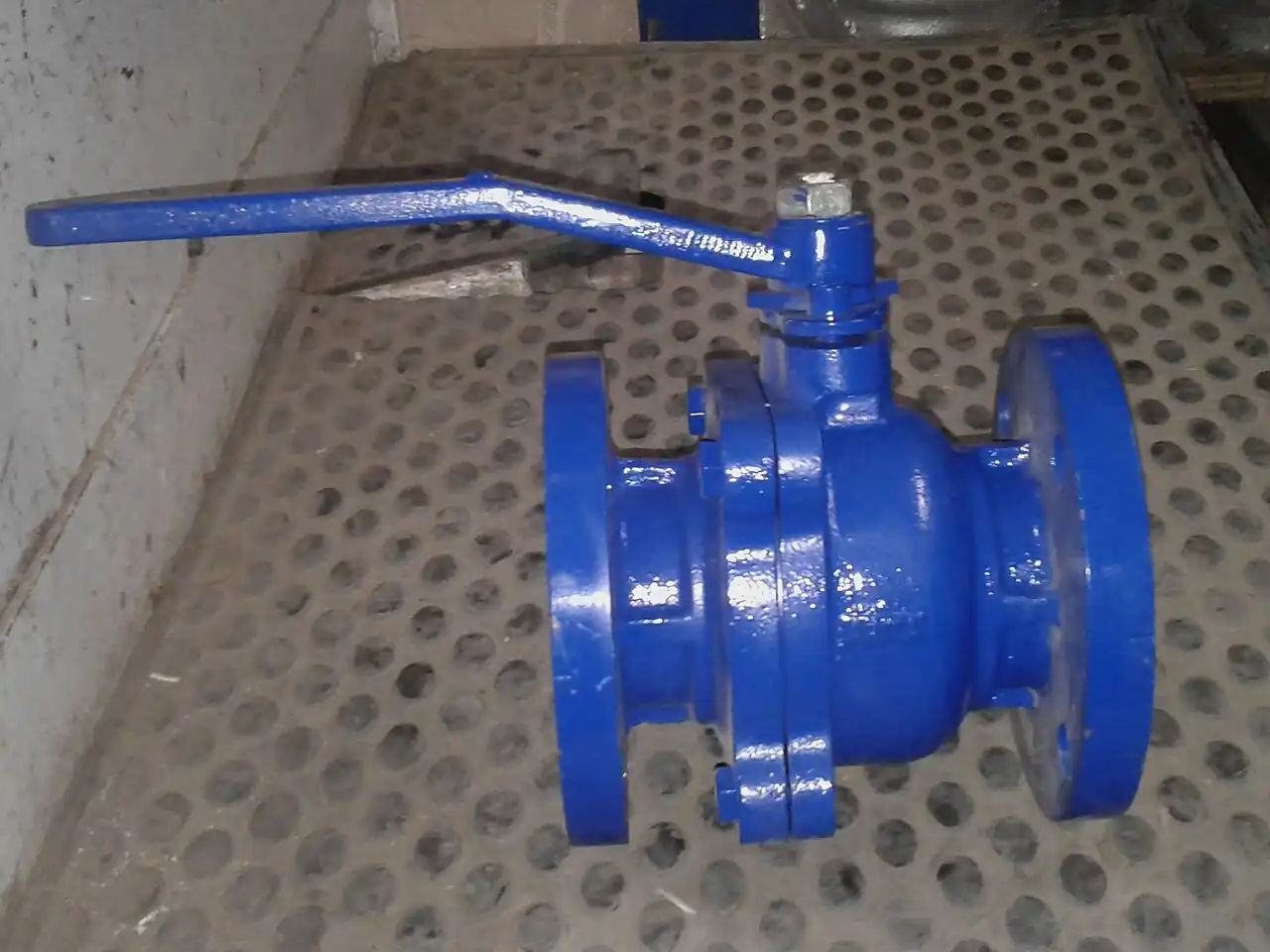
A cryogenic ball valve is a quarter-turn valve whose ball-and-seat closure architecture is rebuilt component by component for service in liquefied gases at temperatures from about minus 101 deg C down to minus 196 deg C for LNG, liquid oxygen, and liquid nitrogen, and to minus 253 deg C for liquid hydrogen. The visible signature is the extended bonnet, a gas column of 300 to 1,100 mm that locates the packing box in warm ambient air so the stem seal never sees design temperature, as required by the design logic of BS 6364. Beneath that signature sit decisions a catalog ball valve never faces: austenitic stainless steel bodies impact tested at design temperature, PCTFE or PEEK seats instead of generic PTFE, graphite packing instead of elastomer O-rings, cavity relief so trapped liquid cannot burst the body as it warms, and oxygen cleaning to CGA 4.1 for LOX duty.
Procurement engineers meet these valves at LNG receiving terminal storage and ship loading lines, on air separation unit cold boxes handling LIN, LOX, and liquid argon, on CO2 recovery and injection skids, and on hydrogen liquefaction and trailer filling stations. The decision this page settles is narrow: whether a quotation describes a genuine cryogenic design, engineered bonnet, qualified materials, cleaning certificate, and cryogenic test evidence, or a commodity valve with a length of pipe welded above the packing. The answer lands as an RFQ line set, service temperature, bonnet length and orientation, seat and packing materials, cavity relief arrangement, cleaning level, and the BS 6364 test report, and every chapter below feeds that line set.
This page treats the cryogenic ball valve as a purchasing object: what the extended bonnet gas column does in real temperature numbers, which seat, packing, gasket, and body materials survive which liquefied gas, what BS 6364 testing proves, and how oxygen cleaning, cavity relief, and actuator sizing combine into a defensible RFQ. It is written for engineers who issue purchase specifications, not for readers who want a brochure summary.
Chapter 1 / 06
What a Cryogenic Ball Valve Is and What Is Being Decided
Take a standard ball valve and cool it to minus 196 deg C, and three things fail in sequence. First the seals: elastomers such as NBR and EPDM pass through their glass transition between roughly minus 40 and minus 60 deg C and turn brittle, so any O-ring body seal or elastomer packed seat cracks on the first stroke. Second the packing: a conventional short bonnet puts the packing box a few centimeters from the ball, so the packing operates at line temperature, shrinks away from the stem, and leaks cold gas continuously. Third the trapped liquid: close a ball valve with seats on both sides and you have a sealed cavity full of liquid cryogen; as it warms, LNG expands roughly 600 times and liquid nitrogen roughly 700 times in the change to gas at ambient pressure, and the pressure rise can exceed 300 bar in a dead volume. A cryogenic ball valve is defined by how it answers those three failures, not by the word cryogenic in a catalog heading.
The answers have names. Extended bonnet, a gas column long enough per BS 6364 design intent to keep the packing above about minus 40 deg C. O-ring free construction, with body joints sealed by spiral wound 316 and graphite gaskets and the stem sealed by flexible graphite packing. Cavity relief, either a hole drilled in the upstream face of the ball or self-relieving seat rings that lift off their back seat when cavity pressure exceeds upstream line pressure by a defined margin. Around those three sit material qualifications, austenitic stainless steel Charpy tested at design temperature, and cleanliness qualifications for oxygen service. A genuine cryogenic quotation addresses all of them by name; a commodity quotation with a long neck addresses none.
What is actually being decided at RFQ stage is therefore evidence, not geometry. The buyer is deciding whether to accept, per line item: a bonnet length table tied to temperature and size, material certificates with impact tests at the design temperature, a cleaning certificate for LOX service, cavity relief described in the sectional drawing, and a cryogenic test report where shell and seat tests were repeated at temperature with helium after cooldown in liquid nitrogen. A ball valve offered for minus 196 deg C service without that file is a wager paid at 3 am when a frosted packing leak shuts the loading line.
The valve also sits inside a station, and the RFQ should name the neighbors. On a transfer line the isolation ball valve works alongside a check valve preventing backflow into the pump or storage drum when the line shuts, and alongside a safety relief valve protecting any pipe segment that can be trapped between two closed valves and left to warm. Manual vent and drain points often use a small globe valve because it throttles a two phase stream with less chatter. A gate valve with an extended bonnet exists for coarse cold box penetration duty, though the wedge and seat contraction mismatch makes it a poor choice where cycling is frequent. On large bore vapor headers above DN 600 a butterfly valve sometimes appears for manual duty where bubble tight shutoff is not demanded, and the selection chapter returns to all of these.
Four documents organize the datasheet. BS 6364 defines the qualification route: the test sequence from ambient shell and seat tests through cooldown to seat testing and operability at temperature. ASME B16.34 governs wall thickness and pressure ratings by class at the cold end. ISO 5752 fixes face-to-face dimensions so a replacement body fits the existing spool. ISO 5211 standardizes the actuator mounting flange on top of the extended bonnet, which matters because the actuator must sit in warm air above the gas column. Fire safety qualification to API 607 is a separate line, demanded on LNG service where a pool fire must not leave the valve open. A datasheet quoting none of these is a price tag, not a specification.
Chapter 2 / 06
How the Extended Bonnet Gas Column Works
The bonnet is a heat exchanger working in reverse: its job is to deliver cold to nowhere. Inside the tube sits the stem; around it, an annular column of process gas. Cold gas is denser than warm gas at the same pressure, so within a vertical column the cold gas settles at the bottom and a stable stratification forms. Because gas conducts heat poorly, a column with no forced flow transfers almost no heat along its axis, and the packing box at the top can sit at close to ambient while the ball end sits at minus 196 deg C. This is why every credible installation drawing shows the bonnet within 45 degrees of vertical: tilt it further, lay it horizontal or point it down, and the cold gas runs out of the column, the gradient collapses, and the packing takes line temperature within hours.
Length is set by calculation and confirmed by test, and BS 6364 makes the confirmation mandatory. Manufacturer tables typically run from about 300 mm for small valves in minus 162 deg C LNG service to beyond 1,000 mm for large bodies and for LH2 at minus 253 deg C, where the sensible heat margin is smallest. The acceptance logic is the packing temperature: the design target keeps the packing box above roughly minus 40 deg C, comfortably warm for flexible graphite, so the stem seal sees a temperature any standard fugitive emission packing set can survive for years. A shorter bonnet than the table calls for saves 300 mm of stainless and costs the packing; an undersized gas column cannot be fixed on site.
Thermal contraction runs through every clearance in the valve. Austenitic stainless steel contracts at about 16 x 10 to the minus 6 per deg C, so cooling a body from plus 20 to minus 196 deg C, a fall of 216 K, shortens it by roughly 3.5 mm per meter of length: a face-to-face of 600 mm pulls in about 2 mm, which the piping stress calculation must absorb or the flange loads will. The seat material is the harder problem. PCTFE contracts roughly four times as much as the stainless ball and seat carrier, so a seat that fits correctly at ambient is loose at temperature unless the designer has built the interference in from the start, and a seat sized for room temperature dimensions will either bind the ball or leak at minus 196 deg C. This single coefficient mismatch explains most field failures blamed on cold service in general.
The stem and the actuator live on top of the column, and both depend on it. The stem, typically 316L bar, transmits torque through the gradient; blowout proof design is standard. Above the packing, an ISO 5211 mounting flange carries the operator. A pneumatic valve actuator on a cryogenic valve must be sized for the torque measured at temperature, not at ambient: PCTFE and graphite parts stiffen in the cold, and breakaway torque at minus 196 deg C commonly runs 1.5 to 2 times the ambient figure, so an actuator chosen from the ambient torque table stalls on the first cold stroke. Spring return to the closed or open position, chosen for the failure path, is the default on loading and isolation duty; an electric actuator is chosen where instrument air is absent, on skid mounted ESD packages and trailer filling points, mounted high on the extension.
Flow behavior is the quiet advantage of this service. A cryogenic liquid in storage is saturated: any pressure energy the valve takes out of it drops the liquid below its vapor pressure and it flashes to gas instead of cavitating. Cavitation damage, the collapse of vapor bubbles back to liquid against metal surfaces, needs the downstream pressure to recover above the vapor pressure, and in near saturated service it rarely does. So the classic cavitation erosion of a throttled water valve is largely absent, replaced by two phase flashing flow through the seat, which the sizing calculation must treat as choked and which erodes soft seats by impingement rather than by bubble collapse. The consequence: leakage and erosion, not cavitation pits, are the seat failure modes to specify against.
Chapter 3 / 06
Types, Construction, and Duty Boundaries
Three body architectures cover the market, and the choice follows size, class, and how often the valve cycles. A floating ball valve, in which the ball is free to slide onto the downstream seat under line pressure, is the economical standard through about DN 150 and CL300 in cryogenic service. Deep cold does not change the floating logic, but the contraction mismatch shifts seating load, so the design earns its price only with a cryogenic test report for that exact size and class. A trunnion ball valve, with the ball held on fixed trunnion bearings and spring energized seat rings pressing toward it, carries the hydraulic load at larger sizes and higher classes, DN 100 up to DN 600 and CL600, and gives the more repeatable seating that matters when the valve counts as a tight shutoff element in a custody or ESD scheme. The seat springs in a cryogenic trunnion build must themselves survive the cold, Inconel X-750 spring wire is the usual answer, and the drawing should say so.
The third architecture is the metal seated ball valve, both faces coated, usually tungsten carbide or hard chrome, seating by hard wipe instead of resilient squeeze. In cryogenic duty it is chosen for two reasons: services that cycle hundreds of times a day, where a soft seat takes a compression set inside a season, and fire safe constructions on LNG duty, where API 607 qualification with a soft seat is possible but a metal seat removes the argument. Its leakage acceptance is class IV or class V rather than class VI, and in cryogenic service that acceptance must be written into the specification.
Materials are a short list with no exotic options. Bodies and bonnets are CF8M cast or 304L and 316L wrought austenitic stainless steel, with the casting grade impact tested, Charpy at the design temperature, because austenitics hold toughness at minus 196 deg C and the ferritic and duplex alternatives do not: duplex 2205 is a chloride corrosion answer down to roughly minus 50 deg C and no further, and carbon steel has no place in the cold section at all. Bolting follows the same logic, ASTM A193 B8M class 2 with A194 nuts, or ASTM A320 low temperature grades, with Charpy qualification at design temperature. Balls and stems are 316 or 316L, and no hardened martensitic stainless that has not been impact qualified should appear anywhere in the cold zone.
Seats and packing are where the real specification lives. PCTFE is the default cryogenic seat: it stays ductile and dimensionally usable to minus 196 deg C and below, its contraction is known and designed for, and it holds the class VI bubble tight result in the BS 6364 seat test at temperature. PEEK serves the warmer end of the range and abrasive service, but its published minimum sits around minus 60 deg C in most manufacturer tables, so it belongs on CO2 and cold gas duty, not on LIN or LOX. Filled PTFE compounds are the budget answer and the wrong one below about minus 100 deg C, because PTFE contracts roughly twice as much as the metal carrier and cold flows under seat load. Packing is flexible graphite rings in a length sized for the bonnet top temperature, and the construction is O-ring free end to end: no elastomer anywhere in the pressure boundary or stem path, a sentence worth writing verbatim into the RFQ.
Ends and joints follow the cold. A flange face in raised face execution seals with a spiral wound gasket, 316 winding with flexible graphite filler, which keeps its resilience at temperature where compressed fiber sheets and PTFE based sheets embrittle and relax; the gasket line belongs on the valve datasheet, not in a piping note written later. Butt weld ends remove the joint from the argument and dominate inside cold boxes, where the insulation and the vacuum or perlite fill make a flanged joint a maintenance problem. The duty map below consolidates the boundaries.
Service
Temperature
Construction to specify
Construction to avoid
LNG storage inlet and outlet isolation
minus 162 deg C
CF8M or 316L, PCTFE seat, graphite packing, bonnet per BS 6364 table, API 607 fire safe
Filled PTFE seat, short bonnet, elastomer body seals
Air separation LOX and GOX drain and isolation
minus 183 deg C
Oxygen cleaned to CGA 4.1, PCTFE seat, O-ring free, bagged and certified
Any valve without cleaning certificate, hydrocarbon lubricants
LIN cold box isolation and bypass
minus 196 deg C
Trunnion ball valve over DN 100, butt weld ends, bonnet through box wall
Floating ball in DN 300 cold box duty without cryo test report
Liquid CO2 transfer and injection
minus 30 to minus 50 deg C
CF8M, PEEK or PCTFE seat, heating traced where dry ice can form
Untraced low points where depressurization freezes CO2 solids
LH2 liquefier and trailer filling
minus 253 deg C
316L throughout, PCTFE or metal seat, longest bonnet column, helium leak tested
Duplex 2205 components, filled PTFE, any unqualified hardcoat
Frequently cycled ESD duty, over 50 strokes per day
minus 162 to minus 196 deg C
Metal seated ball valve or qualified PCTFE with cycle tested seats
Soft seat with no cycle evidence at temperature
Chapter 4 / 06
Key Specification Parameters
The table below decodes the datasheet lines that decide whether a quoted valve is a cryogenic design or a labeled one. Each row is purchase defining; the paragraphs after the table explain what to demand and what a weak answer looks like.
Attribute
Typical range or options
What it decides
Nominal size
DN 15 to DN 600
Pipe schedule, flange drilling, face-to-face per ISO 5752, bonnet length class
Pressure class
CL150, CL300, CL600 per ASME B16.34; PN equivalents
Body rating at temperature and the test pressures behind the certificate
Service temperature
minus 162 LNG, minus 183 LOX, minus 196 LIN and LAr, minus 253 LH2 deg C
Bonnet table, seat material qualification, and the impact test temperature
Bonnet length and orientation
300 to 1,100 mm per size and fluid, within 45 deg of vertical
Packing box temperature, roughly above minus 40 deg C, and actuator location
Seat material
PCTFE standard; PEEK to about minus 60 deg C; carbide metal seat
Leakage class at temperature and seat life under cycling
Stem seal survival and fugitive emission behavior after cooldown
Body, ball, stem materials
CF8M, 304L, 316L; Charpy impact tested at design temperature
Toughness at temperature and code acceptance of the material file
Cavity relief
Ball relief hole or self-relieving seat rings
Survival of trapped liquid warming between closed seats
Cleaning level
CGA 4.1 or ASTM G93, oxygen service, certified and bagged
Ignition safety in LOX and GOX service and particulate cleanliness
Cryogenic test evidence
BS 6364 sequence: shell, seat, cooldown, operability and seat test at temperature
Whether the shutoff claim is measured or asserted
The bonnet row deserves its own paragraph because it is the row most often fudged. Demand the bonnet length table, length against size against service temperature, and demand the packing box temperature the design targets. A supplier who answers with one length for all fluids has not done the column calculation: the answer differs between LNG at minus 162 deg C and LH2 at minus 253 deg C for the same body. Where the valve passes through a cold box wall, the drawing must show the bonnet clear of the insulation and the column in free air, with the orientation limit written into the installation paragraph rather than left to the pipefitter.
The material rows are verified by paper, not by inspection. The purchase specification should demand EN 10204 3.1 certificates for body, bonnet, ball, and stem, with Charpy impact results at the design temperature, and the analysis should confirm no ferritic or duplex 2205 content below its qualification floor. The cleaning certificate for oxygen service is a separate document stating method, verification, and bagging per CGA 4.1 or the ASTM G93 practice, and on LOX lines it separates a professional quotation from a liability.
The table below compresses the architecture decision.
Architecture
Size and class envelope
Seating behavior at temperature
Best duty
Floating ball valve
DN 15 to DN 150, CL150 to CL300
Line pressure loads the downstream seat; contraction must be designed into seat fit
Small bore isolation and vent duty with cycling under a few strokes per day
Trunnion ball valve
DN 100 to DN 600, CL150 to CL600
Spring energized seats, Inconel X-750 springs, load independent of line pressure
Main isolation on storage, loading headers, and cold box penetrations
Metal seated ball valve
DN 25 to DN 400, all cryo classes
Carbide coated hard wipe, class IV or V leakage accepted
High cycle ESD duty, abrasive CO2 slurries, fire safe LNG constructions
The actuation rows close the specification. The operator sits on the ISO 5211 flange at the top of the column, in warm air, and is sized on torque at temperature with a margin: breakaway measured at minus 196 deg C, commonly 1.5 to 2 times ambient, times a 1.25 to 1.5 safety factor, with the fail action, spring closed or open, chosen for the hazard path. A pneumatic valve actuator with spring return is the default on loading lines; an electric actuator serves unpowered trailer fills and remote skids and needs a torque switch or current limit set for cold breakaway. A quotation sized from the ambient torque table stalls on the first cooldown.
Chapter 5 / 06
Selection Decision Factors and RFQ Language
The decision sequence is short enough to run as a checklist in a specification meeting, and each step eliminates a class of quotations before price comparisons begin.
Fix the fluid and the temperature from the process data, not from a service class word: LNG, LOX, LIN, LAr, CO2, or LH2, with the operating and cooldown transient temperatures stated.
Confirm the valve is isolation duty: if the line genuinely throttles continuously, a globe valve trim in the same cryogenic qualification is the right instrument and the ball valve is not.
Set the architecture from size and cycle count: floating ball valve to DN 150 with low cycles, trunnion ball valve above, metal seated ball valve for high cycle or abrasive duty.
Take the bonnet from the manufacturer table for that fluid and size, and write the orientation limit, within 45 degrees of vertical, into the installation specification.
Fix seat and packing: PCTFE seat with graphite packing as the default, PEEK only above its minimum temperature, metal seat where cycling or fire exposure rules.
Specify cavity relief and prove it on the sectional drawing, ball hole or self-relieving seats, and pair it with a safety relief valve on every trappable line segment outside the valve.
Order the cleaning level for oxygen or clean service, CGA 4.1 or ASTM G93, with certificate and bagging, before the valve is built, not after.
Fix the evidence package: EN 10204 3.1 material certificates with Charpy at temperature, BS 6364 cryogenic test report, API 607 fire safe certificate where the hazard study demands it.
Against the neighboring valve types, the comparison a specifier needs runs as follows, and it belongs here in the selection chapter. A standard ball valve fails on this service for the packing and elastomer reasons in chapter 1, whatever the label says; the bonnet, the O-ring free construction, and the cryogenic test report are the difference, and they are what is being paid for. A gate valve with an extended bonnet is legitimate for coarse manual isolation on cold box headers, but its wedge and seat contract by different amounts on cooldown, and it binds and passes when cycled weekly. A globe valve is the correct cryogenic instrument where the duty is continuous throttling, absorbing pressure energy in trim that a ball has no equivalent of, at the cost of weight, length, and price. A butterfly valve in triple offset metal seat execution appears on large bore LNG vapor duty above DN 600 where weight and price dominate, but it does not offer bubble tight shutoff at cryogenic temperature and is not the instrument for ESD liquid service. A check valve in the transfer line protects the pump and loading arm from reverse flow; it is not isolation. Choose the type the failure path demands, and buy the evidence with it.
The application map below turns that comparison into a table the project file can carry.
Application
Construction to specify
Check before order
LNG receiving terminal tank inlet and outlet
Trunnion ball valve, CL150 or CL300, PCTFE seat, fire safe to API 607
Bonnet table for minus 162 deg C, cavity relief, ESD actuator torque at temperature
Ship loading arm isolation and ESD
Trunnion or high cycle metal seated build, spring return actuator, close on fail
Cycle life evidence at temperature and breakaway torque margin
Cleaning certificate per CGA 4.1, bonnet clear of box insulation
Cold box internal isolation, butt weld
Trunnion ball valve with extended bonnet through the box wall
Weld end preparation and bonnet flange position relative to insulation
CO2 recovery and injection skid
CF8M body, PEEK or PCTFE seat, heat traced low points
Seat minimum temperature against the depressurization case, dry ice handling
LH2 trailer filling station
316L throughout, longest gas column, helium leak tested assembly
Material file at minus 253 deg C, packing box temperature test result
Cryogenic pump suction and recycle line
Floating ball valve isolation with check valve downstream of the pump
Suction strainer mesh, NPSH margin, actuator sized for cold torque
The RFQ block should be written once and reused. A complete block reads: quantity, size, and class with flange drilling or weld ends; fluid and design temperature, operating and transient; bonnet length per the supplier table with orientation stated; seat material, PCTFE, PEEK, or metal with coating named; flexible graphite packing and O-ring free pressure boundary stated; body, ball, and stem materials with EN 10204 3.1 certificates and Charpy impact at design temperature; gasket specification for every flanged joint, spiral wound 316 winding with flexible graphite filler or ring joint as fits the class; cavity relief arrangement shown on the drawing; cleaning level, CGA 4.1 or ASTM G93 as fits the service, with certificate; actuation, pneumatic valve actuator or electric actuator, ISO 5211 mounted, sized at temperature with fail action; and the evidence schedule, BS 6364 cryogenic test report plus API 607 fire qualification where demanded. A quotation returned without the bonnet table or the cryogenic test report is incomplete at any price.
Chapter 6 / 06
Installation, Standards, Failure Modes, and Maintenance
Installation quality decides whether the gas column ever works. Mount the valve with the bonnet within 45 degrees of vertical, ideally dead vertical, and keep the upper half of the column out of insulation, lagging, and weather enclosures: the column rejects heat to air, and anything that warms the top of the column destroys the stratification it depends on. Where the valve penetrates a cold box, the bonnet flange or gland sits outside the box wall and the insulation detail is drawn, not improvised. Purge the line with dry nitrogen before cooldown so no moisture freezes in the body and scores the ball on the first stroke. Bring flange bolts up in a cross pattern to the torque table and re-check after the first cooldown, when the spiral wound gasket and bolting have taken their thermal set.
Commissioning protects the seat and the evidence file. Stroke the valve at ambient, cool gradually with the line, stroke again at temperature, and record the torque: the cold stroke number, commonly 1.5 to 2 times ambient, is what actuator sizing lives or dies on, and it belongs in the equipment record. Verify the fail action by bleeding the actuator, not by trusting the nameplate. Leak check the packing and every flange with a cold compatible detector after thermal stabilization, because a joint that passes at ambient can weep at minus 160 deg C, and file the result as the baseline for fugitive emission trending.
The standards set the verification frame, and BS 6364 is the spine of it. In sequence, the standard expects the pressure shell proven at ambient at its code test pressure, seat tightness verified at ambient, then the valve cooled to the cryogenic test temperature, usually in a liquid nitrogen bath at minus 196 deg C, operated open and closed at temperature to prove the mechanism is not cold bound, and finally seat leakage remeasured at temperature with helium, against defined allowable rates. The result that matters is the seat number at temperature, because a seat that passes at ambient and weeps at minus 196 deg C is the failure the whole exercise exists to catch. Around that spine sit the supporting documents: ASME B16.34 for walls and ratings, ISO 5752 for face-to-face interchange, ISO 5211 for actuator mounting, API 607 for fire test qualification, CGA 4.1 and ASTM G93 for cleaning, EN 10204 3.1 for material certificates, and ISO 15848 for fugitive emission qualification where the permit audits the stem seal. Citing them by name in the RFQ transfers the burden of proof to the supplier, which is where it belongs.
Failure modes in service follow a short and predictable list. Packing leak: the classic cryogenic field failure, caused by a short bonnet, a tilted column, or a packing set installed dry; the fix is orientation, length, or repack. Seat leakage after cycling: PCTFE takes a compression set and the contraction mismatch opens the land; detected as frost or a cold gas plume downstream, remedied by seat renewal planned from the cycle count. Cavity overpressure: trapped liquid warming between closed seats with no relief lifts the seat, unseats the plug, or cracks a body fitting; the fix is the specified relief hole or self-relieving seats, plus a safety relief valve on the trappable pipe segment. Icing of the stem and actuator: atmospheric moisture freezing on the column makes the valve stiff and the limit switch lie; drip rings answer it. Oxygen service ignition: a LOX valve contaminated with hydrocarbon grease, refitted with the wrong lubricant, or cleaned by someone without the certificate, is a fire waiting for a stroke; only controlled oxygen clean spares and procedures answer that.
Maintenance intervals scale with cycling severity. A loading line valve that strokes daily deserves a stroke and leak check quarterly and a seat inspection at every shutdown, with PCTFE seats budgeted as consumables. A storage inlet valve that opens twice a year stretches the same checks to annual, plus packing adjustment and a flange re-torque after each campaign cooldown. Keep oxygen clean spares double bagged with their certificates. Every valve in cryogenic service earns a full internal inspection at the first shutdown after five years of duty or 10,000 cycles, whichever arrives first, because contraction driven wear is invisible from outside the loop until the leak is a plume. None of these checks costs a tenth of one unplanned shutdown, and each produces a number the next RFQ can use.
FAQ
How long must the extended bonnet be on a cryogenic ball valve?
Long enough to hold the packing box above roughly minus 40 deg C at full line temperature, per BS 6364 design logic. Manufacturer tables typically run 300 mm for small valves in LNG at minus 162 deg C to beyond 1,000 mm for large bodies and liquid hydrogen at minus 253 deg C. Demand the supplier table for your size and fluid, and keep the bonnet within 45 degrees of vertical.
Can a standard ball valve be used for LNG if I fit a long bonnet?
No. The bonnet is one of four necessary changes. A cryogenic build is also O-ring free, with graphite packing and spiral wound 316 and graphite body seals, because elastomers embrittle below minus 40 to minus 60 deg C. It carries cavity relief so trapped liquid cannot overpressure the body as it warms, and it comes with a BS 6364 cryogenic test report and impact tested materials. A long neck without those four items is a catalog valve relabeled.
Which seat material should I specify at minus 196 deg C?
PCTFE is the standard answer: it stays ductile and dimensionally usable at liquid nitrogen and liquid oxygen temperatures and holds class VI shutoff in the BS 6364 seat test at temperature. PEEK belongs on the warmer end, most tables rate it to about minus 60 deg C minimum. For high cycle or fire safe LNG duty, specify a carbide coated metal seated ball valve and accept class IV or V leakage in writing.
What does BS 6364 cryogenic testing actually prove?
It proves the valve seats and operates at temperature, not just on paper. The sequence shell tests the body at ambient, checks seats at ambient, cools the valve, typically in a liquid nitrogen bath at minus 196 deg C, strokes it open and closed at temperature to prove it is not cold bound, and remeasures seat leakage with helium against defined allowable rates. The seat result at temperature is the number that matters.
Why is oxygen cleaning required for LOX valves?
Because oxygen at concentration and pressure ignites readily against hydrocarbon contamination, and a valve seat closing on an oil film is an ignition source. Cleaning to CGA 4.1 or the ASTM G93 practice removes oils, greases, and particulates, and the valve is bagged so the cleanliness survives to installation. The certificate is part of the purchase, and field repairs must use oxygen clean parts or the qualification is void.
Does the valve need cavity relief, and is a safety relief valve also required?
Both, at different scales. Inside the valve, a relief hole in the ball or self-relieving seat rings vent the cavity between closed seats, where warming liquid can build hundreds of bar, since LNG expands roughly 600 times in the change to gas. Outside the valve, any pipe segment that can be trapped between two closed valves needs its own safety relief valve. Specify both and show each on the drawings.
What gasket and bolting belong on a cryogenic flange?
Specify a spiral wound gasket with 316 winding and flexible graphite filler, or a ring type joint at higher class, because compressed fiber and PTFE based sheets embrittle at low temperature and weep after cooldown. Bolting is ASTM A193 B8M class 2 with A194 nuts, or ASTM A320 low temperature grades, Charpy qualified at design temperature. Bring bolts up to the torque table and re-check after the first cooldown cycle.