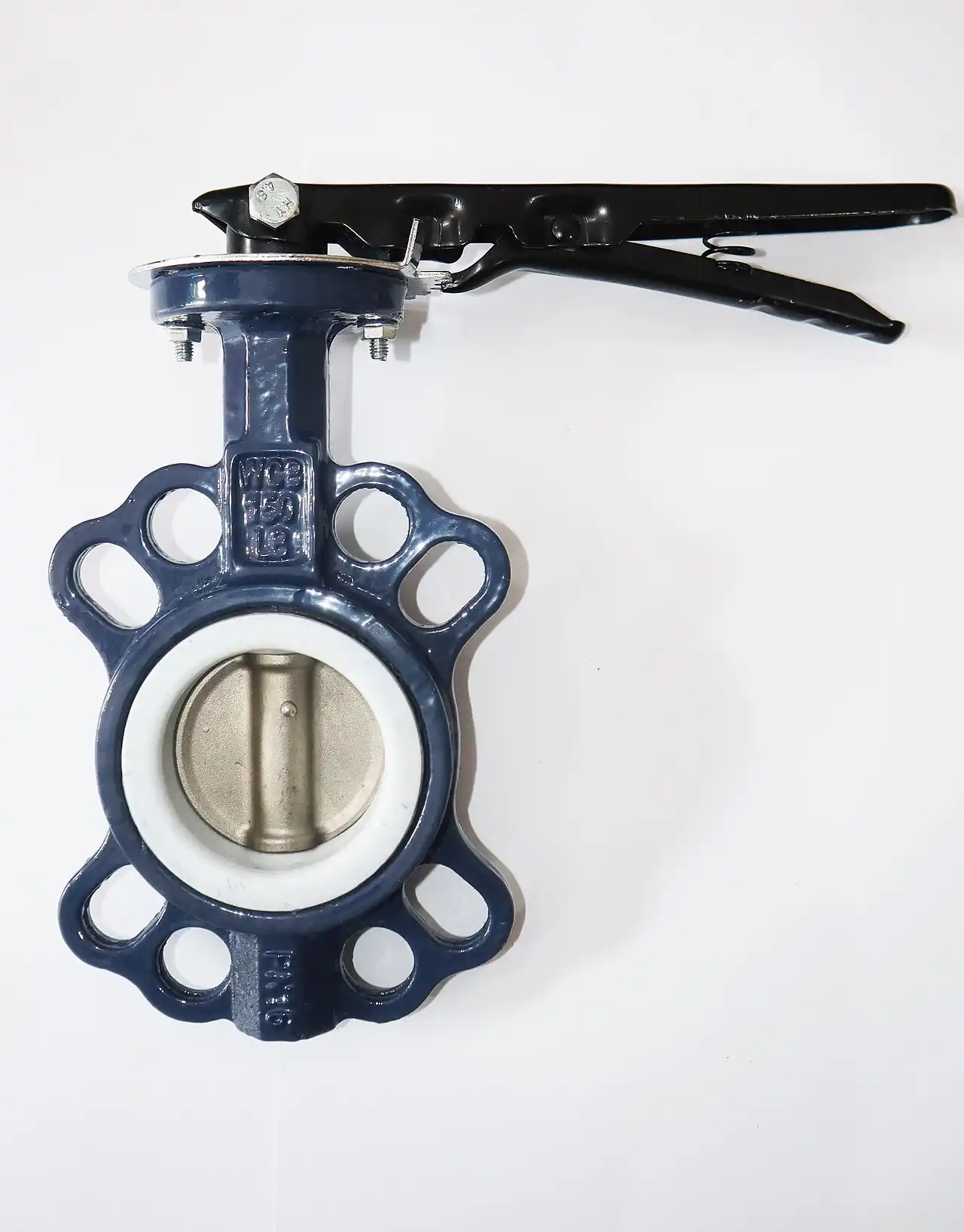
A triple offset butterfly valve is a quarter-turn isolation valve in which the disc and seat geometry carry three deliberate offsets: the shaft is displaced from the seat centerline in two axes, and the seating surfaces are machined as matched cones rather than parallel rings. The result is a metal-seated butterfly valve whose disc travels almost entirely friction-free and only cams into its seat in the final few degrees of closing rotation, then seats with a deliberate jamb load. It is the API 609 Category B valve: built for high temperature, high pressure drop, fire-safe hydrocarbon and steam isolation duties where a resilient-seated concentric butterfly valve loses its elastomer and a generic butterfly valve design gives up either tightness or cycle life.
The purchase decision is a geometry and materials decision more than a size decision. Sizes run DN50 to DN2400 and beyond, classes 150 through 900 and higher in small sizes, but the real specification content is the seat system: lapped metal-to-metal for abrasive and hot service, graphite-lamellar for bubble-tight shutoff with fire survival, hardfaced discs for catalyst and slurry lines. This page decodes the offsets, the seat families, the pressure-temperature envelope to ASME B16.34, the fire-test certificate chain, and the torque and actuator arithmetic that decides whether the valve that arrives closes at the differential it will face.
This page treats the triple offset butterfly valve as a geometry-driven isolation machine: how the three offsets remove seat friction, how metal and graphite-lamellar seats divide the duties, what ASME B16.34 and API 609 Category B certify, how torque sizing catches the actuator mistake, and what an RFQ must state for hydrocarbon, steam, and slurry service.
Chapter 1 / 06
What a Triple Offset Butterfly Valve Is and What Is Being Decided
The butterfly valve family spans three geometry generations, and the generations are duty classes. The concentric design, the wafer butterfly valve and lug butterfly valve pattern that dominates water and HVAC service, centers the disc on its seat and seals an elastomer liner squeezed by the disc edge: cheap, compact, tight, and limited by the liner to roughly the minus 10 to plus 200 deg C window that elastomers tolerate. The double offset or high-performance design moves the shaft off the seat centerline so the disc lifts clear of the seat early in travel, cutting friction and wear and enabling PTFE and metal seats at higher pressure and temperature. The triple offset design adds the third offset, a coned seat axis, so the sealing contact degenerates from a sliding squeeze to a pure cam jamb in the last degrees of closure. Each generation answers a failure of the previous one, and the buyer is choosing how much temperature, pressure drop, fire exposure, and cycle count the service will throw at the seat.
What is being decided with a triple offset valve is therefore four things at once. First, isolation performance in the honest metal-seat sense: leak rates to ISO 5208 Rate A, bubble-tight gas tightness with graphite lamellar seats, in services where elastomer tightness is not available at all. Second, survivability: fire-safe qualification to API 607 or API 6FA, anti-static design, and body materials to ASME B16.34 pressure-temperature ratings that hold 400 to 600 deg C service. Third, quarter-turn economy at large size: at DN600 and above, a triple offset butterfly valve is a fraction of the weight, face-to-face, and cost of a gate valve or a metal seated ball valve of the same class, which is why it owns isolation on large hydrocarbon, steam, and cooling water headers. Fourth, actuation practicality: predictable torque curves across the travel with seating torque as the design point, driven by a pneumatic valve actuator, an electric actuator, or a spring-return scotch yoke actuator sized for the worst differential.
The competition is specific, not generic. Against a gate valve: quarter-turn speed, smaller envelope and weight, no sliding wedge wear, and better high-cycle behavior; the gate valve answers with dead-simple robustness and full bore where pressure drop of the disc in line is unacceptable. Against a globe valve: isolation duty is not throttling duty, and a globe body belongs where control is the job; a triple offset valve throttles reluctantly and its manufacturer says so. Against a metal seated ball valve: the ball wins on full bore and often on abrasive slurries at small size, the butterfly wins on weight and price at large size and on torque at high differential. Against a knife gate valve: the knife gate owns thick slurries and dry solids at low pressure; above its pressure class the triple offset takes over. And where modulating control is genuinely the duty, the answer is a control valve, not an isolation valve pressed into service.
One naming note for procurement files: triple offset, triple eccentric, and TOV name the same geometry, and API 609 Category B is the standard designation that formally covers the double and triple offset metal-seated class. RFQs written around API 609 Category B with the seat system and fire-safe clause attached will quote cleanly from any serious maker.
Chapter 2 / 06
Offset Geometry and Seating Physics
The three offsets have precise jobs. The first offset moves the shaft axis away from the seat centerline plane, and the second moves it off the cone axis, so the disc rotates out of the seat circle with a growing clearance instead of scraping along it. The third offset tilts the seat plane into a cone whose apex lies upstream of the seat: disc and seat are then two matched cones, and as the disc closes, the cone surfaces approach each other along a line that moves radially inward, making contact only in the final few degrees. Through the other roughly 85 degrees of travel the disc never touches the seat, which is why a triple offset valve cycles thousands of times without the seat polishing and galling that consume eccentric metal designs.
The closure mechanics are a cam, and the consequences run through the whole specification. In the last degrees, the disc motion relative to the seat is almost tangential, a wipe-free jamb that converts shaft torque into seating load. Seating torque is therefore the peak of the torque curve, and it is set by the required seat load for tightness against the differential, not by friction through travel. Two numbers follow. Breakaway torque on opening exceeds running torque and approaches the seating value as the jamb releases, so actuator sizing uses seating and breakaway at maximum differential with a safety factor, commonly 1.25 to 1.5 over computed torque, plus the differential-relaxation case where full line pressure sits on a closed disc. And torque is not monotonic with size and class alone: seat width, cone angle, material pair, and graphite compression behavior all enter, which is why serious makers publish torque tables per size, class, and differential, and why an RFQ should demand the torque curve at the actual service differential, not a generic figure.
Seating load buys tightness, and tightness in the metal-seat world is graded. ISO 5208 valve seat leakage testing defines rates from Rate A, no visible leakage, downward; a lapped metal-to-metal triple offset seat tests to Rate A on liquid and near-Rate A on gas when new and correctly seated, while a graphite-lamellar seat, a metal seat ring carrying compressible graphite layers, achieves bubble-tight gas shutoff by graphite flow into sealing-surface imperfections. The graphite seat is also the fire-safe seat: when fire consumes soft components, graphite survives and maintains a defined leakage limit through the burn, which is exactly what API 607 and API 6FA qualify by burning a valve, cooling it, and re-testing. The trade is service temperature and oxidation life of the graphite against the abrasion immunity of a fully lapped metal pair, and Chapter 3 draws that boundary.
Flow behavior through the disc is the second physics block. A butterfly disc in mid-travel is a bluff body: pressure recovery downstream of the disc produces cavitation and noise on liquid at high differential, and compressible flow chokes across the disc vena contracta. Triple offset valves are isolation valves first, and makers publish allowable differential tables or velocity limits, commonly tens of meters per second for liquid service depending on trim, precisely because throttling service kills seats by erosion and cavitation at the disc edge. The engineering rule that survives every revision: use the valve for isolation, add a dedicated control element for regulation, and if partial travel must happen, keep it out of the cavitation window and verify allowable differential with the maker.
Finally the pressure boundary. Bodies are rated to ASME B16.34 or the EN 1092 equivalent: class 150 through 900 as standard, with class 1500 in mid sizes and class 2500 in small sizes from specialist makers. The pressure-temperature table for the body material, carbon steel WCB for the minus 29 to 425 deg C baseline, chrome-moly WC6 and WC9 for steam toward 550 and 595 deg C, stainless CF8M and duplex for corrosion service, defines the envelope; the seat system usually caps the practical temperature before the body does, which is why the seat line in the RFQ matters more than the body line. Cryogenic versions with extended bonets and lantern rings serve to minus 196 deg C on LNG and ethylene duties, where the graphite lamellar seat and lapped metal pair each have their advocates and the decision belongs to the leak spec.
Chapter 3 / 06
Seat Systems, Materials, and Duty Boundaries
The seat system is the valve. Three families cover the catalog. The lapped metal-to-metal seat machines disc cone and seat ring as a matched, lapped pair in hardfaced materials: it is the abrasive and hot service seat, immune to graphite burn-away above 450 deg C in oxidizing service, standard on catalyst, coke, and steam duties, and its tightness is a machined-surface tightness, excellent liquid, very good gas, and dependent on the final lapping and on not being scored by weld spatter or pipe scale. The graphite-lamellar seat bonds or mechanically clamps compressible graphite layers onto a metal seat ring: it is the bubble-tight and fire-safe seat, standard on hydrocarbon isolation where fugitive and survival tightness matter, and its boundary is graphite oxidation in air above roughly 450 deg C and erosion on solids, where metal takes over. The third family is the engineered hybrid, PTFE or elastomer-energized metal seats for special chemical tightness in moderate temperature, a small segment that exists to answer specific refinery chemistry and is quoted only against a written process datasheet.
Materials ladder upward by service temperature and chemistry. Carbon steel A216 WCB bodies with A105 trims are the minus 29 to 425 deg C baseline of steam, air, oil, and water. Alloy steel A217 WC6, 1.25 chrome 0.5 moly, extends steam service toward 540 deg C, and WC9, 2.25 chrome 1 moly, toward 595 deg C, both standard in power and refinery steam loops. Stainless CF8M, and CF3M for welded installations, serve corrosion duties; duplex and super duplex bodies answer seawater and chloride service; and Monel or Inconel trims appear where the chemistry demands. Seat and disc faces carry hardfacing, typically cobalt or nickel alloys applied by welding, or tungsten carbide coatings by spray for abrasive service, and the pairing matters as much as the choice: like-on-like hard faces gall, so makers specify dissimilar pairs with a hardness differential, and the RFQ should name both faces.
Duty boundaries in one paragraph each. Steam above 425 deg C: WC6 or WC9 body, lapped metal seat, hardfaced dissimilar pair, graphitized packing replaced with live-loaded metal or flexible graphite, and the pressure-temperature table checked at operating not class pressure. Hydrocarbon isolation with fire-safe requirement: graphite-lamellar seat, API 607 or 6FA certificate, anti-static design, and fugitive-emission packing to ISO 15848 or API 624 low-leak test. High-cycle isolation, cooling water, air, and gas headers at large diameter: graphite-lamellar or metal seat by tightness need, actuator with the cycle count in the sizing basis, and position feedback. Abrasive slurry and catalyst: lapped metal seat with tungsten carbide faces, velocity limits enforced by the process design, and an admission that partial-open throttling will consume the seat on schedule. Cryogenic service: extended bonnet, graphite-lamellar or lapped seat per leak class, and type testing to the cryogenic leak criteria the project invokes.
Seat system
Typical temperature band
Tightness
Where it stops being right
Lapped metal-to-metal, hardfaced
minus 196 to approx. 600 deg C by body
ISO 5208 Rate A liquid, near-Rate A gas new
Needs gas bubble-tight without graphite; scores on weld spatter
Graphite-lamellar on metal ring
approx. minus 196 to 450 deg C in air
bubble-tight gas, fire-surviving
Graphite oxidizes in hot air; erodes on solids-laden flow
Elastomer or PTFE energized
minus 10 to 200 deg C by polymer
soft-seat bubble-tight
Fire exposure and high temperature; that duty is why TOV exists
The concentric and double offset siblings hold the duties below these boundaries: the wafer butterfly valve and lug butterfly valve with elastomer liners own water and HVAC isolation to about 200 deg C, and the double offset high-performance pattern covers mid-temperature tightness duties at lower cost than triple offset. The triple offset earns its premium when the seat must be metal, graphite, or fire-surviving, and honest selection states which of those three requirements is doing the buying.
Chapter 4 / 06
Key Specification Parameters
The decode table lists the lines that decide fitness and that vendors quietly vary when the RFQ leaves them blank. Every row should leave your desk with a number or a named standard in it.
Parameter
Typical catalog spread
What it decides
Size and class
DN50 to DN2400, class 150 to 900 standard
Envelope, weight, and which pressure-temperature table applies
Body material and rating table
WCB, WC6, WC9, CF8M, duplex to ASME B16.34
Temperature and chemistry envelope of the boundary
Seat system
lapped metal, graphite-lamellar, energized hybrid
Tightness class, fire survival, abrasion behavior
Seat tightness test
ISO 5208 Rate A liquid and gas, API 598
The leak number the certificate actually claims
Fire-safe certificate
API 607, ISO 10497, API 6FA
Survival leakage limits for hydrocarbon service
Operating temperature window
minus 196 to approx. 600 deg C by trim
Seat and packing life at both extremes
Max differential and velocity
maker table by size and class
Whether the disc may throttle or only isolate
Seating and breakaway torque
maker curve at service differential
Actuator or gear sizing with safety factor
Cycle life and test basis
1,000 to 100,000 cycles by duty class
Maintenance interval and seat replacement planning
Emission compliance
ISO 15848-1 or API 624 fugitive test
Stem sealing legality and reporting class
Two of these rows carry most rejected quotations. The differential row: a valve quoted at class differential may still be velocity-limited at your pressure and density, and partial-open operation against high differential erodes the disc edge and seat in weeks; state intended duty as isolation with full-open or full-closed operation, or name the throttling case and demand the allowable-differential table. The torque row: torque at class differential is not torque at service differential, and gear operators and actuators sized on generic figures stall at the worst line condition; demand the torque curve at maximum service differential and temperature, and add the safety factor at the actuator, not in the requirement.
Temperature deserves the two-end treatment. The hot end decides body and seat per the table above; the cold end decides packing and graphite behavior, and cryogenic extension is its own line. Cyclic service across a wide window is the worst case for the seat because graphite relaxes and lapped pairs fret under thermal cycling, so name the cycle rate and the span, and let the maker state the expected tightness retention rather than discovering it at the first turnaround.
The certificate stack is not optional paperwork in hydrocarbon plants, it is the delivery ticket: API 609 Category B for the design class, ASME B16.34 for the rating basis, API 607 or ISO 10497 for fire qualification, ISO 5208 with the rate named for seat testing, ISO 15848-1 or API 624 for fugitive emissions, NACE MR0175 or the ISO 15156 equivalent when sour service applies, and the PED 2014/68/EU conformity when the valve ships into the European pressure equipment regime. A quote that omits one of these is not cheaper, it is undeliverable.
Chapter 5 / 06
Selection Decision Factors and RFQ Language
The selection sequence for a triple offset valve runs from process facts to certificate list, and every step is a place a shortcut becomes a field failure.
State fluid, chemistry including sour service flags, operating and design temperature, and operating and design pressure. This fixes the body material and the pressure-temperature table.
State the duty: isolation with how many cycles, full-open residence time, and any partial-throttling episodes. This fixes whether the seat system leads with metal or graphite and sets the velocity and differential review.
State the tightness requirement as a tested rate, ISO 5208 Rate A on liquid and gas, not as adjectives. This fixes the seat family and the factory test.
State fire-safe and fugitive requirements by standard number. This adds the certificate lines and constrains packing design.
State size, class, end connections, and face-to-face standard. This fixes the envelope and the mating steel.
State actuation: manual gear, electric actuator, or pneumatic or scotch yoke actuator, with fail action and the torque curve at service differential. This is where sizing errors live; demand the maker curve and apply the factor at the actuator.
Assemble the RFQ with every Chapter 4 row, the certificate stack, and the test witness points, and evaluate quotes line by line.
Cost behavior at large diameter is the whole reason the design exists. As a planning spread on the same duty: a concentric wafer valve is the baseline 1.0; a lug pattern adds modestly for end-of-line and dead-end service; a double offset high-performance valve runs roughly 2 to 4 times the wafer; a triple offset valve runs roughly 4 to 8 times and scales more slowly with diameter, which is why it wins total cost from roughly DN400 upward against metal-seated alternatives; a metal seated ball valve at the same class often runs 2 to 4 times the triple offset at large sizes and a fraction of it at small sizes; a gate valve of equivalent class prices between them with far more weight and civil cost. The seat and hardfacing upgrades move a triple offset quote 20 to 60 percent within its own family.
The RFQ checklist, written to copy: fluid and sour flag; operating and design temperature and pressure; size, class, ends, face-to-face standard; duty and cycle count with isolation-only statement; tightness rate to ISO 5208 and test medium; seat system named; fire-safe standard API 607 or ISO 10497; fugitive class ISO 15848-1 or API 624; body, seat, and facing materials with the dissimilar pair named; torque curve at service differential; operator type with fail action and sizing factor; NACE MR0175 if sour; PED conformity if in scope; and the witness test points at seat test and fire review. A quote answering all of it is comparable to the next quote answering all of it, and the deltas between them will be real engineering deltas rather than omissions.
Chapter 6 / 06
Installation, Standards, Failure Modes, and Maintenance
Installation starts with cleanliness because the seat is a machined surface pair. Pipe spatter, scale, and welding residue in the line reach the seat on first stroke and score a lapped pair permanently; flush before first operation and stroke the valve slowly against a vented line. Disc orientation matters: makers define a preferred flow direction so that the disc cone loads the seat correctly and the shaft sees the intended bending; some designs are bidirectional by geometry and others by seat symmetry, and the data plate or the maker letter decides, not folklore. Clearance for removal of a wafer or lug body, actuator, and manifold belongs in the layout review, and at large sizes the valve is a lifting plan, not a two-hand job.
Commissioning verifies three things. First, stroke and timing under actuator with the actual differential across the valve where it can be arranged, confirming the torque sizing in the field rather than on paper. Second, seat tightness as installed, by the same test medium and rate as the factory certificate wherever the piping system permits a test volume. Third, the packing leak check on the first heat cycle, because stem seals that passed cold routinely weep after the first thermal excursion unless live-loaded, and re-torquing to the maker table, not to feel, is the fix. Record the initial stroke torque; it is the baseline for every future condition judgment.
The standards frame was built paragraph by paragraph through Chapters 2 to 4: API 609 defines the Category A and B design classes, with Category B the double and triple offset metal-seated class this page covers; ASME B16.34 governs the pressure-temperature rating of the body; ASME B16.10 and B16.5 or EN 1092 govern face-to-face and flange mating; ISO 5208 and API 598 govern seat and valve testing; API 607, API 6FA, and ISO 10497 govern fire testing; ISO 15848-1 and API 624 govern fugitive emissions; NACE MR0175 or ISO 15156 govern sour service materials; PED 2014/68/EU governs European pressure conformity. Citing the stack in the RFQ is not ceremony, it is how the maker knows which factory tests to schedule and which documents to ship.
Failure modes rank by frequency. Seat leakage from particulate scoring heads the list on lapped pairs and from graphite relaxation on lamellar seats; the fix discipline is flushing, stroke discipline, and seat re-lapping or element replacement at the interval the cycle count predicts. Packing leakage after thermal cycling follows, cured by live-loading and correct re-torque. Actuator undersizing at true differential shows as stalls near closed and is a specification failure traceable to the torque curve row. Graphite oxidation in hot air above roughly 450 deg C converts a lamellar seat into a metal pair with worse finish, and is prevented by selecting lapped metal from the start on hot-air and flue service. Erosion at the disc edge from throttling against high differential is a duty violation, not a valve defect, and the allowable-differential table exists precisely to catch it at design. Cryogenic apps add trim contraction offsets, answered by extended bonets and the cryogenic leak test the project invokes.
Maintenance is condition-based and cheap when the baseline exists: stroke torque versus commissioning record, seat tightness by volume or bag test at turnarounds, packing adjustment to table values, and the seat inspection interval set by cycles rather than calendar. Graphite seat elements and packing sets, shaft bearings, and the hardfaced seat ring are the planned spares; on high-cycle duty a spare seat element on site is the difference between a one-shift repair and a procurement event. And the surrounding system counts: keep a check valve or isolation arrangement that prevents the valve from becoming the surge arrestor of the line, and if the duty genuinely modulates, move that function to a proper control valve and let the triple offset do the isolation it was geometrically built for.
FAQ
What do the three offsets actually do?
Two shaft offsets move the disc rotation out of the seat plane so the disc lifts clear instead of sliding; the coned seat axis turns seating into a cam jamb in the final degrees. Net effect: almost no friction through travel, so the metal seat survives thousands of cycles and the seating torque becomes a predictable design quantity.
Is a triple offset valve really bubble-tight like a soft seat?
A graphite-lamellar seat is: compressible graphite flows into sealing-surface imperfections and holds bubble-tight gas shutoff, and it survives fire exposure per API 607 or 6FA. A lapped metal-to-metal pair tests to ISO 5208 Rate A liquid and near that on gas when new. State the required rate and medium in the RFQ rather than trusting the adjective tight.
Why choose it over a gate valve on a large header?
From roughly DN400 upward it wins on weight, face-to-face, stroke time, and total installed cost at the same class, and it tolerates frequent cycling far better than a sliding wedge. The gate valve answers with full bore and mechanical simplicity where those matter more than envelope and speed.
Can I use it for throttling?
Not as a rule. It is an isolation valve; partial-open operation at high differential erodes the disc edge and seat through cavitation and velocity. If regulation is needed, use a control valve and let this valve sit open or closed. Where limited throttling is unavoidable, enforce the maker allowable differential and velocity limits in the design.
Which seat for steam service?
Steam above roughly 450 deg C calls for a lapped metal seat with hardfaced dissimilar faces on a WC6 or WC9 body. Graphite-lamellar serves the mid-temperature band well, but oxidizes in hot air long term, so on flue gas and hot air duties the metal pair is the default.
How is the actuator sized without stalls?
Demand the maker torque curve at your maximum service differential and temperature, take seating and breakaway as the design points, and apply a 1.25 to 1.5 factor at the actuator. Spring-return designs, including scotch yoke units on quarter-turn service, must also carry the fail-closed load at worst-case supply pressure.
What certificates must ship with a hydrocarbon order?
The working stack: API 609 Category B design class, ASME B16.34 rating basis, ISO 5208 or API 598 test certificate with the leak rate, API 607 or ISO 10497 fire certificate, ISO 15848-1 or API 624 fugitive test, NACE MR0175 or ISO 15156 for sour service, and PED 2014/68/EU conformity where in scope. Missing any one of these is a delivery stop, not a discount.