
Seven process families account for virtually all commercial 3D printing output in 2026: material extrusion (FFF/FDM), vat photopolymerisation (SLA, DLP), powder bed fusion (SLS, MJF, DMLS/SLM), material jetting (PolyJet), binder jetting, and directed energy deposition (DED) [S1]. The classification is taxonomy-only — material, tolerance, surface finish and cost-per-part differ sharply between them, which is why "3D printing" is meaningless as a single specification line on a purchase order.
On the bureau side, FFF, SLA and SLS make up the bulk of online service-bureau throughput for polymer parts, while DMLS/SLM and binder jetting handle metals [S1]. A 3D printer is, mechanically, a positioning system that deposits or fuses successive thin layers of a material from a digital model [S2], so every process is a layer-by-layer build — the differences are in *how* the layer is formed and consolidated.
Process families and the material each one can actually run
Material extrusion (FFF) feeds thermoplastic filament through a heated nozzle; commodity filaments are PLA, PETG and ABS, while engineering thermoplastics (PA6, PA-CF, PC, PEI/ULTEM) and high-performance PAEK (PEEK, PEKK) sit in the industrial tier [S1][S4]. Industrial FFF systems built for PAEK run heated build chambers at 90–250 °C and nozzle temperatures above 400 °C, which is what separates an office FDM box from a production PAEK cell [S4].
Vat photopolymerisation (SLA, DLP) cures liquid photopolymer resin with a UV laser or projector and delivers the smoothest surface finish of the polymer group, with typical build volumes smaller than FFF and post-cure mandatory [S1]. Powder bed fusion covers three distinct routes: unfused SLS for nylon, multi-jet fusion (MJF) for nylon with fusing agents, and DMLS/SLM for metals (316L, 17-4PH, Ti-6Al-4V, IN718, AlSi10Mg, maraging steel 300) [S1]. Material jetting (PolyJet) and binder jetting (metal and sand) are niche on engineering-part throughput but lead on multi-material colour prototypes and on large sand-casting patterns, respectively [S1].
Tolerances, surface and the cost-per-part reality
Standard polymer FFF lands in the ±0.2 mm (often ±0.5 mm on the first 25 mm) range with visible layer lines from 0.1–0.3 mm; SLA/DLP drops that to ±0.1 mm and 0.05 mm layers with near-injection-moulded surface [S1]. SLS parts come off the bed at ±0.3 mm with a grainy matte finish that does not need support structures [S1]. DMLS/SLM metal parts sit in the ±0.1–0.2 mm range with 20–60 μm layer thickness and typically reach 95–99.9% density after stress relief or HIP, depending on alloy and parameters [S1].
Cost-per-part on service bureaus is driven by build-volume packing, machine time and post-processing, not by the part itself — an SLS nylon bracket can be cheaper than an injection-moulded equivalent in lots under ~500, while DMLS titanium moves into the "buy rather than machine" zone above ~20–50 aerospace brackets [S1]. For a fuller sourcing view, see how the Top Machine Tool Companies 2026 map overlaps with metal AM on subtractive-vs-additive part economics.
FFF vs SLA vs SLS vs DMLS — decision criteria compared
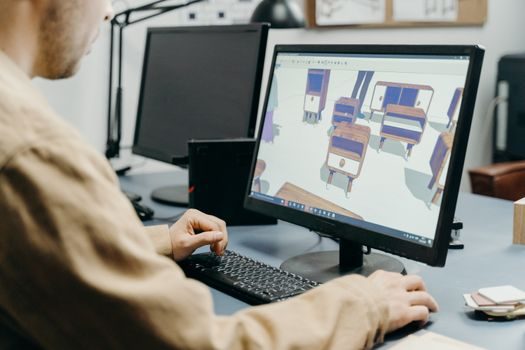
On four decision criteria the polymer processes split cleanly: FFF wins on material cost (PLA ~USD 20–30/kg, PEEK ~USD 200–500/kg) and material range but loses on surface finish and tolerance; SLA/DLP wins on resolution and surface but loses on mechanical strength and UV stability of the cured resin; SLS wins on mechanical strength (PA12 ~50 MPa tensile) and on no-support geometry but loses on surface grain and on moisture-sensitive nylon refresh [S1]. On metals, DMLS/SLM is the only PBF option, and the decision shifts from process to alloy and post-processing chain (stress relieve, HIP, machining of critical interfaces).
The same logic explains why a 3D scanner is upstream of the printer: reverse-engineering a broken part or capturing a free-form surface starts as a point cloud that is re-meshed into a watertight STL, and the resulting mesh's deviation is what sets the floor on the final print's dimensional accuracy.
Where additive fits in a production line and where it does not
Additive makes economic sense in three production scenarios: low-volume serial parts (lots of 1–500) where injection-mould tooling amortisation does not work; mass-customised parts where every unit is geometrically unique (orthotics, dental, jigs for one-of-a-kind assemblies); and weight/complexity-critical parts where conventional machining cannot reach the geometry (lattice structures, internal channels, topology-optimised brackets) [S1]. Industrial PAEK FFF and DMLS titanium are the two routes explicitly positioned for serial production, with the PAEK route targeting aerospace, medical and oil-and-gas chemically-resistant parts and the DMLS route targeting structural metal brackets and implants [S1][S4].
Additive does not fit: high-volume commodity parts where injection moulding drops unit cost below material cost; tight-tolerance drive surfaces (bearing bores, hydraulic spools) where post-machining removes the cost advantage; and large sheet-metal enclosures where DED and wire-arc AM remain throughput-limited. For a related production-technology comparison that runs in parallel on the metal side, see the Industrial Pump Industry 2026 for how investment-cast vs AM vs machined pump housings split by lot size and alloy.
Standards, post-processing and qualification
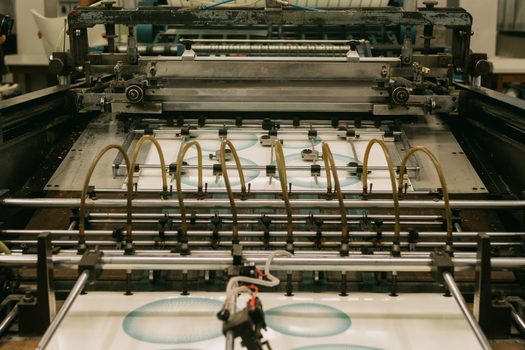
No single ISO/ASME standard yet covers all additive processes end-to-end, but the working stack is fixed: ISO/ASTM 52900 for the process taxonomy, ISO/ASTM 52901/52902 for material datasheet format, ISO/ASTM 52904 for metal process parameters, and ASTM F3301 for post-processing methods [S1]. For serial-production acceptance, buyers should require a process-capability study (Cpk on critical dimensions), powder reuse and traceability records for metal AM, and batch-level mechanical test coupons for polymer PBF. FFF parts need no special certification beyond ASTM D638/D790 coupons for mechanical properties; DMLS aerospace parts sit under Nadcap AC7110/12 audit scope.
The upstream quality control problem is also worth naming: a pressure sensor or a flow meter on the build chamber records chamber temperature and pressure over the print, and those logs are the only way to prove that a specific build met its declared parameter set — without them, "process-qualified" is a marketing word, not a contract term.
Limitations, failure modes and common spec pitfalls
Three failure modes dominate industrial AM returns: warping and layer separation on FFF (root cause: insufficient chamber temperature or wrong bed prep for the polymer), porosity and lack-of-fusion in DMLS (root cause: under-melted powder bed, often visible on CT but invisible on optical inspection), and anisotropic mechanical properties in SLS/MJF (root cause: build orientation not specified on the PO, so the bureau prints with Z-direction as the weak axis) [S1]. Specifying a process without specifying build orientation, post-processing and test coupon requirements is the most expensive way to buy AM.
A second pitfall is material naming: "polyamide" on a PO is ambiguous between PA12 (SLS/MJF baseline), PA11 (bio-based, more ductile, moisture-sensitive) and PA6 (lower cost, harder to process in PBF); "stainless" is ambiguous between 316L (corrosion-resistant, lower strength) and 17-4PH (hardenable, used for tooling inserts). Lock the alloy designation, the heat-treatment condition and the powder reuse limit on the same line as the geometry.
Trackable next signals to watch over the rest of 2026: PAEK filament pricing — currently a hard USD 200–500/kg band — and the number of bureau shops holding Nadcap AC7110/12 for DMLS, both of which are the rate limiters on metal-AM serial production in regulated industries.