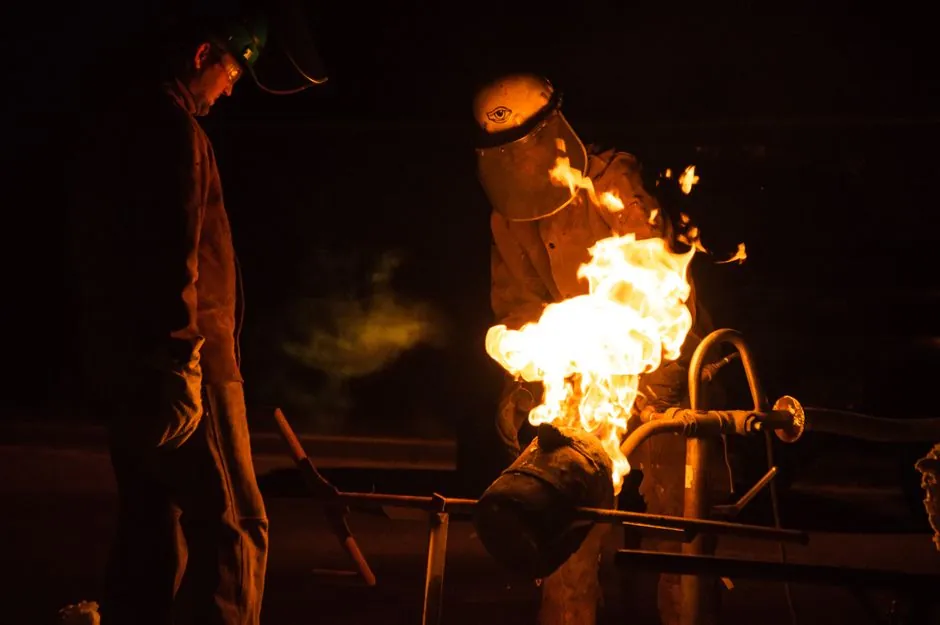
For a tilting furnace, choose a B-shape flat-bottomed or spouted bilge crucible that seats securely in the cradle; for a lift-out furnace, the A-shape (or F-shape bilge) is the workhorse, sized to the tongs that lift it out of the coil. The two geometries exist because a tilting furnace relies on the crucible staying put while the body pivots, whereas a lift-out furnace relies on the operator hoisting the crucible straight up and out [S7][S9].
Beyond shape, the furnace type, the alloy, and the melt temperature all constrain the choice. Silicon-carbide and clay-graphite crucibles cover roughly 850 to 1600 °C, the range that spans aluminum, copper alloys, and most precious-metal work handled in this class of furnace [S4].
Why the shape exists: support versus lift
A-shape crucibles are designed around a clean straight lift path, which is why they are the standard for stationary pit furnaces and for induction drop-coil lift-out cells [S7][S8]. The wall geometry is matched to a tong with a claw-type gripper that closes on the bilge of the crucible, transfers the load, and allows the operator (or hoist) to withdraw the pot from the coil without the wall binding [S5].
Bilge (F-shape) crucibles add a pronounced bulge at the rim, which gives a defined seat for the tong and gives the crucible a positive land on the furnace base. That same bulge is what makes the bilge shape the workhorse for free-standing service in push-up and drop-coil induction furnaces, where the operator lifts the pot out with a shank and ring set [S2][S4].
Tilting furnaces need a captive, flat-bottomed, or spouted pot
A tilting furnace cannot afford a crucible that is only resting in a coil; the pot must be positively clamped or cradled so it does not slide as the body pivots. This is why B-shape flat-bottomed crucibles and spouted silicon-carbide shapes are the standard match for tilt pours [S7][S1]. In a small shop build the same principle is handled crudely by shimming and wedging the pot in the shell, but the production solution is a purpose-shaped crucible and a matched spout [S6].
Foseco's selection logic is explicit: the geometry must match the emptying method. Tilting means the metal leaves the crucible through gravity via a spout or pour-over, so the body shape is biased toward pour-over (TP shape), spouted basin, or a true spouted design, rather than the plain A-shape that the operator lifts out [S2][S1].
Lift-out furnaces want the A or F (bilge) shape with the right tongs
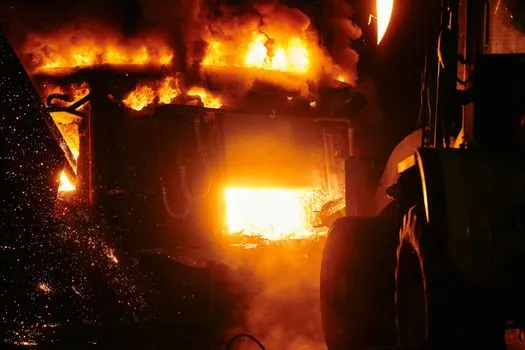
Lift-out service puts the load on the operator and the tong set, not on the furnace shell, so the bilge is the load-bearing feature. MIFCO's standard tong range covers crucible sizes #4 through #275 in matched plain and bent-handle geometries, with part numbers carrying a clear size code (for example, #40B at 38 lbs for a No. 40 crucible, #150B at 105 lbs for a No. 150) and a locking latch to keep the pot captive in the ring [S5].
Crucible Manufacturers Association guidance, as carried through MIFCO's printed instructions, is that the crucible must have a bilge and that the gripper ring fit must be verified before each heat. Excessive gripper pressure is called out as a documented cause of crushed-wall failure under molten-metal load, so the clamp geometry is not cosmetic, it is structural [S5].
Selection criteria, lined up
Decision matrix for the two pot geometries against the four selection criteria that actually drive the call:
1) Furnace type. Tilting bodies need a flat-bottomed B-shape or spouted silicon-carbide shape that can be clamped or seated; lift-out and drop-coil induction cells take A-shape or F-shape (bilge) and live or die by the tong fit [S7][S4].
2) Support and restraint. A-shape assumes the coil or base seats the pot; bilge adds a positive land for tongs and shanks; B-shape flat-bottomed assumes a cradle in the tilting frame [S7][S2].
3) Pouring method. A-shape pours by lift-and-tilt with the operator, bilge does the same with a more positive grip, and tilting-furnace shapes pour by spout or pour-over as the body pivots [S2][S1].
4) Operator load. MIFCO's published table shows 8 lbs for a #4B tong rising to 106 lbs for a #275B, and that is the tong weight alone, on top of the crucible and the melt, so the geometry has to stay liftable at the size you actually run [S5].
Material, temperature, and induction compatibility
Shape is only one axis; the other is the crucible body. INDUX clay-graphite crucibles, the common A/F/E cylinder range, are specified for medium-frequency induction in the 1 kHz to 3 kHz band and are coloured black with the suffix IND, rated for a typical metal casting window of 850 to 1600 °C (1562 to 2912 °F) [S4]. At 3 kHz the preheat procedure is to run empty at 20% of maximum power until red heat, then 50% for 30 minutes, then charge; at 1 kHz an empty pot may need a loose charge in place to give conduction heating until the pot itself starts absorbing power [S4].
For tilting service, the silicon-carbide body comes into its own. SiC crucibles are built with a carbon bond plus glass-forming elements for oxidation protection, and they are supplied in basin, spouted, and TP pour-over variants in addition to the A and bilge shapes, with the main alloy system being silicon carbide plus natural flake graphite [S1]. That wider shape family is what lets a tilting-furnace buyer match a spout angle and a cradle seat without going to a custom tool.
Limits and failure modes to design around
Three failure modes come up repeatedly. First, thermal shock on a tilting cycle: INDUX guidance is to preheat the empty crucible from cold at no more than 100 kW (or 50% of maximum power, whichever is lower) for 20 to 40 minutes until it is bright red, otherwise the cold-start ramp cracks the wall [S4]. Second, mechanical crushing by the tongs: MIFCO calls out that excessive gripper pressure against the wall is a documented wall-crush failure, which is why the tongs have an adjustable stop [S5]. Third, the wrong seat geometry in a tilt frame, which is solved by choosing a flat-bottomed B-shape rather than trying to wedge a round-bottomed A-shape into a tilting shell [S7][S6].
Size scaling matters as well. The MIFCO table lists tong weights from 8 lbs at #4B up to 106 lbs at #275B, and the notes on the #1025B part (100 to 125 size) call out explicitly that it cannot be used with a T-80 furnace, a reminder that pot, tong, and furnace frame are a matched set, not three independent purchases [S5].
Sourcing, standards, and a workable decision
Foseco frames the selection as a nine-variable process: furnace capacity and type, alloy, melt and hold temperature, ramp rate, charging method, fluxes, degassing, slag handling, and emptying method. The nine variables are why the geometry question (A vs bilge vs B vs spouted) cannot be answered in isolation, and why a serious spec is a joint exercise between the melter and the supplier [S2].
Practical rule of thumb: if the furnace tilts, start with a B-shape flat-bottomed pot or a spouted silicon-carbide shape and confirm the spout angle with the mould station; if the furnace is a lift-out, start with an A-shape or F-shape bilge and confirm the tong part number against the published table before quoting a melt size [S7][S5]. For comparison-grade information on how foundry equipment selection cascades into other shop choices, the seamless pipe specification guide covers the same kind of criterion-by-criterion decision flow on a different product class, and the fuel-fired crucible furnace efficiency breakdown puts hard numbers on the thermal side of the same furnace. For broader process-engineering context, the construction machinery and equipment reference sets the wider plant-engineering frame, and the lamps and light fittings and lighting equipment and electric lamps entries cover the radiant-heat side of furnace lighting and inspection.
Trackable next signals: (1) confirm whether your tilting frame is rated for a spouted pot or a flat-bottomed B-shape before ordering, since the wrong seat geometry is the single biggest driver of pot slippage in tilt service [S6][S7]; (2) verify the tong part number against the MIFCO table for the actual melt size you intend to run, because the published weight table (8 lbs at #4B to 106 lbs at #275B) is the cheapest sanity check on whether the lift is even operable [S5].