
An internal-gear or external-gear pump is a rotary positive-displacement unit designed for clean, viscous, lubricating fluids, while a truck-mounted concrete pump is a hydraulically driven double-piston machine that pushes abrasive, heterogeneous aggregate slurries at hundreds of atmospheres of pressure [S1].
Concrete is heavy, viscous, abrasive, contains pieces of hard rock, and solidifies if not kept moving, which is precisely the service condition that gear geometry cannot survive, and the reason concrete-pump designers have defaulted to seat-valve piston pumps since the 1932 Kooijman patent [S1].
Operating Principle Mismatch: Rotary Gears vs Hydraulic Pistons
A gear pump displaces fluid by meshing the teeth of a drive gear and an idler gear inside a tight housing, producing flow proportional to speed and relying on a thin hydrodynamic film between the gear flanks and the casing wall [S1, comparative]. Concrete contains hard-rock aggregate up to 3/4 inch (19 mm) in line-pump service, with peak grain sizes dictated by hose diameter, and that aggregate would score the casing, jam the tooth tip clearances of 10–100 µm typical of industrial gear units, and stall the pump within minutes [S1].
A truck-mounted concrete pump, by contrast, uses a hydraulic double-piston arrangement operating in two-stroke mode, where one pressure cylinder draws concrete from the hopper while the advancing delivery piston on the other side pushes the previous charge through the transfer tube, generating hundreds of atmospheres of pressure to lift concrete 38 m vertically and 120 m horizontally as the 1927 Giese and Hull prototype first demonstrated [S1]. For ground line pumps, modern static units reach 150 m vertical and more than 1000 m horizontal, a regime no gear pump can match because pressure capability is limited by shaft seal and bearing loading, not by displacement geometry [S2].
Why a Concrete Pump Truck Is Specified, Not a Gear Pump
Truck-mounted boom pumps are specified when the job demands high-volume pours at height, with hydraulic cylinders driving the concrete cylinders and a multi-section articulating boom placing the mix accurately without manual hose handling, and outriggers extending for stability during operation [S3]. A 360-degree continuous swing boom, four- to six-section Z-fold or roll-fold configurations, and boom lengths of 33 m to 63 m are the standard deployment envelope for current truck chassis, with CIFA K42L and K56L units delivering 180 m3/hour output for high-rise and infrastructure work [S3][S4].
Line pumps remain the right tool for residential foundations, sidewalks, driveways, and swimming pools, where hose extensions of 3.0, 3.8, 7.6, and 15.2 m (10, 12.5, 25, and 50 ft) feed concrete through delivery pipes and flexible hoses, but they still rely on the same hydraulic piston architecture, not gear displacement [S1]. For lift-truck, dock, and yard material handling, a reach truck or dump truck is the matched mobile platform; neither is a candidate for concrete placement at all, and a gear pump is similarly out of scope because it cannot move aggregate-bearing slurries in any configuration [S1][S2].
Decision Matrix: Gear Pump vs Concrete Pump Truck on Five Criteria
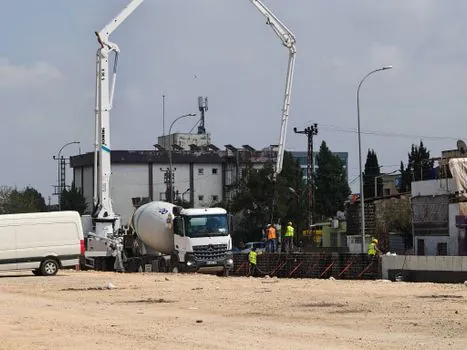
On the criterion of fluid compatibility, gear pumps handle clean oils, fuels, resins, and viscous chemicals with viscosity typically 1–1000 cP, while concrete pump trucks handle abrasive slurries with coarse aggregate up to 19 mm in line service, and the gear pump loses outright [S1].
On pressure capability, an industrial gear pump is usually limited to 10–25 bar continuous service with peaks near 40 bar before shaft seal and bearing life collapse, whereas a hydraulic double-piston concrete pump routinely generates hundreds of atmospheres, the 1927 Giese-Hull prototype already demonstrated 38 m head at 120 m horizontal, and modern line pumps reach 150 m vertical and over 1000 m horizontal [S1][S2].
On flow class, a small gear pump delivers 1–500 L/min depending on size, while a boom-pump truck in the CIFA K42L/K56L class delivers 180 m3/hour, equal to 3000 L/min, an order of magnitude beyond any gear unit and a direct match for continuous ready-mix delivery from a concrete mixer truck [S3]. On mobility and placement, a truck-mounted concrete pump carries a 360-degree continuous swing boom and outriggers for direct placement, while a gear pump is a stationary process skid. On maintenance cost, gear pump rebuilds are driven by tip-clearance wear from contamination, while concrete pump maintenance is dominated by delivery-pipe and hose cleaning to prevent blockage, especially in cold weather, not by displacement-element wear in the same way [S3].
Where a Gear Pump Is Still the Correct Answer
For clean, lubricating service such as hydraulic power units feeding the very piston pumps on a concrete pump truck itself, gear pumps remain standard, which is why the question of gear pump vs concrete pump truck is really a category error, the gear pump is the pump that powers the concrete pump, not a substitute for it [S1][S5].
For high-viscosity chemical transfer, polymer and resin metering, lube-oil circulation, and bitumen transfer within a project site, internal-gear pumps deliver steady, pulse-free flow at moderate pressure and are not interchangeable with the high-pressure, two-stroke piston architecture used on truck-mounted boom units feeding concrete pump truck placements [S1][S5]. A truck scale on the same site may be loaded by a dump truck feeding aggregate, but the actual placement of ready-mix concrete through the boom remains a piston-pump job.
Selection Rules When the Job Is Actually Pumping Concrete
For pours under 150 m horizontal and modest height, specify a trailer-mounted line pump with hose extensions of 3.0–15.2 m matched to aggregate size, accepting 3/4 inch maximum rock for line service and 3/8 inch or pea-gravel size for grout service [S1].
For high-rise buildings, bridges, large industrial complexes, schools, stadiums, and shopping malls, specify a truck-mounted boom pump with four, five, or six sections in a 33–63 m boom length and a rotary distribution valve driven by hydraulic cylinders, with 360-degree continuous swing and outriggers for stability, sized to a 180 m3/hour output class if the pour rate justifies it [S3][S4][S5].
For shotcrete slope stabilization and tunnel work, specify a dedicated shotcrete pump with high-pressure capability and durable wear components, and consider rail- or skid-mounted concrete pumps on specialized jobsites such as mines and tunnels where truck chassis cannot enter [S1][S5].
Limits, Failure Modes, and Field Signals
The dominant failure mode on a concrete pump truck is blockage in the delivery line from aggregate segregation or stiffening of the mix, which is why S-valve reversing and hopper agitator design are critical and why cold-weather pumping of line pumps requires active mix-temperature management [S1][S2][S3]. Piston-pump wear on concrete cylinders is the second major maintenance item and rebuild intervals are governed by abrasive aggregate exposure, not by fluid viscosity as on a gear pump [S1].
For contractors weighing boom-pump truck investment against rental and project economics, the 2026 boom-pump market offers four-, five-, and six-section configurations in 33–63 m reach bands with Z-type, roll, and fold geometries, so the decision is reach and fold-pattern, not pump type, because every credible truck-mounted concrete placement unit in 2026 is a hydraulic piston-pump platform, not a rotary gear unit [S4]. For adjacent site-lift decisions, an aerial work platform TCO analysis follows similar 5-to-20-year lifecycle math to boom-pump ownership.