
Agricultural operations use motor graders sized between 125 kW (170 hp) and 165 kW (215 hp), with operating weights of 15-17 t and moldboard widths near 3965-4270 mm [S3]. Three configurations dominate the farm segment: direct-drive, torque-converter-drive, and hydrostatic, each suited to different duty cycles [S1].
Core selection pivots on engine power class, moldboard geometry, transmission architecture, and tire specification, since agricultural work typically combines haul-road grading, terrace shaping, and field-leveling at slower travel speeds than highway construction. For background on the platform itself, see the motor grader reference page.
Engine Power Class and Operating Weight Bands
Agricultural motor graders cluster into three power bands: 125 kW (170 hp) at 15 t, 140 kW (190 hp) at 15.4 t, and 147-165 kW (200-215 hp) at 16-17 t [S3]. The lightest band (GR165 class) suits orchards, small farms, and lanes under 4 m; mid-band graders (GR180/GR200) handle standard farm roads and irrigation channels; the upper band (GR215) fits commercial-scale operations with 10+ km of internal road network.
Operating weight below 15 t reduces moldboard down-pressure and risks poor compaction of the base course, while above 18 t the machine over-compacts loose agricultural soils and damages tillage layers. For hydraulic systems that drive these implements, reference the hydraulic motor overview.
Transmission Type and Drivetrain Match
Three transmission types are offered across major OEMs: hydrostatic, direct-drive, and torque-converter-drive [S1]. Hydrostatic drives deliver infinitely variable speed in the 0-8 km/h grading range, ideal for finish work on farm roads and terraces. Direct-drive offers the highest mechanical efficiency for fuel-conscious operators on long, flat haul roads.
Torque-converter-drive sits between the two, providing torque multiplication for heavier cuts in compacted earth or light rock. The drivetrain interfaces with auxiliary AC motor circuits for cab electronics, fans, and hydraulic oil coolers; selection should verify 24 V DC bus compatibility with existing farm electrical standards (typically 24 V on European and Asian ag equipment).
Moldboard Geometry and Blade Width Specs
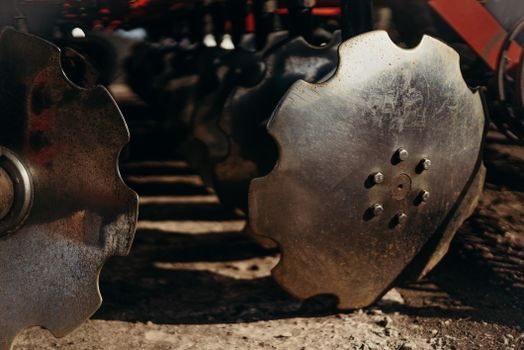
Standard moldboard width for 170-200 hp agricultural graders is 3965 mm with a 610 mm height, while 215 hp units step up to 4270 mm x 610 mm [S3]. Width-to-height ratios above 6.5:1 are typical for fine-grading applications, while 5.5:1 to 6:1 favors material mixing in earthmoving or snow removal [S1].
For orchard and vineyard operations, moldboard width under 3700 mm is preferable to navigate between rows; above 4000 mm suits open-field drainage work. Articulation around the front wheels is standard across the segment, allowing the rear frame to offset the blade from the tractor's centerline for cutting side ditches and V-ditches.
Tire Specification and Ground Pressure
Agricultural motor graders typically run 14.00-24 G-2 or L-2 tires at low inflation (180-220 kPa) to reduce ground pressure below 150 kPa and protect field soils. Larger 17.5-25 or 20.5-25 tires are fitted on 215+ hp units for stability on uneven terraces. [S1]
Tandem rear axles distribute weight across four contact patches, critical for operation on soft farm-road surfaces during wet seasons. Tire selection should match the OEM-approved load curve for the grader's GCWR; under-rated tires on the rear tandem are a common cause of premature failure in agricultural duty cycles where the grader hauls its own snowplow or disc attachment.
Work-Tool Attachments and Lift Groups
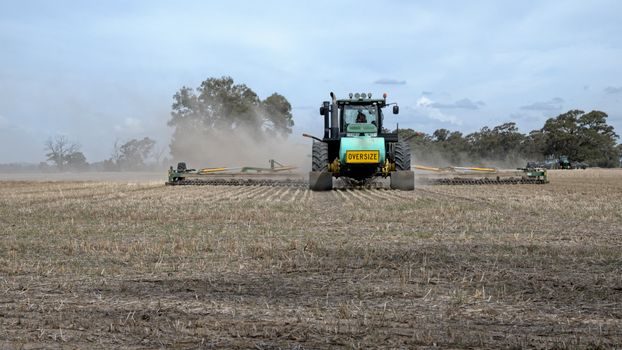
Lift groups mount between the frame and the front or rear of the grader, enabling quick changeover between moldboards, rippers, snow wings, and V-plows [S2]. Standard three-point lift geometry on the rear accepts Category 3N or 3 ag implements, including disc harrows, box scrapers, and land planes commonly used in farm road maintenance.
High-performance circle-drive upgrades are available for precise moldboard positioning on slope work, important for terraced farms where cut/fill accuracy directly affects irrigation gradients. Operators should verify the lift-group's rated lift capacity (typically 1.5-2.5 t at the implement pivot) matches the heaviest intended attachment, factoring in dynamic loads during transport at 25-30 km/h.
Agricultural Use Cases and Operator Considerations
Primary on-farm applications include haul-road grading, terrace maintenance, field leveling for laser- or GPS-guided systems, ditch cleaning, and snow removal [S1]. A 170 hp grader typically maintains 8-15 km of farm road per day; 215 hp units extend to 25-30 km under similar conditions. Cab comfort features (ROPS/FOPS, climate control, joystick vs. lever controls) directly affect operator productivity during long shifts.
Joystick controls became available on the Cat 140 platform from late 2025 onward, alongside traditional lever-and-steering-wheel layouts [S1], and the SmartGrade integration on John Deere P-Tier models (620-872) introduced in March 2026 brings 3D-GPS grading to the ag segment [S1]. For comparison of mining-scale graders, see the motor grader spec map for mining haul roads and pit floors. For demolition-site selection criteria, see the motor grader selection map for demolition projects.
Selection Criteria Comparison Across Power Bands
170 hp (GR165): 15 t weight, 3965 x 610 mm blade, best for orchards, lanes under 4 m, fuel cost-sensitive operations; limited down-pressure for hard cuts. 190 hp (GR180): 15.4 t weight, 3965 x 610 mm blade, balanced for mixed farm roads and light terracing. 200-215 hp (GR200/GR215): 16-17 t weight, 4270 x 610 mm blade, required for commercial farms with 10+ km of internal road, heavy terrace work, and high-speed snow removal. [S3]
Transmission selection: hydrostatic for finish grading under 8 km/h with frequent direction changes; direct-drive for long, steady passes on flat roads; torque-converter for variable load conditions including rocky cuts and wet soils [S1]. Tire selection: low-pressure G-2/L-2 fitments for soil protection; heavier L-3/E-3 for abrasion resistance on gravel or crushed-rock surfaces.
Standards, Sourcing, and Next Watch-Points
CE-marked agricultural motor graders such as the GR215 comply with the EU Machinery Directive for operator safety, ROPS, and noise emission [S3]. Procurement timelines in 2026: XCMG used 170 hp units (GR165) are listed at USD 19,701-42,686 FOB, while new 240 hp units (GR2405T) run USD 500,000-600,000 FOB [S4]. Trackable signals to watch: OEM rollout of fully GPS-integrated SmartGrade variants across the 200-220 hp ag class, and the entry of additional Chinese and Indian manufacturers into the European agricultural motor grader segment through 2026-2027.