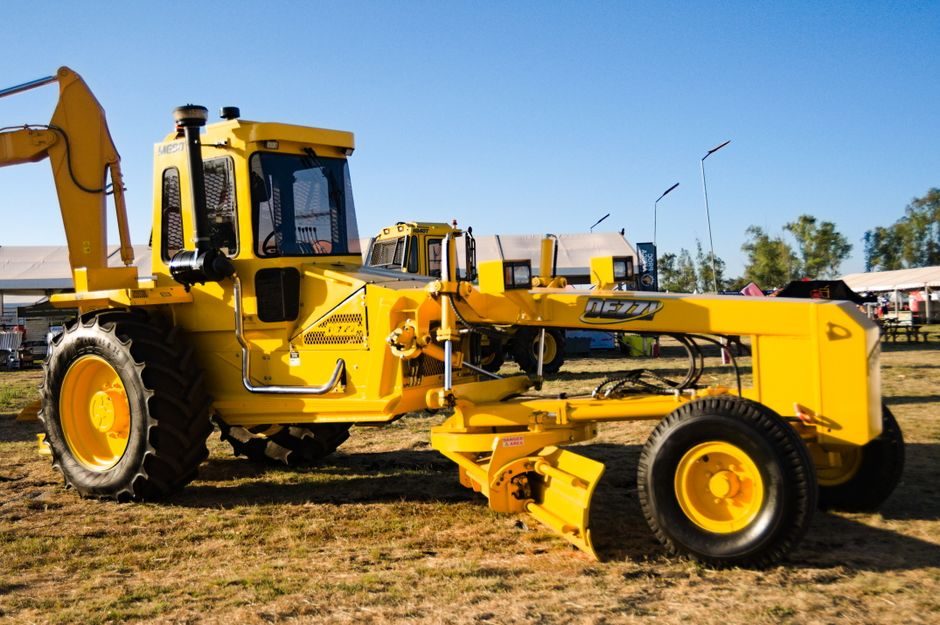
Motor graders rarely lead a demolition fleet, yet contractors continue to specify them for slab cleanup, sub-base trimming, and access-road grading on structural-tear-down sites where an excavator is over-sized and a skid steer is under-powered [S3].
Selection for demolition duties turns on three published reference points: operating weight class, motor grader lift-group geometry, and ground-engaging tool (GET) metallurgy — each documented in current OEM catalogs dated May–June 2026 [S1][S4].
Operating Weight Class and Demolition-Duty Match
Cat catalogs its motor-grader line with operating-weight bands suitable for general roadwork; heavier-class units (typically the 24-tonne range and above) carry the higher-capacity lift-group geometry that demolition contractors repurpose for rubble push-out and slab-edge cleanup [S1][S3].
For pure structural demolition — concrete slab breaking, reinforced-masonry push — a purpose-built demolition hammer carrier or hydraulic excavator outperforms a grader; the grader's role is the finish pass, not the primary break [S3].
Lift-Group Geometry and Attachment Interface
Cat's published Lift Group Work Tool offering for motor graders documents the drawbar, circle, and blade-lift geometry that defines how an OEM-spec ripper or push-block transmits load into the frame [S1]. The lift group is the structural backbone for any demolition-rated attachment that bolts to the machine.
Demolition contractors commonly specify an upgraded circle assembly to handle the asymmetric side-loads of push-out work, where the blade is used as a pusher rather than a fine-grader [S1]. For heavy ripping in compacted demolition debris, a rear-mounted ripper-scarifier is paired with the front lift group so loads are split between two ground-contact zones.
Ground Engaging Tools: Hardness and Service Life
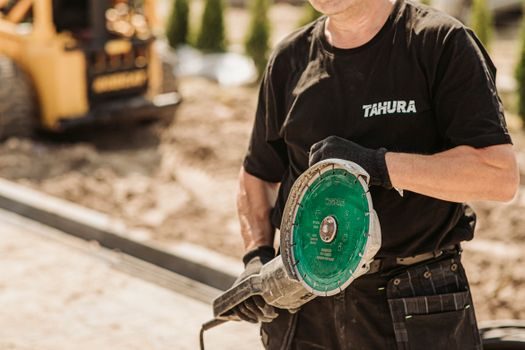
Cat documents its GET for motor graders as "built to deliver performance, strength, and reliability in demanding applications" with hundreds of cutting-edge options plus a Made-to-Order (MAO) customization path [S4]. The Cat GraderBits™ system is positioned as the answer to "the toughest application needs," paired with multiple end-bit options for varying wear profiles [S4].
For demolition sites with rebar-contaminated sub-base, the practical spec is a through-hardened or carbide-tipped cutting edge over standard carbon-steel edges, since abrasive wear in mixed debris is the dominant failure mode. Operators should plan edge-rotation intervals in the 100–250 hour range when working reinforced-concrete rubble, though no published Cat document states an exact hour figure [S4].
Power Train and Hydraulic Margin
Demolition-side push work loads the hydraulic motor circuits that drive the circle turn and blade side-shift far more aggressively than grading; OEM data shows lift-group work tools are specified for higher flow and pressure than the base grading circuit [S1].
Frame articulation, all-wheel drive availability, and tire size — typically 14.00R24 on mid-to-large graders — are the three power-train levers a contractor pulls when re-tasking a grader onto a demolition access road. Standard 2WD configurations are generally under-powered for push-out work on broken slab.
Comparison: Grader vs. Purpose-Built Demolition Carrier
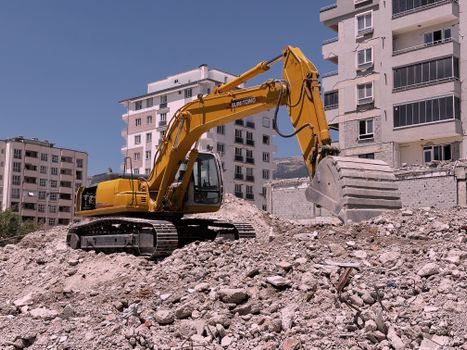
On a four-criterion decision matrix — primary break capability, finish-grade precision, sub-base compaction control, and attachment versatility — a motor grader scores high on finish-grade precision and attachment versatility but low on primary break capability when compared to a hydraulic excavator with a demolition hammer attachment [S3].
The same matrix shows graders winning on sub-base compaction control because their weight distribution and tire footprint compact rather than disturb the sub-base — useful when the next trade is pouring a new slab directly on the cleaned sub-grade.
Who Should and Should Not Specify a Grader for Demolition
Spec a grader when the demolition scope includes 500 m² or more of finish-grade work after structural removal, when access roads must be maintained for haul trucks throughout the tear-down, and when a single machine can sweep, rip, and trim without a mob-demob cycle [S3][S4].
Do not spec a grader as the primary breaker on reinforced-concrete or steel-framed structures; the machine's AC motor-driven hydraulic circuits are not sized for sustained percussion load, and the frame is not designed for the impact spikes a breaker run generates.
Sourcing, Standards, and Fleet Integration

Current OEM documentation lists Cat Lift Group Work Tools, the Cat GraderBits™ GET system, and the Made-to-Order (MAO) customization program as the three documented procurement paths for demolition-spec motor-grader tooling [S1][S4]. Telematics platforms such as Cat VisionLink and Foley Lynx provide remote monitoring for mixed demolition fleets [S3].
For projects that mix demolition with new construction, the landfill bulldozer selection map and the circular saw selection map for bridge construction cover two adjacent machine classes worth cross-referencing during fleet planning. Trackable signals to watch over the next quarter: OEM announcements of higher-flow hydraulic options for the lift group, and any expansion of the GraderBits™ catalog into carbide-class edges rated for rebar-contaminated sub-base [S1][S4].