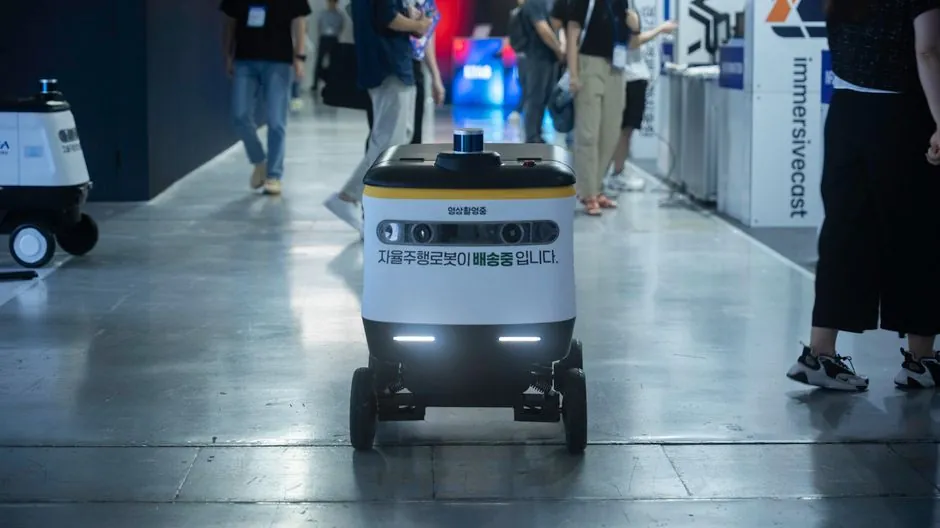
AGV and AMR fleets in e-commerce fulfillment centers are sized against three numbers: peak order volume per hour, tote or pallet payload class, and aisle width of the storage medium, with magnetic-stripe guided vehicles dominating fixed-loop dispatch and laser SLAM AMRs dominating dynamic piece-picking aisles [S2][S4].
The e-commerce segment is structurally different from automotive or 3PL bulk: orders are small (typically 1–6 items), SKU counts are wide, and the same SKU may be picked hundreds of times per shift, so the bottleneck that an AGV robot fleet must attack is worker travel time, not raw transport throughput [S2][S3]. Goods-to-person (G2P) topologies replace that travel with a fleet dispatch problem, and a 60% labor overhead reduction is a common published target for retrofitted e-commerce sites running G2P AMRs continuously [S4].
AGV vs AMR: Which Mobile Platform Fits E-Commerce
AGVs follow fixed paths defined by magnetic tape, QR codes, or wire, while AMRs use onboard laser SLAM or 2D/3D vision to localize and replan, a distinction that maps directly to whether the warehouse layout is stable or evolving [S7][S8]. For a single-tenant e-commerce DC that has stabilized its slotting and tote sizes, magnetic-stripe AGVs deliver sub-millimeter docking to conveyors and vertical lift modules at the lowest unit cost, with the published payback window sitting below 14 months in one vendor benchmark [S4]. For sites that re-slot racks quarterly, run cross-dock operations, or need to share space with human pickers, AMR robots using laser SLAM are the working default because they avoid floor-stripe maintenance and re-route around obstacles without WMS intervention [S7][S8].
The Balyo comparison frames picking and sortation as the dominant AMR use case in 3PL and e-commerce, with AGVs holding the line on heavy pallet moves and conveyor handoffs where the path is engineered, not improvised [S7]. Invio Automation's July 2026 commentary reinforces the same split: most AGV-vs-AMR advice is implicitly written for light-load e-commerce picking, while AGVs remain the right answer for pallet flows and conveyor-coupled transfer [S8].
Navigation and Guidance: What Each Option Costs You
Magnetic-stripe navigation delivers ±10 mm path repeatability at the lowest infrastructure cost (roughly tape cost per meter plus occasional cleaning), and it is the technology behind most "XBOT-AGV600"-class heavy-payload and sortation units aimed at 24/7 cross-docking [S4]. Laser-guided vehicles and laser SLAM AMRs eliminate the floor maintenance but require an initial map-building pass and ongoing localization health checks; the same payload class on a laser-guided chassis typically costs 1.5–2.5× the magnetic-stripe unit before fleet software is counted, per widely cited integrator benchmarks [S3]. QR-code or 2D-fiducial navigation sits between the two on cost and flexibility, and is common in Chinese e-commerce shuttle deployments where the ceiling or floor grid is dense and controlled [S4].
For a greenfield e-commerce site, the practical selection rule is: choose magnetic-stripe AGV when the tote/pallet path count is below roughly 20 and paths are stable for more than 18 months, and choose laser SLAM AMR when route counts exceed that, when aisles are shared with pedestrians, or when the WMS issues ad-hoc pick waves that re-sequence the fleet every shift [S2][S7]. The same point is echoed in the Ellithy et al. (2024) Industry 4.0 review: flexible reprogramming, not raw speed, is the decisive factor under mass customization [S3].
Payload, Battery, and Throughput Sizing

E-commerce fulfillment splits into three payload bands that drive chassis selection: totes and bins at roughly 30–50 kg, single-pick totes at 50–300 kg, and pallet moves at 500–1500 kg, with each band having a different dominant vehicle class [S4][S5]. Tote-bin AMRs in the 30–50 kg class typically run lithium chemistries at 24–48 V with opportunity charging at pick stations, enabling 24/7/365 uptime without battery swaps, and docking accuracy is published at sub-millimeter levels for the integration with conveyors and vertical lift modules [S4]. Pallet-class AGVs in the 500–1500 kg band use counterbalanced forklift or reach-truck chassis and are typically specified for inbound/outbound dock loops rather than pick aisles [S5].
Throughput sizing should be done against peak order volume, not average: a 50,000-order/day site during a Cyber Monday peak can require 3–4× the baseline fleet, and a fleet manager that supports shortest-path optimization, multi-robot traffic management, and real-time status monitoring is non-optional at that scale [S2][S4]. The 365AGV benchmark cites 99.98% order dispatch accuracy, a 60% labor overhead reduction, and a sub-14-month average ROI payback for the integrated AGV + WMS stack on e-commerce sites, although exact payback is sensitive to local labor cost and shift structure [S4].
Fleet Management Software and WMS/WES Integration
A professional fleet manager in this segment must support automatic task assignment, shortest-path optimization, multi-robot traffic management, real-time status monitoring, and bidirectional integration with the customer's WMS or ERP, and any vendor that cannot expose those five capabilities should be screened out at RFP stage [S1][S2].
Practical integration pattern: the WMS issues a pick wave, the WES breaks it into robot-dispatched "bring tote to station" tasks, the fleet manager routes the collaborative robot or AMR to the right shelf face, and the WES reconciles picks back to the order, with the entire loop closing in 1–3 seconds per pick at a healthy deployment [S1][S2]. Software-only deployments are a valid first step: inVia Logic and comparable WES products demonstrably improve productivity on their own, so a phased "software first, robots later" rollout lowers execution risk on sites where order profiles are still maturing [S1].
Comparison: AGV vs AMR for E-Commerce Fulfillment
Selection criteria, in priority order for an e-commerce site: (1) layout stability, (2) load class and aisle width, (3) peak-shift throughput target, (4) integration depth with WMS/WES, and (5) total cost per pick over 5 years. On layout stability, magnetic-stripe AGV wins for fixed paths and conveyor handoffs, while laser SLAM AMR wins for reconfigured or shared aisles [S4][S7]. On load class, AGV chassis dominate above 500 kg, and AMR tote-bots dominate below 50 kg; the 50–500 kg band is contested and usually goes to whichever vendor's fleet manager best fits the WMS [S5].
On peak throughput, AGVs deliver deterministic cycle times because the path is engineered, whereas AMRs add 5–15% travel variance from dynamic replanning, a gap that fleet software can largely close but rarely eliminates [S3][S8]. On integration, the AMR ecosystem is generally more open (REST/JSON WMS connectors, ROS 2 stacks, and VDA 5050 fleets) while AGV ecosystems still depend on vendor-proprietary fleet managers, an asymmetry that matters for brownfield sites with mixed fleets [S2][S7].
Use Cases, Limitations, and Failure Modes
Three use cases consistently deliver in e-commerce: (a) tote-to-picker G2P in a 1.5–2.5 m aisle grid with AMR tote-bots, (b) cross-dock pallet transfer on magnetic-stripe AGV tugger trains for inbound-to-outbound dock moves, and (c) sortation induction where AGVs feed merged orders into sliding-shoe or cross-belt sorters at sub-millimeter accuracy [S4][S7]. The 60% labor overhead reduction figure quoted by 365AGV is most defensible in G2P tote-to-picker, less so in pure transport where the baseline is already mechanized [S4].
Known failure modes to spec against: floor-stripe contamination and QR-code wear on magnetic/QR AGVs (mitigation: scheduled floor cleaning and fiducial replacement), localization drift in laser SLAM AMRs after rack moves (mitigation: remap SLA in the vendor contract), traffic deadlocks in narrow aisles during peak (mitigation: digital twin simulation before deployment), and WMS-to-fleet-manager latency above 500 ms which collapses pick rates (mitigation: edge-resident fleet manager or on-prem WES) [S2][S3][S8]. For facilities with significant conveyor infrastructure, the articulated robot and SCARA robot classes are typically deployed upstream of the mobile fleet for induction and decanting rather than as substitutes for it [S1][S5].
Signals worth tracking through the rest of 2026: vendor disclosures on VDA 5050 conformance for mixed AGV/AMR fleets, WES platforms adding reinforcement-learning task assignment, and the first wave of retrofits where e-commerce sites consolidate AGV and AMR traffic under a single fleet manager rather than two parallel systems, a pattern that is already visible in the 365AGV and Balyo positioning [S2][S4][S7]. The Pneumatic Conveying Selection for Warehouse Automation: A 2026 Spec Map article is a useful cross-reference for sites where tote transport is split between mobile robots and fixed-path conveying.