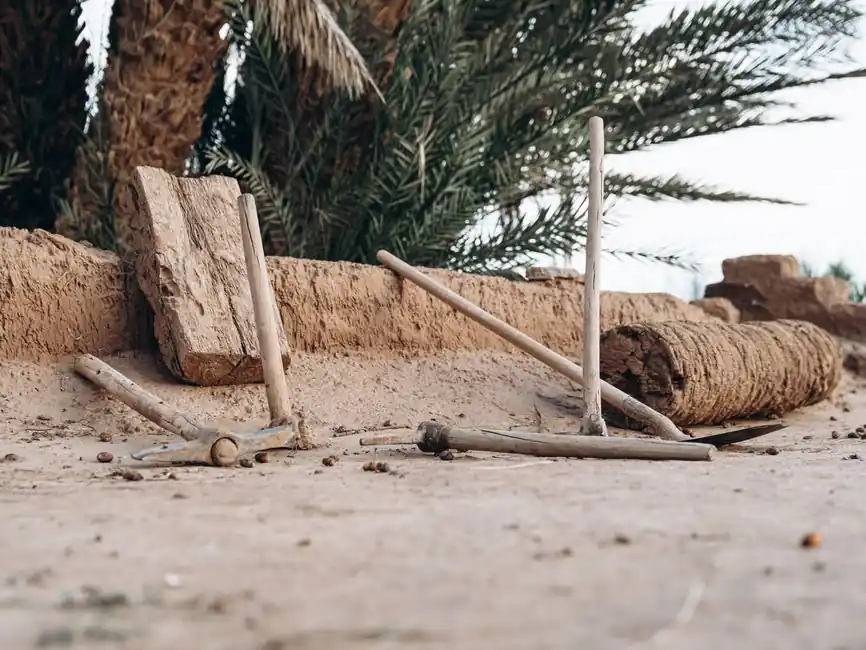
The landscaping job drives a hard split: a converging/diverging-nozzle pneumatic-excavation air pick (a "soil pick" or "air lance") is the correct tool when the goal is to clear soil, expose roots, or daylight buried utilities without metal-on-metal impact, while a reciprocating pneumatic-percussion air pick is the correct tool when the goal is to break frozen ground, chip concrete edging, or split a stubborn root mass [S2][S9].
Both families run on a 100 psi (6.9 bar) class shop-air supply, but their air budgets differ by a factor of roughly two: a small 1/2 in-bore percussion pick can run 3000+ bpm at 90 cfm (2550 L/min) and weigh 5-7 lb (2.3-3.2 kg), whereas a heavy 1-1/8 in-bore foundry-class pick drops to under 1500 bpm at 50-60 cfm (1420-1700 L/min) and weighs 25-35 lb (11-16 kg) for one-handed horizontal work [S2].
Pneumatic-Excavation Class: cfm Bands, Stand-off, and Dielectric Safety
Soil-pick (air-lance) variants are converging/diverging-nozzle tools that accelerate compressed air to supersonic speed and rely on the violent decompression of that jet at the cutting edge to fracture and displace porous or semi-porous material, which is why landscapers specify them around roots, drip irrigation, and shallow utility lines [S2]. The reference MBW Soil Pick family ships three sizes (SP80 / SP125 / SP160) that share weight (6.2 lb / 3 kg), length (52 in / 132 cm), barrel diameter (1.25 in / 3 cm), airstream velocity (1475 mph / 2375 km/h) and effective cutting depth (4 in / 10 cm), and differ only in air volume: 80, 125 and 160 cfm (2265, 3540, 4531 L/min) at 100 psi (6.9 bar) tool-inlet pressure [S2].
The 4 in (10 cm) cutting-edge stand-off is deliberate: the jet must decompress before it can damage a buried utility, and the brass nozzle is threaded and cemented into the barrel to prevent it becoming a high-velocity projectile, a detail that matters whenever a crew is working around tree roots and shallow PVC irrigation laterals [S2]. For dielectric work near energised lines, the MAC3 PAC3000 series air lance ships with a 500 mm extension tube, a 45° swivel elbow, an optional 90° elbow, and key materials dielectric-tested at 80,000 V in the laboratory and 35,000 V in operation [S1][S6].
Percussion-Pick Class: Bore, bpm, Weight and Bit Selection
Percussion air picks for landscaping chip concrete, break frozen earth, drive a moil point into clay, and split woody root balls, with the cutting action delivered by a chisel or moil point driven by an internal piston struck by a compressed-air motor, not by the air jet itself [S2][S5]. Selection is governed by ISO 11148 part 4 (hand-held non-electric power tools, safety requirements for percussion tools) and by OSHA 29 CFR 1910.243 for guarding and air-hose whip restraint on every jobsite that runs these tools in the U.S. [S2].
The standard ETW G-series percussion picks cover the landscaping weight window in six sizes: G10 (10 kg), G11 (11 kg), G15 (15 kg), G20 (20 kg), G22 (22 kg), and G40 (40 kg), all rated for 0.4-0.63 MPa (4-6.3 bar) working pressure with impact frequency of 15-17 Hz and air consumption of 20-64 L/s, so a single product line spans everything from one-handed root splitting to heavy frozen-ground work [S5]. For bit selection, the spec map on the air pick encyclopedia page ties process medium to recommended bit: moil point for reinforced concrete and coal, moil point or flat chisel for masonry and soft rock, wide chisel for asphalt, and spade/clay spade for frozen earth and clay [S9].
Compressor Sizing and Air Budget: Real cfm, Not Nameplate cfm
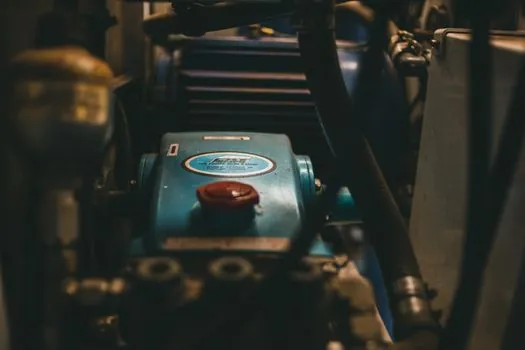
Air picks are sized in real cfm at tool-inlet pressure, not the compressor's nameplate peak cfm, and the difference between those two numbers is the single most common cause of under-performing picks on landscaping jobsites [S2]. A PAC3000-6 air lance draws 2000 L/min (70 cfm) and a PAC3000-8 draws 3000 L/min (105 cfm) at 6 bar (87 psi), with both variants sharing the 2.8 kg (5.9 lb) bare-tool weight, 1000 mm (39.4 in) tube length, 33.3 mm (1.3 in) tube diameter, and 92 dB noise level measured at 1 m [S1][S3][S4].
For an SP80/SP125/SP160 soil-pick fleet, the compressor must deliver 80, 125, or 160 cfm (2265, 3540, or 4531 L/min) at 100 psi (6.9 bar) with a 3/4 in supply line, and crews that try to run an SP160 off a 90 cfm portable routinely lose cutting aggressiveness at the nozzle [S2]. The same rule applies to a percussion pick: a 90 cfm (2550 L/min) small demo pick needs a compressor rated to deliver that volume continuously, with receiver tank volume sized to absorb the per-stroke demand spikes of the reciprocating mechanism [S2][S8].
Ergonomics, Noise and Vibration: Operator-Facing Limits on the Landscaping Job
The PAC3000 air lance specifies 0 m/s² vibration and 92 dB noise at 1 m, with a horizontal/vertical swivelling control handle and a support handle designed to reduce operator fatigue during long trench-daylighting shifts [S1][S6]. For percussion picks, the operator-facing risk is opposite: hand-arm vibration climbs with piston bore and blow rate, which is why heavy 1-1/8 in foundry picks (25-35 lb / 11-16 kg) are used one-handed for horizontal work only and small 1/2 in demo picks (5-7 lb / 2.3-3.2 kg) are the choice for vertical root-zone chipping above shoulder height [S2].
The MAC3 PAC 3000 ships ready to use in a carrying case with the 45° elbow and 500 mm extension tube fitted, so a two-person landscaping crew can deploy it on a residential root-pruning job without a compressor-side fitter [S3][S4][S6]. For utilities exposure, the dielectric-tested 80,000 V laboratory / 35,000 V in-service rating on the PAC3000 series is the headline number that lets a crew work around low-voltage landscape lighting without an additional isolation step [S1][S6].
Buying Map: Piston Class vs Excavation Class for Common Landscaping Tasks
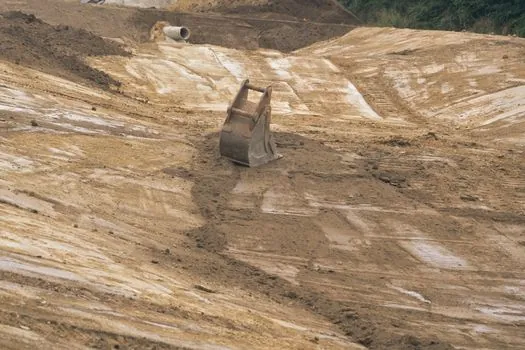
The cheapest mistake on a landscaping job is buying a percussion pick to clear topsoil or buying an air lance to break a concrete edging, because the two tools solve different physical problems and neither substitutes well for the other [S2][S9]. The decision is governed by four criteria: target material, stand-off distance from sensitive assets, required impact energy, and total air budget at 100 psi / 6.9 bar.
For root-zone work, drip-line exposure, and trench daylighting around PVC or low-voltage cabling, specify a pneumatic-excavation air pick (SP-class or PAC3000-class) in the 80-160 cfm band with a 4 in (10 cm) cutting-edge stand-off and a brass nozzle [S1][S2]. For frozen-earth excavation, concrete edging removal, and clay-spade work, specify a pneumatic-percussion pick in the G10-G22 weight band (10-22 kg) at 0.4-0.63 MPa with 15-16 Hz impact frequency, fitted with a moil point for penetration or a flat chisel for line splitting [S5][S9]. For heavy demolition of an old retaining wall, a G40 (40 kg) class percussion pick is the right size, while for one-handed vertical work above shoulder height the 1/2 in-bore small demo pick is the only safe pick [S2][S5].
Standards, Sourcing and Common Failure Modes
Two regulatory references govern landscaping air-pick use: ISO 11148 part 4 for hand-held non-electric percussion tools, and OSHA 29 CFR 1910.243 for guarding and air-hose whip restraint on U.S. jobsites [S2]. On the supply side, the air pick encyclopedia entry documents bit/process pairing, while the air impact wrench encyclopedia entry covers the sister 100 psi-class tool family that often shares a compressor on a landscaping service truck [S9].
Common failure modes on landscaping jobs include: a brass nozzle working loose and becoming a projectile (specify threaded-and-cemented nozzles, not press-fit), an under-sized compressor choking a percussion pick mid-stroke (size to real cfm, not peak cfm), and a dielectric lance used outside its tested 35,000 V in-service rating (verify the rating on the actual data plate, not the marketing sheet) [S1][S2]. Crews that have standardised on 12 mm hex scaling chisels should not buy a 10.6 mm hex scaler, because the small dimension difference locks out the existing inventory, and a 12-needle scaler head with replaceable 3 mm steel needles is the standard configuration for paint and weld-slag cleanup on landscape-metalwork sub-contract jobs [S8]. For tool selection across the wider landscaping toolchain, the theodolite selection map for landscaping work covers accuracy and magnification for site layout, and the aluminum ladder selection map for masonry sites covers access equipment that often pairs with an air pick on a tree-care crew.
Track these signals next: the 2026 update to the SourceBySpec air-pick buying guide is published and references 12 mm hex consumable inventory locks, while the MAC3 PAC 3000 carrying-case supply (45° elbow + 500 mm extension) is the current stock configuration for landscaping crews ordering through U.S. distributors in Q3 2026 [S3][S4][S8].
Spec-level background on the components involved: air quality monitor.