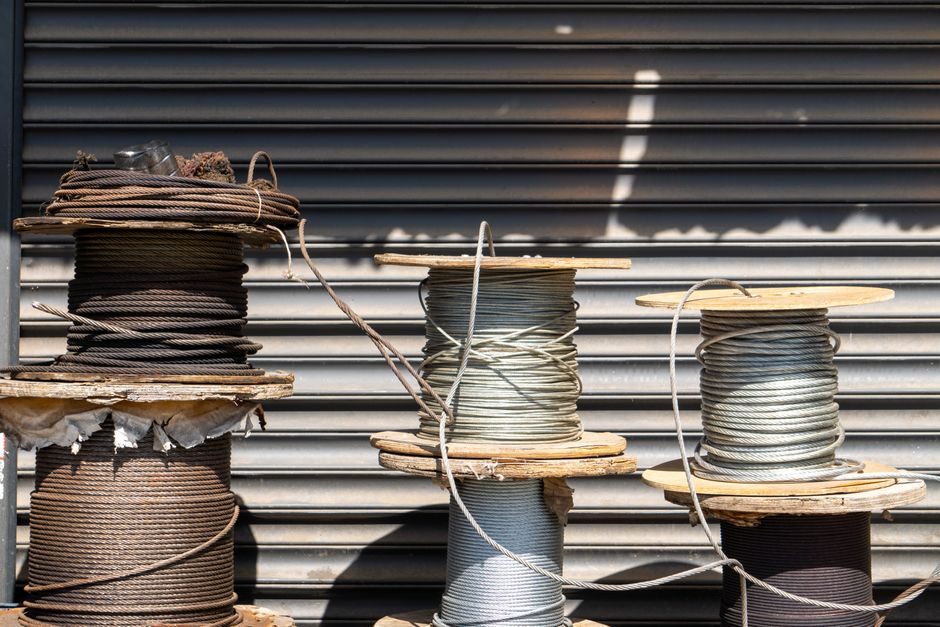
Packaging-line retrofits hit their reliability ceiling on cable selection, not on the carrier itself: a 2026 industry review of moving-cable systems shows drag chain cable failures account for the majority of unplanned stoppages on retrofitted form-fill-seal and cartoning lines, with conductors below IEC 60228 Class 6 and underspecified bend radius the dominant root causes [S3][S4].
The four binding parameters any spec sheet must lock before ordering a cable drag chain for a packaging retrofit are: conductor class (IEC 60228 Class 6 / VDE 0295 Class 6), minimum bend radius (typically 7.5x–10x outer diameter for shielded power, 5x–7.5x for control), declared flex cycles (≥5 million for two-shift packaging duty), and travel length plus acceleration profile [S4][S5].
Why Packaging Retrofits Are a Distinct Drag Chain Duty
Packaging lines differ from CNC or machine-tool service in three measurable ways: travel is usually short (1–4 m), cycle frequency is high (60–120 cycles/min on form-fill-seal axes), and the ambient includes wash-down chemistry, condensation, and occasional food-grade lubricant mist — so a chain selected for a CNC X-axis cannot be copied across without re-deriving the cable spec [S10].
For a typical horizontal-traverse cartoner with 1.2 m travel, 2 m/s traverse speed, and 5 m/s² acceleration, the cable spec must combine IEC 60228 Class 6 stranding, a PUR or TPE outer jacket (not PVC), and a minimum bend radius no smaller than 10x the largest cable OD — exactly the geometry pattern used in the CNC X-axis retrofit example, but with the jacket upgraded for chemical resistance [S7].
Decision Matrix: Cable Type vs Packaging-Line Duty
For packaging retrofits the four realistic cable families reduce to two practical choices: drag chain cable (PUR/TPE jacket, Class 6 stranding) for the powered axes, and high-flex cable (often PVC, lower cycle rating) for low-motion infeed conveyors. Robot cable is overspec for linear travel and adds cost without a flex-life benefit on purely reciprocating duty [S10].
The comparison below lines the three options a packaging engineer is most likely to quote against the four criteria that actually drive replacement cost: declared flex cycles, bend-radius multiplier, jacket chemistry, and relative unit cost (indexed, drag chain cable = 1.0).
Drag chain cable (PUR/TPE) — flex cycles ≥5 million, bend radius 7.5x–10x OD, jacket resistant to hydrolysis and most cleaning agents, cost index 1.0. High-flex cable (PVC) — flex cycles 1–3 million, bend radius 10x–12x OD, jacket adequate for dry ambient only, cost index 0.6–0.8. Robot cable (PUR/TPE, torsion-rated) — flex cycles ≥10 million including torsion, bend radius 7.5x–10x OD, jacket chemically resistant, cost index 1.4–1.8 [S4][S9][S10].
Sizing the Carrier: Inner Width, Bend Radius, Fill Ratio
AutomationDirect's MP18 design guide walks through a five-step method to select drag chain part numbers and optimize system design, addressing inside width, bend radius, maximum unsupported length, and stroke length [S6], with selection examples setting bend radius at 10× the largest cable's OD and adding width for dividers [S7].
Fill ratio should stay between 60% and 80% of the carrier's internal cross-section — below 60% the cables whip and wear prematurely on the inner radius, above 80% the jacket abrasion and mutual heat rise shorten service life. For a 1.2 m cartoner retrofit the published worked example settles on inside width A = 55 mm and height B = 20–25 mm after a 13.2 mm motor cable, 7.7 mm encoder cable, and two 9.6 mm air lines are summed [S7].
Mechanical Selection Parameters That Drive Cable Life
The minimum bending radius of cables defines the smallest radius by which the cable can be bent; to keep the cable manufacturer service-life statement valid, the drag chain radius must not be smaller than that cable minimum, and the cable must be routed with adequate strain relief at both fixed and moving ends [S5].
HELU KABEL's drag-chain white paper reduces cable choice to five interacting elements: cores, stranding, screening, sheathing, and the required standard. On a packaging retrofit, screening (typically tinned-copper braid, coverage ≥85%) is non-negotiable on any cable that runs parallel to a VFD output, and the sheath must be a hydrolysis-resistant PUR or TPE rather than PVC whenever the line is washed down or exposed to condensate [S9].
Who Should NOT Use Standard Drag Chain Cable
Standard drag chain cable is the wrong pick on three packaging-line scenarios: (1) any axis where the cable also sees torsional rotation (a robot arm, a rotary pick-and-place) — use torsion-rated robot cable instead, with a verified ±180°/m torsion rating; (2) any zone where the cable enters a food-contact area without a sealed jacket rated to FDA 21 CFR or EU 1935/2004 — a generic PUR jacket is not enough; (3) any long-travel axis above roughly 6 m where a roller chain–guided carrier or a separate chain conveyor trough becomes mandatory because unsupported sag will exceed the carrier's catalog limit [S7][S8].
High-flex PVC cable, despite its lower cost, should not be specified for any wash-down packaging line or any line where ambient temperature drops below -10 °C; PVC plasticiser migration embrittles the jacket within 12–18 months in those conditions [S9][S10].
Standards, Specifying Discipline, and Sourcing
International project specs should explicitly require four parameters, not a trade name: conductor to IEC 60228 Class 6 (or VDE 0295 Class 6), minimum flex cycles (e.g. ≥5 million), minimum bend radius at operating speed, and travel length — these four define the actual drag chain performance requirement and outrank any type designation on the packing list [S4].
For Chinese-supplied drag chain cable on export projects, the cross-reference to verify is the conductor class statement against IEC 60228 Class 6, plus a published cycle-life test report; suppliers such as Hebei Ruiao (founded 1993) and ANPU publish TRVV and equivalent drag-chain cable lines, but the spec must be written to the standard, not the brand [S1][S4]. The buyer-side checklist before PO release: confirm the cycle test method, confirm the bend-radius multiplier, confirm the jacket material chemistry, and confirm the operating temperature window against the line's wash-down and oven-zone profile [S3][S9].
Failure Modes and Trackable Signals on a Retrofitted Line
Three failure modes repeat on packaging retrofits and each has a trackable signal: conductor break (resistance drift >5% between phases on a power cable) — root cause is almost always stranding below Class 6 or a bend radius undersized for the carrier; jacket abrasion (white dust at the inner radius) — root cause is fill ratio above 80% or absence of interior separators; shield failure (encoder or communication error rate >1E-6) — root cause is missing or undertwisted tinned-copper braid, or routing a VFD output cable alongside a signal cable without a divider [S3][S9].
For broader selection context on adjacent moving-cable decisions, the vacuum packaging spec map covers the wet-line parallel, and the industrial Ethernet switch criteria covers the communication side of any drag chain that carries PROFINET or EtherNet/IP.