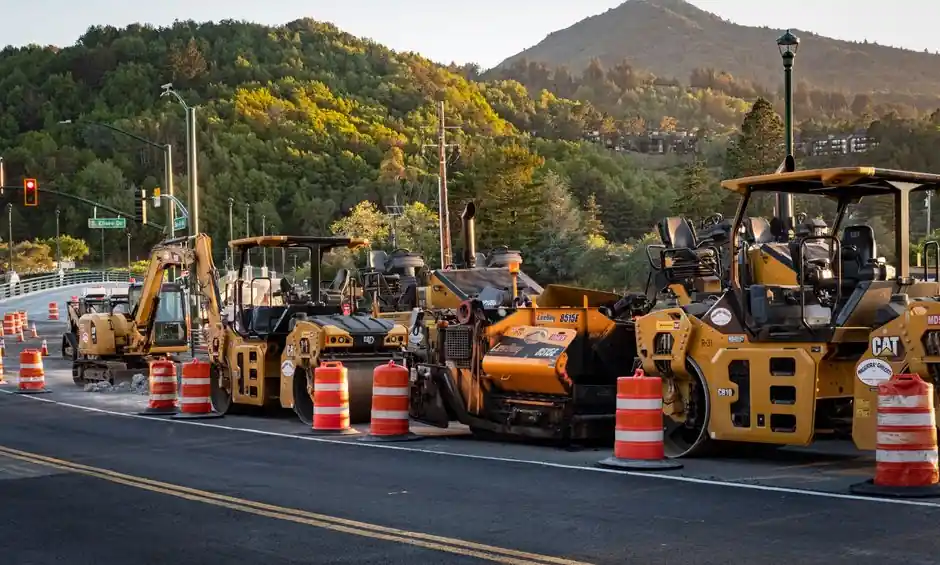
Forestry haul-road resurfacing projects in 2026 are typically specified around tracked asphalt pavers in the 4.5-9 m paving width band, paired with high-clearance receiving hoppers and bolt-on floor plates sized for aggregate-graded mixes [S2][S1].
Asphalt pavers place and pre-compact hot mix asphalt (HMA) in a uniform layer before rolling, and the same machine class is increasingly rented onto logging, plantation, and biomass terminal sites where subgrade is unsurfaced and grades run steep [S2]. For sourcing, global construction-machinery parts suppliers routinely stock undercarriage, auger, conveyor, and radiator components for the dominant OEM brands (Komatsu, Caterpillar, John Deere, Volvo, Liebherr, Sany, XCMG) used on these routes [S1].
Tracked vs Wheeled Undercarriage on Forest Subgrade
Tracked asphalt pavers are the default for forestry work because their steel or rubber-pad track frames spread the machine's operating weight over a longer footprint, reducing ground pressure on wet, rutted, or root-crossed subgrade that wheeled units would shear [S2][S3].
Wheeled pavers remain faster between sections on hard, prepared forest spurs and depot yards, but they require intact, swept surfaces and lose traction once the screed-extended working width exceeds roughly 6 m on loose material [S2]. Most forestry contractors therefore pair one wheeled unit for yard paving with a tracked unit for the in-wood haul road itself. Replacement undercarriage parts, including track rollers, idlers, and sprockets, are commonly listed as aftermarket stock items by parts suppliers serving this market [S1].
Paving Width and Screed Class for Haul-Road Bands
Forestry haul roads are typically paved 4.0-6.5 m wide for two-way truck traffic, which maps to the mainstream tracked-paver class with hydraulically extending screeds rated 2.55-9.0 m, with bolt-on extensions up to roughly 9 m [S2].
For biomass terminals and plantation access tracks, 3.0-4.5 m widths are more common, and a 2.55 m main screed plus extensions is usually sufficient, while main-line forest arterials handling loaded timber trucks with trailers call for 6.0-9.0 m paving passes to keep longitudinal joints out of the wheel path [S2]. Screed-heating systems (electric or propane) are non-negotiable on cold, shaded forest sections because HMA below roughly 120 degrees C tears instead of levels, and screed wear plates, tamper bars, and end-gate heaters are the wear items contractors keep on the shelf [S1].
Hopper, Conveyor, and Auger Build for Crusher-Run Mixes
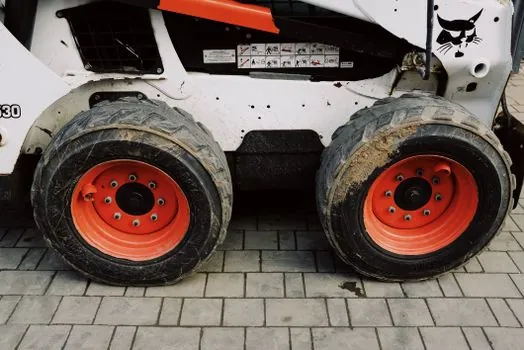
Forest-road mixes are commonly a 0-16 mm or 0-20 mm crusher-run dense-graded HMA, and the paver's receiving hopper, slat conveyor, and auger set must be sized to move that larger aggregate without bridging [S1].
Suppliers list conveyor chains, charging pumps, connecting rods, augers, and floor plates as the high-wear assemblies on pavers running coarse-graded forest mixes, with replacement plates typically specified as 10-16 mm abrasion-resistant steel [S1]. A wider, deeper receiving hopper (commonly 3.0-3.5 m wide) is also preferred so a 20-tonne on-site truck can discharge in a single pass without the truck and paver colliding on narrow forest spurs [S2].
Engine, Hydraulics, and Dust-Tolerant Cooling
Forestry sites expose pavers to fine wood dust, chip fragments, and elevated ambient temperatures in summer, so radiator sizing and air-filter service intervals drive the engine-hydraulic spec more than peak horsepower [S1].
Suppliers stock asphalt-paver air filters, hydraulic filters, radiators, and charging pumps as a distinct service group, and dust loading on forest sites typically forces a 2-3x compression of the OEM's clean-air filter change interval [S1]. Engines in the 75-160 kW band are common across the mid-size tracked class, and the hydraulic loop for conveyor-auger drive, vibratory screed, and track propel is the system most exposed to contamination when fines ingress past worn floor plates [S1][S2]. For a wider view of matching pump displacement and duty cycle to the rest of the machine, see this hydraulic pump selection spec map.
Wear Parts Stocking and On-Site Serviceability
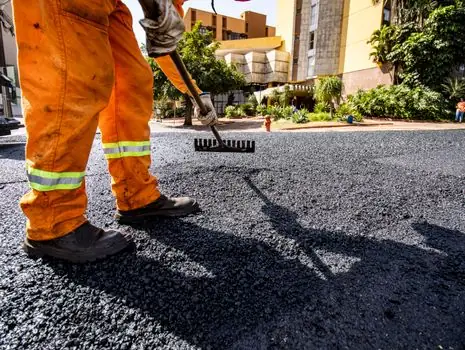
Forestry paving shifts are typically 60-90 km from the nearest OEM dealer, so contractors pre-stock augers, conveyor chains, floor plates, hydraulic filters, and undercarriage parts rather than waiting on a service truck [S1].
Wear parts common to Komatsu, Caterpillar, John Deere, Volvo, Liebherr, Atlas, Demag, Ingersoll Rand, Sany, Zoomlion, XCMG, JCB, Shantui, and Changlin pavers are listed as in-stock by global parts suppliers, with part-number-based inquiries rather than VIN-based, which matters when a contractor runs a mixed fleet across multiple sites [S1]. Bearing sets and connecting rods on the screed's vibratory drive are the next most common failure items after floor plates, because the higher mat thickness typical of haul-road paving loads the vibrator bearings beyond their road-shoulder duty rating [S1].
Sourcing, Standards, and Decision Criteria
Asphalt pavers placed on forest roads are not governed by a forestry-specific product standard, so selection reduces to subgrade bearing capacity, paving width, screed type, hopper volume, and wear-parts lead time, the same five criteria used by roadbuilders, but with the threshold values shifted toward coarser mixes, longer track frames, and heavier floor plates [S2][S3].
For comparison: tracked mid-size pavers (4.5-9 m width, ~75-160 kW) suit unsurfaced forest arterials and steep grades; wheeled pavers (up to 9 m width, similar power) suit prepared depot yards; and mini-track pavers (2.0-4.0 m) suit plantation tracks and cul-de-sac spurs. Across the three, tracked machines score higher on traction and ground pressure, wheeled machines score higher on relocations between paved sections, and mini-tracks score higher on bridge-load limits and tight-radius plantation curves. For context on adjacent off-road paving work, this asphalt paver selection map for mining haul roads and this agricultural-width paver spec map cover the two closest neighbouring duty cycles, while the general asphalt paver reference page defines the machine class and its core sub-assemblies.
Track the next two signals: OEM disclosures of rubber-pad track-frame options for low-bridge forestry corridors, and parts-supplier expansion of pre-stocked floor-plate kits for crusher-run HMA, both of which would shift the cost case for tracked pavers on small-diameter plantation paving.
Spec-level background on the components involved: pressure transmitter, and flow meter.