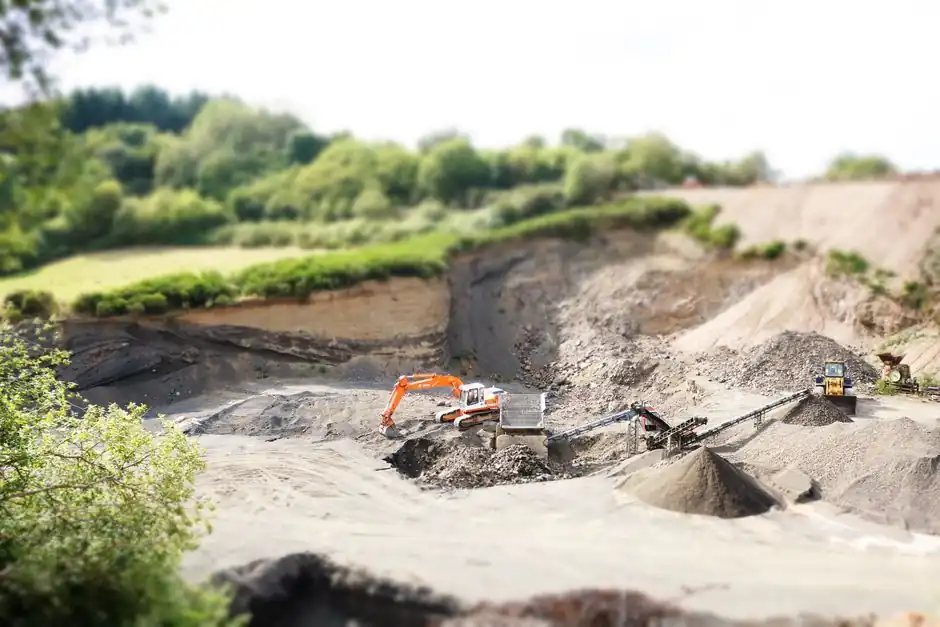
Quarry haul roads, crusher hardstandings and weighbridge aprons are not city streets, so the paver that works for a municipal job usually underspecs them. Specifiers in 2026 should anchor the decision on three quarry-specific variables: sub-base stiffness (often uncompacted blasted rock, not engineered fill), required lane width on tight haul loops, and the mat density needed to survive loaded dump-truck channelised traffic [S3][S4].
The category split is well defined: mini pavers (e.g. Ammann ABG 1570, Vögele SUPER 700i), tracked city/multi-class pavers (ABG 4820/6820, Bomag BF300C-3, Vögele SUPER 1300-3i), highway-class tracked pavers (ABG 7820/8820, Bomag BF800C-3, Vögele SUPER 1900-5i), and wheeled pavers (ABG 4870, Vögele SUPER 1303-3i) [S4]. For quarrying, wheeled units are almost always a wrong choice because of traction loss on loose sub-base [S4].
Quarry duty profile vs paver class
Quarry pavements take a 30–50 t articulated dump truck running in the same ruts for years, so channelised loading and aggressive braking rule out anything below a tracked multi-class or highway-class chassis [S3][S4]. Bomag product manager Henry Polk flagged that contractors working "residential, commercial and some mainline" jobs have migrated toward 10-foot (≈3.0 m) pavers, but quarry mainline paving usually needs more than that: a 4.5–9 m basic screed width with bolt-on extensions covers a full haul-lane plus 0.5–1.0 m overlap in a single pass [S3][S4].
Paving depth in quarry applications also runs thicker than municipal overlays, typically 80–200 mm for new haul-road construction or crusher hardstandings, with thin 30–60 mm resurfacing reserved for repair sections [S2][S4]. That depth range is exactly what the Ammann Duotamp two-tamper screed is rated for (10–20 cm thick lifts, 3–6 cm thin lifts), and the published claim is up to 98% Marshall density before rolling, which materially reduces the compactor train needed behind the paver [S4]. For the wider screed choice, the asphalt paver reference covers bolt-on extension kits and pre-heated screed plates that matter for cold-morning quarry shifts.
Sub-base and traction: why tracked wins
Wheeled pavers (ABG 4870, ABG 6870, Vögele SUPER 1303-3i) are documented to have lower traction and to be unsuitable for soft or uneven bases, which is precisely what a freshly graded quarry sub-base looks like before the first roller pass [S4]. Tracked pavers spread the ≈10–18 t machine mass over a longer track contact length, which on blasted-rock fill keeps the screed floating over a stable mat rather than bridging soft spots [S3][S4].
For a related material-flow comparison, concrete pump truck selection for quarrying discusses the same sub-base conditions for boom-pump outriggers, and the same "no wheeled, no soft pad" logic applies: if the paver cannot keep all four corners of track (or both outrigger pads in the concrete case) on competent ground, mat quality collapses.
Mat temperature and thermal segregation on long haul
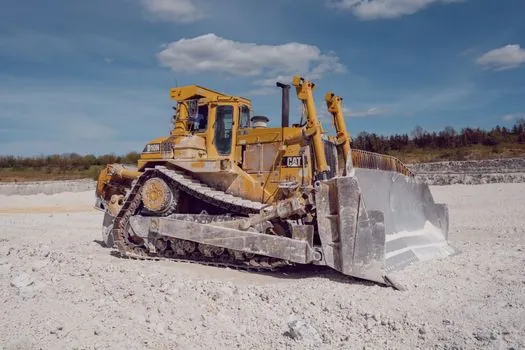
Quarry pavers typically run with longer truck haul distances from the batch plant to the screed, which raises the risk of thermal segregation in the mat, and Bomag's Polk has explicitly tied thermal-spec contracts to non-stop paving or on-site reblending [S3]. Vögele's RoadScan non-contact temperature scanner and the Bomag Cedarapids Remix Anti-Segregation System MTV are documented responses, with the latter using augers inside the hopper to aggressively reblend the asphalt before placement [S3].
The operating consequence is that a quarry paver should be specced with a heated, insulated hopper and either a thermal-imaging option or an on-board reblender, not just bare conveying hardware [S3]. If a contractor is moving between an asphalt plant and a remote pit, the storage rack selection for quarrying article is not directly relevant to paver choice, but the parallel logic of planning for off-grid, long-cycle conditions is, and so is the use of dynamic compactors to chase mat density on thick lifts.
3D paving, automation, and screed compatibility
Vögele's VP Jim Holland said in 2018 that customers were already asking for 3D-machine-control compatibility even when they would not implement it on the first contract, and that pattern has matured since [S3]. Dynapac's SD range of pavers was named in the same article as offering automatic steering, automatic screed-width measurement, and automatic paving-thickness measurement, with 3D paving singled out as critical for airport smoothness specs [S3].
For quarrying, the practical takeaway is different from airports: smoothness is less critical than consistent cross-fall on a curved haul loop, so a 3D-compatible levelling system with a stringline or GPS-based reference is the relevant ask, and screed choice should lean toward a tamper-vibratory (TV) or dual-tamper screed rather than a high-compaction (HV) screed, the latter being overkill at typical 80–150 mm quarry lift thicknesses and harder to keep floating on uneven sub-base [S3][S4].
Selection criteria mapped to paver class
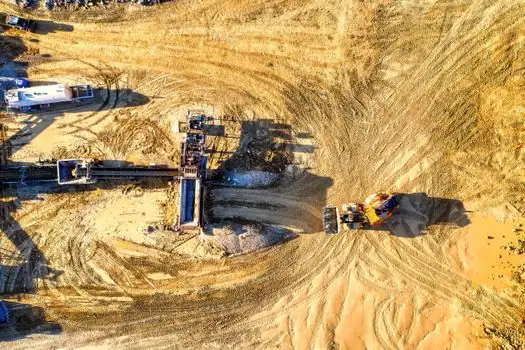
Four criteria dominate quarry paver selection: operating weight class, basic screed width, tamper type, and traction type [S1][S2][S3][S4]. The decision matrix for the four common paver classes in quarrying looks like: mini pavers score 0/1/0/1 (unsuitable on traction, OK on small repair patches), tracked city/multi-class pavers score 2/2/2/2 (the default quarry hauler-yard choice), highway-class tracked pavers score 3/3/3/2 (mandatory for main haul roads and crusher hardstandings, oversized for small patches), wheeled pavers score 2/2/2/0 (excluded by traction on quarry sub-base) [S4].
That matrix maps directly to the published model ranges: Ammann ABG 4820 and 6820 cover city/multi-class; ABG 7820 and 8820 cover highway-class; ABG 4870 and 6870 cover wheeled and are generally excluded for quarry mainline, although they can serve sealed hardstandings on pre-compacted concrete slab [S4]. Bomag, Vögele and Dynapac equivalents follow the same class split (BF300C-3 through BF800C-3, SUPER 1300-3i through SUPER 2100-5X, F80W for mini), so the spec discussion is brand-agnostic at the class level [S4].
Limitations and failure modes to spec against
Three failure modes repeat across the source material and should drive exclusion clauses. First, wheeled pavers on soft or uneven quarry sub-base cause screed drift and uneven density [S4]. Second, mini pavers used on thick (≥80 mm) quarry lifts under-run their compaction envelope and leave the mat dependent on the roller train to make density, which is harder to do on cold patch [S4]. Third, non-stop-paving thermal specs without a reblender or thermal scanner on a long haul from plant to pit will produce cold-streak segregation that later raves under channelised truck traffic [S3].
Quarry procurement should also ask the OEM whether the screed is front-mount or rear-mount, since operators tend to stick with what they know, and regional dealer support on the chosen mount is the practical determinant [S3]. Where a contractor is selecting complementary equipment on the same site, the backhoe loader vs asphalt paver spec match piece frames the prep-and-pave split, and the concrete pump truck selection for quarrying piece is the parallel selection track for structural concrete on the same site.
Two trackable signals to watch on the next procurement cycle: OEM publication of 3D-machine-control retrofit kits for highway-class tracked pavers (Vögele and Dynapac have already named 3D compatibility as an active ask [S3]), and any updated density claim on two-tamper screeds that quantifies pre-roller Marshall percentages for thicker 150–200 mm quarry lifts beyond the documented 10–20 cm range [S4].
Spec-level background on the components involved: pressure transmitter, and flow meter.