A balancing valve meets a piping system's pressure-rating requirement only when three independent ratings are verified together: body shell rating, seat/trim rating, and end-connection rating, each evaluated against the system design pressure at the maximum operating temperature, not at ambient [S2].
Published OEM data on 2026-05-24 and 2026-05-31 shows the HVAC/hydronic market clustered at 16 bar (232 psi) and 25 bar (362.6 psi) brass-body units in DN15–DN50 [S3][S4][S6], while oilfield frac manifolds run 5,000–20,000 psi (345–1,379 bar) on carbon/stainless bodies in 9 in and larger bores [S2].
What "pressure rating" actually means on a balancing valve datasheet
Most published ratings are cold working pressure ratings at ambient; the in-service allowable pressure drops as temperature climbs, and brass-bodied units derate faster than steel-bodied ones because of creep at elevated temperature [S3].
Comparato Nello's SCPV series, published 2026-05-24, lists 25 bar (362.6 psi) as the maximum allowable pressure across a temperature window of 5 °C to 100 °C (41 °F to 212 °F) in DN 15/20/25 [S3]. Taloar's T330, published 2026-05-31, is rated to 300 psi (about 20.7 bar) over -10 °C to 120 °C (14 °F to 248 °F) in DN 0.5–2 in brass [S4]. SIMPLE VALVE's D080-00500 piston balancing valve, published 2026-06-06, holds 16 bar (232.1 psi) for water, oil, and air service in DN 0.5–2 in threaded brass [S6].
For comparison, the balancing valve encyclopedia entry confirms that static balancing valves are static throttling devices, so their pressure drop at design flow must be subtracted from the available system head, not added to the safety margin.
Pressure-class tiers mapped to real plant service
Tier 1: hydronic heating, cooling, and potable water (≤120 °C, ≤16 bar) is dominated by dezincification-resistant (DZR) brass balancing valves with threaded ISO 228/1 or ISO 7/1 Rp ends, Kvs-calibrated orifice, and 40-position handwheel [S2].
Tier 2: HVAC distribution, mid-rise hot water, and light-process (≤100 °C, 25 bar) is covered by 2-way and 3-way motorised PICV (Pressure Independent Control Valve) ball valves in brass with proportional 0–10 V or 4–20 mA control and position feedback [S3].
Tier 3: hydraulic and load-holding (up to 31,500,000 Pa / 315 bar) requires counterbalance or pilot-operated hydraulic valves sized to actuator back-pressure, not to system static pressure [S2].
Tier 4: upstream oil and gas, wellhead, and frac (5,000–20,000 psi / 345–1,379 bar) is served by carbon-steel or stainless frac valves with balanced lower stem, full-bore ports, and API-style end connections rather than threaded brass ends [S2].
These tiers align with how the pressure reducing valve encyclopedia entry frames pressure-class boundaries: each reduction in pressure class lets the specifier use lower-cost materials, but the boundary must be engineered, not approximated.
Interface layers that decide "compatible" vs "fits-on-paper"

Mechanical mounting: thread standard (ISO 228/1 parallel, ISO 7/1 Rp tapered, NPT) and DN/inch pairing must match the mating pipe; a DN 15 (1/2 in) ISO 228/1 parallel port will not seal in an NPT female without an adapter [S2].
Pressure envelope: the lower of body rating, seat rating, and end-connection rating governs; a 25 bar body with 16 bar threaded-end brass nipples is a 16 bar assembly [S3][S6].
Fluid/material compatibility: dezincification-resistant brass is the default for potable and hydronic service; bronze-bodied units are specified where dezincification risk and higher temperatures coincide, and stainless trim is added for glycol, demineralised water, or oxygen-inhibited loops [S4][S9].
Protocol and signal (for motorised PICVs): proportional 0–10 V, 4–20 mA, or 3-point floating control; the actuator datasheet must list the same signal as the BMS or controller output, and the operating time (30/60/120 s for 90° on the SCPV) must be inside the loop's stable-control window [S3].
Where a PICV is paired with a dynamic balancing machine for impeller or fan trim, the valve authority at the design flow must stay above 0.5, otherwise the PICV's pressure-independent behaviour collapses to fixed-orifice behaviour.
Selection criteria when pressure rating is the deciding variable
Define the design pressure first, then add a safety factor (commonly 1.5× for steady service, 2× for surge or water-hammer risk), then derate for maximum operating temperature using the body material curve; do not pick a valve at its ambient rating and assume it survives the hot case [S2].
Cross-check the chosen valve against these four criteria in this order: (a) body pressure class vs system design pressure at peak temperature; (b) seat leakage class vs shut-off requirement; (c) end-connection pressure class vs piping class; (d) actuator torque vs differential pressure at design flow [S3][S4][S6].
For PICV sizing, Comparato's published Kvs range and minimum 360 l/min / maximum 4,000 l/min flow window in the SCPV datasheet must overlap the design flow at the calculated authority; if the design flow falls below 360 l/min, the SCPV cannot be used regardless of pressure rating [S3].
For manual static balancing valves such as the Taloar T330, the published 300 psi and 120 °C ceiling is the limit, not the target; specifying close to the limit forfeits margin against pump overshoot and thermal expansion [S4].
Pair a properly rated balancing valve with a safety relief valve sized to the same design pressure on any branch that can be isolated, because a static balancing valve is a throttling device, not a pressure-relief device.
Use cases from the 2026 manufacturer catalogue
HVAC terminal-unit balancing on DN 15–DN 25 branch lines at 16 bar / 100 °C: brass DZR threaded balancing valves with fixed calibrated orifice and two quick-test points for differential pressure measurement, 40 handwheel positions, memory stop, and digital-manometer compatibility [S2].
District heating sub-stations and building risers at 25 bar / 120 °C: DZR brass double-regulating globe valves in DN 15–DN 50 with 25/16 bar dual-rating, venturi-style flow measurement, and memory-stop handwheel [S2].
Sanitary hot-water recirculation (PWH-C) at 16 bar / 50–90 °C: thermostatic balancing valves in DN 15/20/25 with diaphragm actuation supporting thermal disinfection cycles [S2].
Oil and gas frac manifolds at 5,000–20,000 psi / -75 °F to 250 °F (-59 °C to 121 °C): carbon- or stainless-steel ball or plug valves in 9 in bores with balanced lower stem, API end connections, and continuous high-pressure large-displacement duty [S2].
Process plants running 2026 smart-manufacturing upgrades should reference the broader specialty-chemicals smart-manufacturing spec set when the balancing valve is being tied into a PICV + actuator + BMS loop.
Common pitfalls that pass a datasheet check but fail on site
Pitfall 1: rating the valve at ambient (25 bar cold) and installing it in a 100 °C hot-water loop where the derated allowance is closer to 20 bar; the valve passes the bench test but creeps at the seat over months [S3].
Pitfall 2: matching DN but mismatching thread standard — ISO 228/1 parallel into ISO 7/1 Rp tapered, or metric into NPT — the assembly leaks at test pressure even though both ends are "1/2 in" [S2].
Pitfall 3: specifying a brass balancing valve on a demineralised or oxygen-treated loop; dezincification accelerates in low-mineralisation water and the body can fail well below the mechanical pressure rating [S4][S9].
Pitfall 4: assuming a balancing valve can serve as a shut-off; static balancing valves are not bidirectional bubble-tight shut-offs, and PICVs with 2-way brass ball bodies have a defined but limited close-off differential pressure that drops with size [S3].
Pitfall 5: applying a 16 bar hydronic balancing valve on a hydraulic counterbalance duty at 200–315 bar; the body, seat, and threads are all under-rated by an order of magnitude, and the correct product is a hydraulic counterbalance or pilot-operated valve, not a hydronic balancing valve [S2].
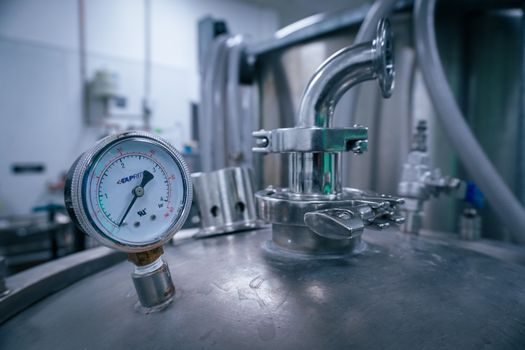
When the spec moves from pressure-class to functional class, the pressure gauge used to commission the valve also has to be re-rated: a 0–10 bar gauge on a 25 bar circuit cannot be used to set the valve at design ΔP because it pins at full scale.
Standards, calibration, and how to verify on receipt
Pressure-rating claims should be traceable to a hydrostatic test standard; on a typical 16 bar / 25 bar brass balancing valve the factory test is shell at 1.5× rated pressure and seat at 1.1× rated pressure, with the test medium and duration stamped on the body or the data sheet [S2][S3].
For field verification, the pressure calibrator used against the balancing valve's test ports should be itself within its own calibration window (commonly 0.05% of reading or 0.1% FS), and the test ports must be the same type as the calibrator fittings to avoid adapter-induced error [S2].
End-connection standards most often referenced in the 2026 catalogue data are ISO 228/1 for parallel threads, ISO 7/1 Rp for tapered threads, and ASME B16.34 or API 6D for the higher-class oil-and-gas valves; valves supplied to one standard should not be mated to piping supplied to another without a documented adapter and re-rating [S2].
Material traceability is increasingly asked for at the PO stage; expect to receive a material test certificate (EN 10204 3.1) for body and trim on 16 bar and above brass units, and full NACE MR0175 / ISO 15156 compliance statements for any valve going into sour-service hydrocarbons, even though the 2026 catalogue excerpts do not always surface the sour-service marking [S2][S4].