Belt conveyors and chain conveyors solve overlapping material-handling problems but are not interchangeable: belts suit light-to-medium bulk and unit loads on continuous, flat-or-inclined paths, while chain conveyors dominate heavy, hot, abrasive, or palletized duty in foundries, paper mills, and automotive lines [S1][S2][S7].
This spec-by-spec comparison is built from current manufacturer data published between November 2025 and August 2026, including Indian system builders, Chinese conveyor component makers, and a paper-line specialist. The goal is to give process engineers a defensible decision matrix, not a feature list.
Operating Envelope: Load, Speed, and Length
Advance Equipment Co. (Thane, India, est. 1992) specifies its standard belt conveyor at load capacity up to 50 kg per unit at 5-60 m/min with AEC 100 friction-driven belt bends for positive transfer, with rollers taking over for heavier loads (precision bearings above 250 kg, pressed bearings below) [S1].
Chain conveyors run slower, typically 0.1-0.5 m/s, because chain pitch limits velocity before vibration becomes destructive, but they accept much higher point loads and tolerate heavier, irregular shapes that would deflect or damage a belt [S2][S7]. For long horizontal runs above 50 m, multiple-drive belt conveyors generally win on energy per ton; for short, steep, or hostile-environment runs, chain pulls ahead on mechanical robustness.
Belt Types and Materials
Belt conveyors split into several families by belt media. Solid woven PVC/PU belts dominate light packaging and food-grade duty at Changshuo Conveyor (Wuxi, China), which lists PVC/PU belt conveyors, modular belt conveyors, and slat-chain conveyors as parallel product lines for the food, pharmaceutical, and lithium-battery industries [S2].
Wire-mesh belts from Bharat Wire Mesh Co. (Mumbai) extend the belt family into heat treatment, with balanced-weave, compound-balance, honeycomb/flat-wire, chainlink, flattened-wire, rod-reinforced, and duplex-weave constructions for sintering, brazing, annealing, and continuous furnaces, plus food processing, freezing, baking, and parts washing [S3]. For higher temperature or open-mesh cleaning duty, see the engineering properties of mesh belt conveyor systems.
For general bulk-material handling across mining, cement, and grain, EP (polyester-nylon) and NN (nylon-nylon) carcass belts with chevron or sidewall cleats from Jiangsu Kezhirun Standard Industrial Inc. handle inclines and abrasive lump ore on long overland runs [S8].
Chain Types and Materials
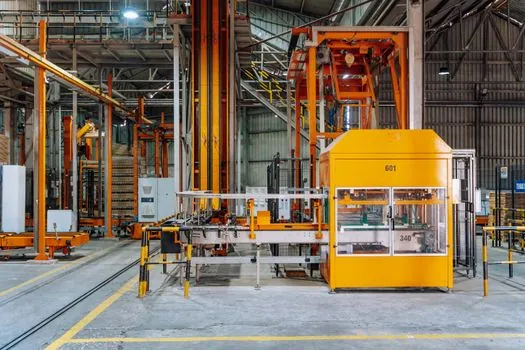
Chain conveyors are not a single product. The main constructions are: roller chain (for pallet and accumulator conveyors), slat chain (wood or metal slats on single/double strand chain, used as a traveling work platform), drag chain or en-masse conveyor (for enclosed bulk), and wire-mesh / chainlink belt (a hybrid of chain drive and woven metal mesh) [S1][S2][S3][S4].
Ningjin Hengsong Chain Conveyor Equipment Co. (Dezhou, Shandong) lists net chain, mesh belt, chain conveyor, chain plate turning machine, and mesh belt conveyor as its main lines, indicating chain-and-mesh hybrid builds are a standard Chinese offering for food drying, washing, and pasteurization [S4]. For an introduction to the working principles and common failure modes, see the chain conveyor reference page. The roller-chain side of the family is covered at roller chain, which doubles as a drive element in many non-conveyor power-transmission systems.
Decision Matrix: Belt vs Chain on Five Criteria
On load capacity, chain wins above roughly 100 kg per unit or for hot parts above 200 deg C, where rubber/PVC belts would degrade; on speed, belt wins for throughput above 30 m/min on continuous duty [S1][S2].
On cleanliness and hygiene, stainless wire-mesh and modular plastic belts win because they survive washdown, while open roller chain collects debris in food lines and needs guarding [S3]. On incline angle, sidewall-cleated EP/NN belts reach 30-90 degrees, and chain conveyors with flights or slats match that, but plain flat belts slip above 15-20 degrees depending on friction coefficient [S8].
On energy per ton, belt conveyors typically run 0.3-0.8 kW per 100 t/h on horizontal runs; chain conveyors run 0.5-1.2 kW per 100 t/h on the same duty, with the gap widening as chain pitch and sprocket count increase. On maintenance, belts are quieter and need only periodic tracking and tension checks; chains need regular lubrication, sprocket inspection, and pin/wear-part replacement at predictable intervals.
Use Cases by Industry
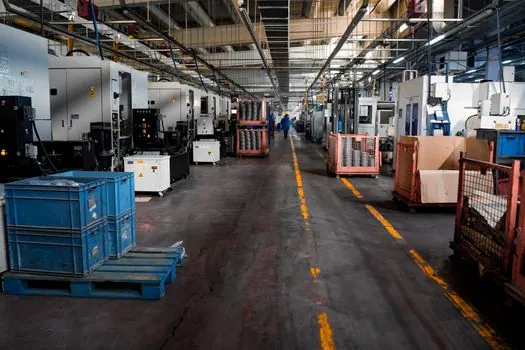
Paper mills use both: the leizhanpulper comparison lists chain conveyors for large conveying capacity, steep inclines, slow stable running, and long service life, while belt conveyors win for high speed, long distance, and low noise on the same paper-recycling line [S7].
Foundries and heat treatment specify wire-mesh belts (balanced, compound-balance, duplex) for sintering, brazing, and annealing because the open mesh survives thermal cycling and allows airflow [S3]. Food and pharmaceutical lines use stainless steel top chains, modular plastic belts, and flexible chain conveyors from suppliers like Changshuo for steamed buns, cosmetics, and mask lines, where washdown and cleanability dominate the spec [S2]. Bulk agricultural handling, including flour, feed, rice, and grain, specifies screw conveyor, chain conveyor, belt conveyor, and bucket elevator as a matched set from suppliers like Zhenjiang AGS Machinery, with equipment exported to more than 30 countries including Thailand, the Philippines, Vietnam, Malaysia, and Indonesia [S5].
Selection Criteria and Failure Modes
Engineers should match the conveyor type to four primary constraints, in order: peak load per unit or per meter, ambient temperature and chemical exposure, required throughput and line length, then available maintenance access and cleanability class [S1][S3][S7].
Common belt-conveyor failures are mistracking, splice failure at the join, carryback on the return run, and cover wear at the loading zone; common chain-conveyor failures are pin wear, sprocket tooth hook, chain elongation past 3% requiring tensioner take-up, and catastrophic backflex on driveshaft reversal. For an overview of how chain and belt systems compare as drive elements, the conveyor chain and belt conveyor reference pages document the standard model patterns.
Manufacturer and Supply Notes (2025-2026)
Indian system builders (Advance Equipment, Bharat Wire Mesh) remain strong in fabricated belt and mesh-belt systems for general industry; Chinese suppliers (Changshuo, Hengsong, Kezhirun, Junling, Zhenjiang AGS) lead in modular plastic chain, flexible chain, and EP/NN textile carcass belts for OEM export [S1][S2][S4][S5][S6][S8]. Suzhou Junling Intelligent Equipment holds ISO 9001 certification and lists chain, roller, and belt conveyors as main products, serving furniture and general manufacturing machinery customers [S6]. The pattern across 2025-2026 is stable: belt manufacturers compete on belt-media variety (PVC, PU, modular plastic, woven wire, EP/NN textile), chain manufacturers compete on chain-type variety (roller, slat, drag, mesh) and on stainless/食品-grade finishing.
For a process engineer sourcing in 2026, two trackable signals to monitor: (1) any supply chain disruption or anti-dumping action on EP/NN textile fabric or stainless mesh, since those raw inputs span the Ferrochrome Supply Chain 2026 of stainless mills; and (2) lead-time and capacity expansion among Jiangsu and Shandong chain conveyor makers, who also supply the agricultural bulk sector covered in the Cold Milling Machine Selection for Farm and Feedlot Resurfacing market.