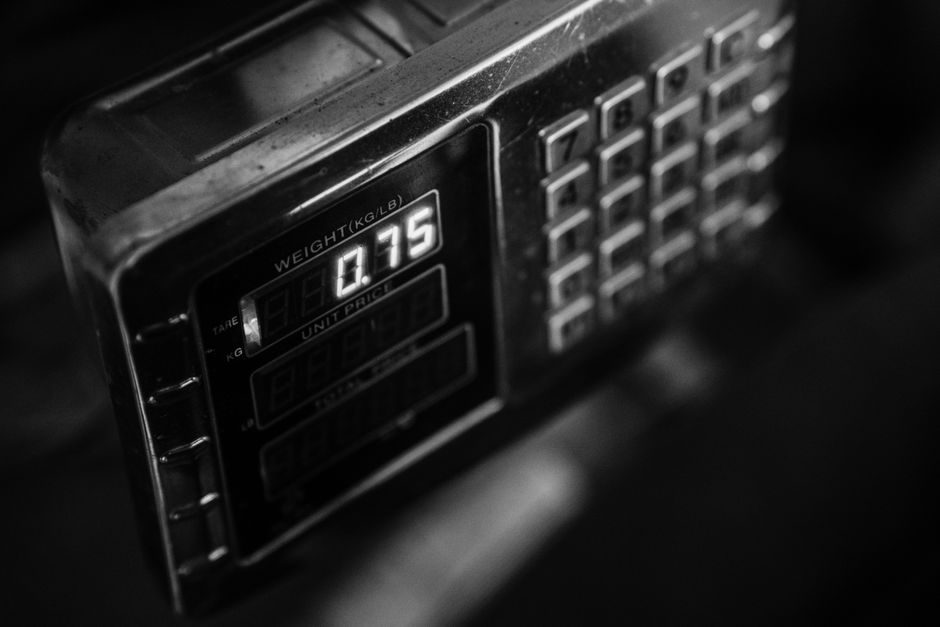
A bench scale tops out around 600 kg on a compact 300–600 mm platform with 0.1 g to 0.5 kg resolution, whereas a truck scale (also called a weighbridge) starts near 30 t and routinely serves 60–150 t vehicle loads on 6–24 m steel decks, and the two products only overlap at the 300–600 kg boundary where the wrong choice costs floor space, accuracy class and certification money [S5].
Both product families sit on the same load-cell + indicator architecture, but the mechanical deck, installation class and verification regime diverge hard above 1,000 kg — picking one for the other's job is the most common 2026 spec error on Alibaba and Made-in-China RFQs, where domestic Chinese shipments dominate 70% of supplier revenue and Southeast Asia 5% [S1].
Capacity, Deck and Footprint
Bench scales are specified by platform size and capacity in a 1:1 relationship: a 300 × 400 mm SS304 pan typically carries 30 kg at 0.001 kg resolution, a 400 × 500 mm pan goes to 150 kg, and a 600 × 800 mm pan is the standard frame for 300–600 kg industrial bench units such as the METTLER TOLEDO dry/dusty bench line with IP65 protection [S5]. Chinese OEM lines out of Jinhua and Fujian push the same envelope with 20-piece MOQs and 3,000 pieces/month supply ability for weighing, counting and platform variants [S2][S6].
Truck scales start where bench scales stop: 6 m single-axle decks for 30 t, 12 m twin-axle decks for 60 t, and 18–24 m multi-module decks for 100–150 t GCW applications. The deck is typically U-beam or I-beam hot-rolled carbon steel, CO2-shielded continuously welded, two-layer epoxy painted, with 700 pcs/year line capacity for typical mid-tier Chinese OEM builds [S4]. For a full cost breakdown by deck length, load-cell count and installation type, see the Truck Scale 2026 Price and Cost Guide — the cheapest variable is almost always the foundation, not the scale itself.
Accuracy Class, Resolution and Indicators
Bench scales are commonly specified to OIML R76 Class II or III with 0.001 kg–0.05 kg verification scale interval (e) and a 6,000–30,000 d max-n, while truck scales are specified to OIML R76 Class III or IIII with 10–50 kg e at 3,000–6,000 d — the accuracy class target is the same standard but the interval is 10,000× coarser because the load is 100–1,000× larger. Stainless indicator housings, IP65 sealing and multi-range auto-switching are now standard on mid-tier 2026 Chinese bench lines; the dust-area bench segment specifically targets IP65 washdown for mill, feed and aggregate environments [S5].
Counting and price-computating indicators are bench-class options you will not see on a weighbridge; conversely, axle-weighing, dynamic vehicle-weighing and traffic-light/red-green ramp interlocks are truck-class features that are mechanical overkill for a 600 kg bench. The same load cell can in principle sit under both, but the platform deflection class, cable shielding and surge protection differ — see the encyclopedia bench scale and encyclopedia truck scale reference pages for the load-cell count and mounting class typical to each form factor.
Selection Criteria: Which One for Which Job

Pick a bench scale when the heaviest single load is under ~600 kg, the item can be carried to the scale, the operator needs 0.1–5 g resolution for counting or batching, and the environment is indoors (IP65–IP68 sufficient). Typical jobs: parts counting in a warehouse, powder batching in food/pharma, retail price-computing, veterinary and parcel scales, and the small end of bagging and filling lines — for the last of those the Filling Scale 2026 Buying Guide covers head type, resolution and material certs that a bench counter alone does not address. [S1]
Pick a truck scale when the load rolls in on wheels and exceeds 1,000 kg, the deck must take a fully-loaded rigid or articulated truck, accuracy of ±0.1% of applied load is acceptable, and the install is outdoors with a pit or ramp foundation. Typical jobs: quarry aggregate outbound, scrap-metal intake, grain-elevator intake, port container weighing, and farm or municipal transfer-station throughput. Do not pick a truck scale for a 500 kg tote job — the concrete civil cost alone is 5–10× the scale cost, and the legal-for-trade resolution will be wasted; conversely, do not put a loaded concrete mixer on a bench scale — see the encyclopedia concrete-mixer-truck for the axle loads a mixer imposes and why a bench frame will fold.
Build, Material and Environmental Ratings
Bench scales in 2026 are dominated by SS304 stainless platforms and frames for food, pharma and washdown environments, with ABS or powder-coated carbon steel for general industrial bench and counting use; load cells are single-point aluminium or stainless, 100–500 kg each, normally a single cell under the pan [S5]. The METTLER TOLEDO dry-bench and dust-bench line ships IP65 sealed, stainless indicator, and a choice of platforms tuned for dusty, dry production halls rather than full wet washdown [S5].
Truck scales are dominantly carbon steel: U-beam or I-beam deck modules welded with CO2 shielding, hot-rust-prepped, two-layer epoxy painted, with bolted access covers over the load cells; high-end or coastal installs go galvanized or even stainless deck at a 30–60% material premium [S4]. Load cells are compression-type, 20–50 t each, four to twelve per deck, mounted in self-centering rockers on the foundation piers. The civil works — pit walls, approach ramps, drainage, lightning and surge protection — typically exceed the scale hardware cost on small (≤30 t) installs.
Limitations and Failure Modes
Bench scales fail by overload shock, water ingress through the indicator keypad, and load-cell zero drift from side-load on a single-point cell — avoid dragging tote bins onto the pan, use the included level foot, and re-verify with test weights every 6–12 months. IP65 is a dry-area rating with splash resistance, not full submersion, so wet fish, dairy and CIP areas need IP66+ or a true stainless sealed bench [S5].
Truck scales fail by foundation settling (re-level annually), moisture in the junction box (use silica gel and surge arrestors), debris under the deck (clean the pit twice a year), and lightning damage to the indicator. The single largest ownership cost on a 2026 Chinese-supplied weighbridge is not the deck — it is the freight, the civil foundation, and the verification/certification by a local metrology officer, which together routinely equal the scale price on a 60 t install.
Supply Chain and Sourcing Signals
Alibaba listings for Chinese scale suppliers show varied market distributions: one complete-scale supplier reports its top three markets as Domestic Market 70.0%, Southeast Asia 5.0%, and Northern Europe 5.0% [S1], while a car-load scale supplier reports Southeast Asia 30%, Africa 30%, and Mid East 10% [S3]. Xiamen Xinsanxin lists 3,000 pieces/month weighing, counting, platform and truck scale supply with a 20-piece MOQ, typical of the mid-tier Chinese OEM that ships to both domestic and export RFQs [S6].
Beware RFQ-only listings with no stated load-cell brand, no OIML/EC type-approval certificate number, and no foundation drawing — these are the three 2026 buying signals most correlated with an under-spec deck, a 6-month warranty dispute, and a failed local verification. For a parallel product-class comparison that applies the same spec-cut logic to mobile work platforms rather than weighing, see the Aerial Work Truck vs Mining Dump Truck spec cut.
Trackable 2026 signal: a) IP66/IP68 stainless sealed bench options are now appearing on the same Chinese OEM lines that were IP65-only through 2024, closing the wet-bench gap with European makers; b) the OIML R134 certificate for automatic rail-weighbridges is being cited more often on truck-scale datasheets even for non-rail installs, indicating a tightening of legal-for-trade posture across Southeast Asia and Middle East export lanes.