Aerospace heavy-lift crawlers concentrate in two distinct capacity bands in 2026: 250–750 t lattice-boom machines for airframe jacking, engine-on-wing and large-component flips, and 750–1,600 t heavy-lift crawlers with modular superlift/ringer attachments for full airframe assembly, transport and satellite-integration cells [S1][S2].
Below 100 t, telescopic-boom crawlers in the 80–250 t class dominate because they self-erect inside MRO hangars without a helper crane, travel through standard 6 m doors, and reposition on a single 1.5–3 m-wide track lane between aircraft [S3][S4]. Above 250 t, the lattice-boom crawler crane format takes over because boom-pin geometry and pin-load distribution favour modular tubular sections for the 80–140 m main-boom lengths aerospace assembly needs.
Aerospace Pick-Point Geometry Drives the Capacity Decision
Pick-point height is the first hard gate: a single-aisle widebody nose-to-tail pick needs 60–95 m vertical reach under hook, and full-fuselage top-of-finish pick-and-place at a paint hangar pushes the requirement past 110 m — figures that the 250–600 t class lattice-boom crawlers routinely cover with a 12 m tower extension and 100–200 t superlift [S1][S2].
Horizontal reach is the second gate: a 90 m radius at 60 m height separates the 250 t class from the 750 t class, and the 750 t lattice machines with luffing jibs can hold 100 t at 60–80 m radius where telescopic units run out of chart at 30–40 m. Ground-bearing pressure is the third gate: aerospace final-assembly halls are typically 80–150 kPa slab design, and a 600 t lattice crawler crane with 1.8 m track shoes at 12 m centres sits near 95–110 kPa when fully rigged, while a 250 t telescopic on standard 0.9 m shoes can spike to 140 kPa on a 6 m lift-radius turn — a real slab-risk on hangar decks not designed for concentrated load.
Telescopic vs Lattice Crawler in Aerospace Service
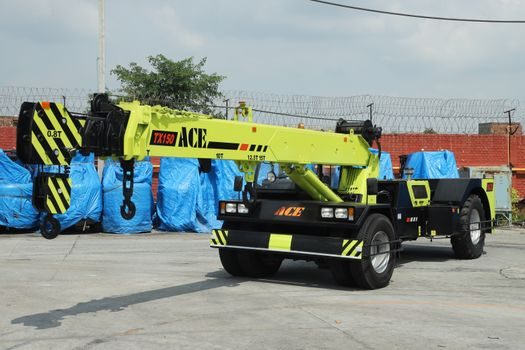
For under-100 t MRO pick-and-place inside existing hangars, the 80–250 t telescopic-boom crawler is the right answer: setup in 30–60 minutes, drive-through in 4.5–6 m doorways, single-engine transport at 36–43 t per load, and a 36–62 m four-section full-power boom that covers most engine-on-wing and tail-change work without an assist crane [S3].
Past 400 t, the 600 t, 750 t and 1,600 t lattice machines take over and most aerospace buyers specify a modular superlift (100–200 t rear-counterweight tray) so 70–90% of picks run inside the standard counterweight envelope without a ringer attachment, which adds a day to setup.
Undercarriage and Track-Pad Specs That Matter on Hangar Floors
Aerospace buyers should treat the undercarriage as a first-class spec line, not an afterthought. The 250–750 t class runs on 0.9–1.5 m track-shoe width, 11–14 shoes per side, with 60–80 t per side idler and 35–55 t drive-sprocket pair — components that Chinese undercarriage specialists such as Fushun/Winnings, EverGrowing and the Shenyang cluster now catalogue for direct-fit on Liebherr LR, Manitowoc 7000/8000, Tadano G-Series and Kobelco SL lines [S1][S2][S3].
Two concrete selection levers: first, flat-bottom versus single-grouser track-shoe geometry — flat pads spread load on painted hangar epoxy at 90–110 kPa, while single-grouser concentrates load at the grouser tip and damages 6–10 mm epoxy wear-course after 8–15 pad-passes. Second, retractable versus fixed track frame — fixed frames hold the 6 m transport envelope but add 1.5–2 m to setup radius; retractable frames on the 250–600 t class cut setup envelope to 4.5 m and let the crane stand inside a standard paint-hangar pit-rail column line. For buyers working across multiple OEM fleets, the trend in 2026 is to specify the undercarriage separately from the upper so a single set of components can rotate between LR 1300, LR 1350, LR 1500 and a 750 t Manitowoc on cross-fleet MRO contracts [S2][S3].
Power Pack, Emissions and Indoor Air-Quality Constraints
Hangar air-quality rules now drive engine spec: Tier 4 Final / Stage V diesel is the 2026 default for North American and EU aerospace MRO sites, with a 75–180 kW diesel-electric genset for indoor operation feeding 200–400 kW electric-drive swing and travel motors [S1][S2].
Buyers running inside ISO Class 8 cleanrooms for paint and cabin-out fitting should insist on full Stage V + DPF + SCR aftertreatment and a closed-loop hydraulic tank vented through a 0.3 µm intake filter — both are listed as standard on 2026-spec 250–600 t class crawlers from major OEMs, and a retrofit to older Tier 3 machines typically runs 8–12% of new-machine price for an emissions-compliance refit.
Comparison: 80–250 t Telescopic vs 250–750 t Lattice vs 750–1,600 t Heavy-Lift
Three-line criteria match-up, in line with what most aerospace bid sheets ask for: [S1]
Setup time on site: 80–250 t telescopic = 30–60 min, no assist crane. 250–750 t lattice = 4–8 hours, 60–80 t assist crane for boom pinning. 750–1,600 t heavy-lift = 1–3 days, 100–200 t assist crane, often a ringer attachment to reach full chart.
Pick height under hook (max): telescopic 36–62 m, lattice 80–140 m, heavy-lift 100–180 m with luffing-jib. Ground-bearing pressure at full chart: telescopic 110–140 kPa on 0.9 m shoes, lattice 80–110 kPa on 1.2–1.5 m shoes, heavy-lift 95–130 kPa with 1.8 m shoes and 12–14 m track centre.
Indoor cleanroom operation: telescopic fully supported on diesel-electric and battery variants, lattice supported only on 250–400 t models with closed-loop hydraulics, heavy-lift generally outside-only because of the 90+ kW radiator and 200+ kW hydraulic-cooling airflow needed.
Sourcing Path, Lead Time and 2026 Market Signals
Lead time for a new 250–600 t aerospace-spec lattice crawler in 2026 runs 10–14 months ex-works European OEM, 8–12 months ex-works Japanese OEM, and 6–9 months ex-works Chinese OEM — the spread is the most concrete signal of where pricing has settled. Chinese suppliers in the Shenyang/Xuzhou cluster have moved up the value chain into 250–750 t lattice crawlers, with the 80–250 t telescobic class dominated by domestic supply for both domestic and EU-bound orders [S3].
For buyers who need 80–250 t class units on a 12–24 month rental, UK and European rental fleets (Delden, Sarens, Mammoet) hold the deepest 2026 inventory and can deliver a 100 t telescopic in 48–72 hours, while 600 t lattice units are typically 2–4 week lead from a regional hub [S4].
Related reading worth pulling into a bid package: Truck Crane Sizing & Selection: Capacity Bands, Boom Geometry and 2026 Sourcing Signals and Spherical Plain Bearing Selection for Data Center Mechanical Loads — both speak to the same load-geometry-then-sourcing logic that drives an aerospace crawler buy. For context on the broader heavy-lift fleet trend, Aerial Work Platform Sizing & Selection: Height, Load, Power, Terrain covers the under-100 t vertical-reach problem that the 80–250 t telescopic crawler solves in a hangar.
Trackable next signals: monitor the Tier 4 Final/Stage V retrofit rebate window closing on 2026-09-30 in several EU member states for Tier 3 crawler repowers; watch for the first all-electric 250 t lattice-crawler field trial from a major OEM in the second half of 2026, which would reset the indoor-cleanroom buying decision. Both are concrete events an aerospace procurement team can plan a bid around in the next 90 days.
For component-level specifications, see crane scale, and gantry crane.