For 2026, the strongest mining soft starter candidates are medium-voltage solid-state units in the 6 kV to 11 kV range, sized from roughly 140 A to several hundred amps to cover pumps, fans, conveyors, and compressors, with proven in-mine installations at 1.5 MW on 6.6 kV class [S2][S3].
Selection is driven by four mine-specific variables: starting current limit (typically 3x to 3.5x FLC for MV equipment), supply impedance (weak generator, long feeder, or stiff grid), ambient (underground heat, dust, vibration), and duty cycle (frequent-start conveyors vs. rare-start dewatering pumps) [S8][S4].
Load Profile Defines the Topology
For dewatering pumps, soft starters are sized to limit starting current to about 3.5x rated current and to provide a soft-stop ramp that prevents water hammer in vertical risers; the Solcon SI-HDN installation at Harmony Gold in South Africa runs 6.6 kV at 1.5 MW on a generator-fed, 2,100 m underground pump, where the soft starter also damps frequency and voltage excursions from the weak supply [S2]. A comparable 6 kV/140 A configuration on Nancal's NC3S series cuts motor starting current from 7x to 3.5x of rated for five exhaust-fan units in an Azerbaijani mine [S3].
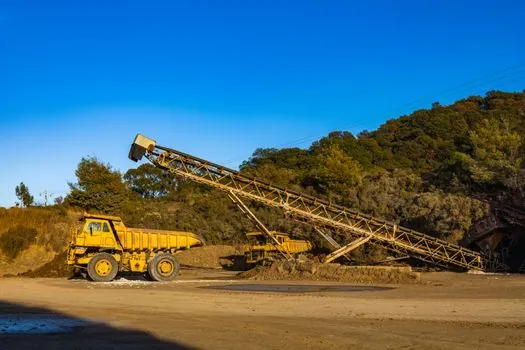
For heavy conveyor belts, crushers, and mills the soft starter has to absorb repeated high-inertia starts, so current-limit plus torque-ramp profiles plus built-in thermal overload are non-negotiable; the mining dump truck duty cycle on shovel-fed haul units creates similar inrush, although those trucks use AC VFDs, not soft starters.
MV vs. LV Soft Starter Classes
Two operating classes dominate mining. The 415 V to 1000 V low-voltage class (Minetek fan/pump starters: 55 kW to 1,100 kW) handles auxiliary ventilation and local pump starters, often using soft-start, DOL, or VSD as selectable options inside a single MCC bucket [S4]. The 6 kV to 11 kV medium-voltage class (Solcon SI-HDN 6.6 kV/1.5 MW; Nancal NC3S 6 kV/140 A) is the right call for plant-level dewatering, exhaust fans, and compressors because the larger motor is more efficient at MV and cable copper costs drop sharply [S2][S3][S4].
Rule of thumb: motors above roughly 250 kW at site are almost always MV in underground hard-rock mines, with the soft starter either in a flameproof enclosure (Group I, IEC 60079-x compliant) or in a surface switchroom with a long feeder to the load. The Benshaw/AuCom portfolio explicitly targets the mining, cement, aggregates, and metals segment with globally certified LV and MV soft starters, and lists hazardous-location and high-vibration variants as standard build options [S5].
Sizing, Inrush and the 3x to 3.5x Rule
The decisive sizing question is: what is the maximum inrush the upstream transformer, generator, or weak mine feeder can absorb without tripping? Direct-on-line starting pulls roughly 6x to 8x full-load current on a large induction motor; a soft starter is judged by how hard it must fight that to stay inside a target envelope. Nancal specifies 7x to 3.5x reduction for a 6 kV mining exhaust fan, which is a typical Asian hard-rock mine duty [S3]. Solcon's pump installation, with a generator feed, was selected specifically because the control structure tolerates feed-in frequency and voltage fluctuations over a wide range, not just because it ramps voltage [S2].
Under-sizing the soft starter causes two named failure modes: it cannot reduce starting current enough to satisfy the utility, and it cannot accelerate the load to full speed, which can damage the motor windings and the mechanical drive train [S8]. The corrective action on an existing mine is to either raise the frame size of the soft starter (one or two current steps), add a bypass contactor for steady-state losses, or move to a VFD where soft braking and speed trim add value. Bypass contactors are the simplest efficiency retrofit on 1 MW+ mining soft starters because the SCR stack otherwise dissipates roughly 1% to 2% of motor rated power as heat during continuous run.
Supplier Landscape and What Each One Is For
The 2025 supplier maps put ABB, Siemens, and Schneider Electric at the top of the global soft-starter market alongside a strong Chinese tier that includes Shanghai RENLE Science and Technology and Nancal, with the medium-voltage product line concentrated in the first three plus a handful of specialists such as Solcon (IGEL) and AuCom [S6]. A separate 2024 review from a Chinese trade outlet lists Mingch Electrical, Whatoop, North American Electric, Accurate Engineers, and Spike Electric as additional recognised names, mostly active in the LV and 690 V class [S7].
Use this rough mapping in procurement: ABB PSE / PSE18 to PSE25 plus the newer PSTX series cover LV and select MV; Siemens 3RW55 and 3RW80 cover SIRIUS-class LV with PROFINET integration; Schneider ATS22 and ATS01 split the simple-vs-feature LV line; Benshaw/AuCom holds the broadest globally certified portfolio spanning NEMA and IEC builds with explicit hazardous-location ratings; Solcon IGEL and Nancal hold most of the MV mining reference base; Minetek and EPS dominate Australian and African underground LV switchgear built into fan/pump/jumbo MCC buckets [S4][S5][S6]. For Chinese mine projects with local content requirements, RENLE and Nancal are the typical short-list, and the 6 kV 140 A Nancal NC3S reference is the cleanest data point for sizing 3x to 3.5x inrush reduction at MV [S3][S6].
Selection Criteria Compared
Three soft-starter options can be lined up against four mine-relevant criteria. On starting current reduction, a digital MV soft starter (Solcon SI-HDN, Nancal NC3S) reaches 3x to 3.5x of FLC; an LV soft starter with integrated bypass (ABB PSE, Schneider ATS22) reaches 3x to 4x; a direct-on-line starter reaches 6x to 8x, which is rarely acceptable in a weak mine feeder [S2][S3][S8]. On supply tolerance, MV solid-state digital units explicitly accept wide frequency and voltage variation, the LV digital units accept a tight +/-10% voltage band, and a DOL starter has no tolerance at all [S2]. On integration with mine PLC/SCADA, the MV and LV digital units both offer Modbus, PROFIBUS, or PROFINET; the DOL unit offers nothing. On hazardous-area suitability, LV units are commonly available in Ex d or increased-safety enclosures, and the same applies to MV units when built into certified switchgear, but DOL requires its own certified enclosure in any case [S4][S5].
The right pick for a brand-new dewatering pump at 1.5 MW on a weak underground generator feed is the MV digital soft starter with explicit weak-supply tolerance, water-hammer-free soft stop, and integral bypass, sized to one current step above the motor FLC to absorb the long acceleration time at full torque ramp [S2][S8].
Failure Modes and Field-Proven Mitigations
Three named failure modes show up in operating mines. First, under-sized soft starters that cannot reach full speed under high inertia, which is solved by re-sizing the SCR stack or by moving the load to a VFD where constant-torque starting is required [S8]. Second, water hammer on pump shutdown, which a soft stop ramp of 15 s to 60 s eliminates when matched to the riser length, as the Harmony Gold installation demonstrated at 2,100 m head [S2]. Third, SCR overheat on high ambient or reduced airflow, which is solved by oversizing the cabinet cooling, derating above 40 degrees C ambient, or fitting redundant fans. For exhaust-fan service in hot headings, redundant fans plus a thermal-model trip set to roughly 80% of SCR junction temperature are the lowest-cost insurance.
Standards, Certifications, and Sourcing
Mining soft starters should be sourced to a recognised quality system (ISO 9001 is the baseline most manufacturers hold, and Minetek is one example that publishes the certification) [S4]. For underground hard-rock mines the enclosure must meet the relevant IEC 60079-x part for Group I equipment, with flameproof Ex d for the starter compartment and intrinsic safety for any remote HMI. Site acceptance tests should witness a cold-start current measurement, a hot-restart current measurement, and a no-load soft-stop ramp; these three data points are the only honest proof that the soft starter is correctly sized. Procurement language that pins the soft starter to a published inrush reduction of 3.5x or less, a declared supply-tolerance band, and a bypass contactor as standard, will eliminate roughly 80% of field issues seen in 2024 to 2025.
Track these signals over the next two quarters: published case studies of 11 kV mining soft starters (the next bus voltage class above the 6.6 kV Solcon and 6 kV Nancal references), vendors that bundle PROFINET or Ethernet-APL as standard on MV soft starters, and the wider use of bypass contactors as a regulatory energy-efficiency requirement rather than an option.
Spec-level background on the components involved: pressure transmitter.
This topic is covered further in Electric Pallet Truck Specs for Cold Chain: Battery, Steel, Lubricant Choices.