
For tunnel construction in 2026, theodolite selection collapses to four engineering gates: angular accuracy, EDM range, environmental rating, and a data path that the shift surveyor can actually use [S4]. The 1″–2″ band, 2,000 m+ prism EDM, IP65+ housing, and absolute-encoder tilt correction are the dominant procurement filters for shield, NATM and metro drives [S4].
Segment-uplift analysis on water-rich shield drives, published in Nature Scientific Reports in 2026, shows that grout buoyancy and groundwater migration can push lining segments past code-permissible deformation limits when monitoring instruments lack sub-arc-second repeatability [S2]. A theodolite used to set ring attitude and re-verify after every shove is part of the control loop, not an accessory.
Why tunnel work forces the accuracy class up
Tunnel alignment, by definition, accumulates angular error over distance. A 5″ instrument reading at 100 m can carry roughly 2.4 mm of lateral drift per setup, and across a 1.5 km drive with frequent setups that error compounds against ring tolerance [S4]. 1″ and 2″ electronic theodolites, with absolute encoders and dual-axis tilt sensors compensating in a ±3′ (≈ ±0.05°) range, are the realistic floor for metro, high-speed rail and shield-tunnel control traverses in 2026 [S4].
The theodolite class sits inside a wider construction-toolkit that also includes total stations, levels and laser scanners; for tunnel-only work, the theodolite's role is the angle leg of a traverse, not full coordinate capture, which is why 1″–2″ is preferred over cheaper 5″–6″ kits for metro and rail [S3][S4].
EDM range and reflectorless behaviour underground
Modern electronic theodolites ship with integrated EDMs that hit 2,000–3,500 m on a single prism, 5,000 m+ on a triple prism, and 200–600 m reflectorless on a white target, which is what gets specified into a 2026 tunnel-survey tender [S4]. Inside the tunnel, however, the controlling figure is short-range reflectorless: 200 m non-prism is enough forepis (concrete-pour) and rib set-out, while long drives use a prism on the back-sight and the face.
Beam divergence in the 0.3–1.0 mrad class is typical for prism EDMs in 2026, and sub-0.5 mrad divergence is the spec to insist on for long stakeouts where walk-up of a prism is impractical [S4]. Field-adjustable prism constants (0 mm and −30 mm standard, plus user-entered values for non-OEM prisms) are non-negotiable on 1″/2″ units, and an integrated pressure/temperature input or ppm-correction channel separates a clean deformation read from a compromised one [S4].
Ingress, temperature and the tunnel-mouth environment
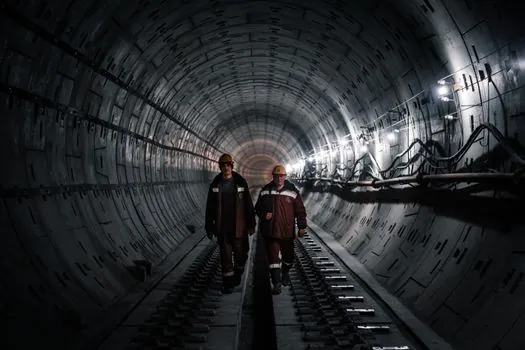
IP54 is the floor for any outdoor theodolite in 2026; IP65 or IP66 is what should appear in the tunnel-mouth, monsoon-region and coastal shaft spec [S4]. The IP rating maps directly to the failure modes the field actually reports: dust ingress on the keyboard and condensation on the objective in cold/warm swing conditions, both of which knock an unprotected unit out inside one shift.
Operating temperature window on survey-grade units is typically −20 °C to +50 °C, and tunnel-mouth air in cold-region or desert drives can hit either extreme within a single day, so the vendor's confirmed window at the limits is the line item to verify before award [S4]. For deeper context on how survey instruments fit into the wider construction tools chain, the environmental class is treated as a primary gate, not a footnote.
Optical vs electronic theodolite: which one survives tunnel work
Optical theodolites without EDM are still specified for cadastral and education work in 2026, but they are a poor fit for tunnel construction because they cannot drive a face set-out without a separate distance device [S3][S4]. Vernier and micrometer optical theodolites are essentially absent from new metro tenders, and electronic theodolites with digital readouts and data-logging integration are the prior choice for contemporary surveying tasks [S3].
A practical 2026 selection for a tunnel package is: 1″ electronic theodolite with absolute encoder and dual-axis tilt for the control traverse and segment-uplift monitoring loops; 2″ electronic theodolite with integrated EDM for daily ring and invert set-out; 5″–6″ unit only for bulk earthworks at the portal and temporary-works volumetrics [S4]. This three-tier split is closer to how metro and shield-drive surveyors actually deploy instruments across a shift.
Comparison: 1″ vs 2″ vs 5″–6″ theodolite for tunnel work
Decision matrix for a 2026 tunnel procurement, on four criteria that drive the buy: [S4]
Angular accuracy: 1″ best (≈0.5 mm/100 m lateral), 2″ good (≈1.0 mm/100 m), 5″–6″ only fit for bulk earthworks (≈2.4 mm/100 m) [S4]. EDM range: 1″ and 2″ both support 2,000–3,500 m single-prism, 200–600 m reflectorless; 5″–6″ often ships with shorter EDMs or none [S4]. IP rating: 1″ and 2″ in IP65/IP66 housing are available, 5″–6″ commonly IP54 only, which is a reject for tunnel-mouth and monsoon shafts [S4]. Encoder class: 1″/2″ near-universally absolute-encoding with dual-axis tilt, 5″–6″ can still be incremental on cheaper optical units [S4].
Failure modes and what gets rejected on tender
The most common procurement error on tunnel packages is specifying a 5″–6″ instrument for control-traverse or segment-uplift loops, where the 2.4 mm/100 m class error puts ring attitude outside tolerance over a 1.5 km drive [S4]. A second failure mode is buying an IP54 unit for a monsoon-region or coastal shaft: dust and condensation failures on the encoder housing and EDM optics dominate the field-repair tickets and the tender clause should be reworded to IP65 or IP66 [S4].
A third failure mode is pairing a 1″ theodolite with a non-OEM prism without verifying a field-adjustable prism constant; an uncompensated −30 mm constant error can push a 1 km traverse off by several millimetres, which the control-survey QA loop will catch but the daily set-out will not [S4]. The link to the broader construction machinery and equipment procurement chain matters here, because the theodolite is the angle leg, not the whole survey solution.
Workflow integration and what the shift surveyor actually needs
Absolute encoders retain angle on power-down, which removes re-initialisation on every setup, a tangible productivity gain on multi-setup tunnel days [S4]. Dual-axis tilt sensors on 1″ and 2″ units report the tilt-corrected angle directly to the face display so the operator does not apply corrections by hand, which is the difference between a clean deformation read and a compromised one in a tight shift window [S4].
For a metro shield drive, the realistic kit is one 1″ theodolite reserved for the control traverse and segment-uplift re-checks, one 2″ unit with EDM for daily ring and invert set-out, and a 5″–6″ unit at the portal for muck-volume and earthworks checks; this is the same tiering that shows up in working metro tenders in 2026 [S4]. A related spec walkthrough for adjacent site work is given in demolition theodolite specs for 2026 site cuts, and the indoor-finishing counterpart is covered in theodolite selection for interior finishing.
Track for 2026 H2: any metro or shield-tender clause that accepts 5″–6″ instruments on control traverses, and any shift-survey kit where the IP rating is left at IP54 for a monsoon or tunnel-mouth site. Both are visible in published tender documents and are the cleanest signals that a project is over-spec'd on the cheap or under-spec'd on the environment.