On a bulk-handling line, the bucket elevator and the screw conveyor are the two most-commonly specified units for moving dry bulk, yet they rarely compete head-to-head: the elevator is a vertical continuous bucket carrier typically specified for lifts above 5–8 m, while the screw conveyor is an enclosed rotating helix normally limited to inclines under 20–45° and lifts under 6–9 m [S1][S2][S7].
Supply-side data from 2026 shows both types bundled in the same vendor catalogs — AGS Machinery ships screw conveyor, chain conveyor, belt conveyor and bucket elevator to 30+ countries, while Dahan (luoxuanshusongji.cn) lists screw conveyors, belt conveyors and bucket elevators in a single product tree [S2][S7]. That co-listing is a useful signal: buyers compare them on the same RFQ, and OEM line-card groupings reflect which jobs they actually win.
Core Operating Envelope: Lift, Angle, Capacity
Bucket elevators are the default spec for straight-vertical dry bulk lifts from roughly 5 m up to 60+ m, with industrial units (e.g. AUMUND) engineered for "high conveying capacities, long service lifetime and low operating costs" in cement, clinker, and aggregate service [S5]. Throughput ranges widely because it scales with bucket size, belt/chain speed (typically 0.5–1.6 m/s on industrial units), and casing cross-section — small grain elevators handle tens of t/h; large cement-plant centrifugal-discharge units exceed 400 t/h. The vertical-only geometry is the hard constraint: any horizontal run is handled by a separate belt conveyor feeding or discharging the boot.
Screw conveyors are enclosed rotating-helix units that work in horizontal, shallow-inclined (typically up to 20° for plain troughs, up to 45° with ribbon or special flighting), and short vertical configurations. Dahan's tube-screw and vertical-screw-feeder variants are explicitly marketed for "limited space applications, small chips, various types of material, and wet or dry applications" — and the standard "screw feeder is also called screw elevator" caveat is the rule of thumb: a screw is a feeder-grade vertical lifter, not a long-haul elevator [S6][S7]. Practical lift ceilings sit at 6–9 m for production units; beyond that, the hanger-bearing and deflection problems start to dominate.
Capacity rules of thumb from current vendor data: a 3000 mm-length Ls3000 SS316 screw conveyor is listed at FOB US$2,000–30,000 per piece in 2026 [S1] — a price band that scales with diameter, length, pitch, and SS316 vs carbon-steel construction. Bucket-elevator price points are equally wide because the equipment scales with lift height, capacity, and casing type, but the cost driver is almost always steel mass × height × drive HP.
Material Suitability: Particle Size, Moisture, Abrasiveness
Bucket elevators handle coarse, free-flowing, low-moisture bulk: grain, clinker, cement, fly ash, aggregate, fertilizer prills. They tolerate lump sizes up to the bucket mouth and discharge cleanly by centrifugal or positive-discharge geometry at the head pulley. The downside is that they are essentially open-cased — a problem for dusty, hot, or hygroscopic materials where leakage, dust ignition, or moisture pickup matter [S5][S8].
Screw conveyors carry fine powders, granules, pastes, wet or oily sludges, and even chips because the casing is fully enclosed, which is why Dahan markets them as the "first step to removing chips from the machining area" [S7]. They also handle mildly abrasive materials when flighting is hard-faced or replaced with abrasion-resistant steel. The trade-off is particle size: a screw cannot move large lumps without crushing them or jamming between flight and trough, and very fluid or sticky materials can wrap the flight and stall the drive.
A 2026 vendor line-card distinction worth flagging: Hongyuan Vibration Equipment bundles vibrating screens, grain cleaners, bucket elevators, belt conveyors and screw conveyors under one roof at 200 sets/month supply capacity [S4]. That product mix mirrors the typical grain-milling line — bucket elevator for the vertical leg, screw conveyor for the horizontal/dosing transfer — and is the cleanest real-world example of how the two machines split a single material flow.
Layout, Footprint and Drive Sizing
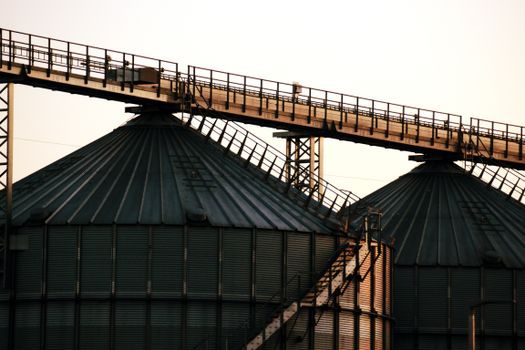
A bucket elevator occupies a small horizontal footprint but a tall vertical envelope; a screw conveyor occupies a long horizontal envelope and almost no vertical height. On space-constrained plant retrofits, this single fact often decides the spec. AGS Machinery's product range explicitly addresses this: the screw conveyor handles the horizontal mill-floor runs, while the bucket elevator handles the bucket-lift leg in a multi-storey flour, feed, or rice mill [S2].
Drive sizing differs in kind. Screw conveyors scale with diameter, rotational speed (typically 30–150 rpm for industrial units), and material-specific horsepower factors; a 300 mm diameter screw at 60 rpm in dry grain may draw 2–3 kW, while a 500 mm diameter unit in wet sand can draw 15+ kW over a 20 m run. Bucket elevators scale with mass-flow × lift height, and the head-pulley drive is typically sized for the full lift work plus bucket-pickup losses. AUMUND markets "high conveying capacities … low operating costs" specifically because the bucket geometry is gravity-assisted on the return side, which keeps specific power (kWh per tonne-metre) competitive at large lifts [S5].
For very small-lot and short-haul jobs, both types are available in mini-form factors. Dahan's "small screw conveyor systems" and Hongyuan's compact bucket-elevator units target the sub-1 t/h grain and feed-mill segment where standardization, not custom engineering, drives the spec [S4][S7].
Standards, Construction and Maintenance Boundaries
Bucket elevators in cement and mineral service are typically designed against ISO 9001 QA programs and OEM internal load/duty classifications; AUMUND's published product range references its own test regimes rather than a single ISO bucket-elevator standard. Material grades track application: mild steel for grain, SS304/SS316 for food and chemical, AR-plate for abrasive clinker. Construction is heavy — head section, boot section, casing, buckets bolted or welded to belt/chain, with take-up at the boot [S5][S8].
Screw conveyors have a deeper published standards base: CEMA (Conveyor Equipment Manufacturers Association) in North America and ISO 7119 / DIN 15261 in Europe cover the geometry, hanger-bearing spacing, and capacity calculation. Xinxiang Hongyuan and Dahan ship SS316 and carbon-steel variants on the same frame, with flighting options including ribbon, paddle, and shrouded types for sticky or fluid service [S1][S4][S7]. Hanger bearings every 3 m or so, removable covers for clean-out, and end-bushing or mechanical seal options at the drive end are the typical construction variables that show up in a 2026 RFQ.
Maintenance profiles diverge sharply. Screw conveyors wear at three points: flight edges, trough liners, and hanger bearings — all field-replaceable on a standard unit. Bucket-elevator wear is concentrated at buckets, belt/chain splices, head-pulley lagging, and boot take-up; a worn bucket or a stretched chain is a longer-outage repair because of the vertical geometry. For a 24/7 plant, the screw conveyor is usually the lower-mean-time-to-repair unit; the bucket elevator is usually the lower-energy-per-tonne unit at lift heights above 10 m.
Use-Case Fit Map: Which Job, Which Machine

Use a bucket elevator when the job is vertical lift above 5–8 m, the material is dry and free-flowing, the plant is a grain mill, cement works, fertilizer plant, or aggregate bin tower, and the operator can tolerate an open casing. The standard reference application is a flour/feed/rice mill where AGS supplies the complete mill conveying line [S2], or a cement pre-heater tower where AUMUND's centrifugal or positive-discharge units dominate [S5].
Use a screw conveyor when the job is horizontal or shallow-inclined transfer, the material is fine, wet, dusty, or chip-form, the line must be enclosed for hygiene or dust control, and the lift is below 6 m. The classic fit is a machining-cell chip auger feeding a chip wagon, a bagged-cement dosing screw under a silo, or a feed-mill horizontal transfer between mixer and bucket-elevator boot [S6][S7]. Dahan's marketing — "usually the first step to removing chips from the machining area, and typically feeds into another system for discharge" — is the cleanest line-card statement of that job [S7].
A useful side-by-side for spec-stage decisions: (1) Lift height > 8 m and angle = 90° — bucket elevator wins on energy and footprint. (2) Material is fine, wet, or dusty — screw conveyor wins on containment. (3) Lump size > 50 mm and dry — bucket elevator wins because screws jam. (4) Multi-storey mill line with a 6–30 m vertical leg and a 5–20 m horizontal floor — both are usually specified, with the screw feeding the elevator boot. The combined-usage pattern is exactly what AGS, Dahan and Hongyuan all sell into in 2026 [S2][S4][S7].
Spec Numbers and Pricing Anchors in the 2026 Market
Published 2026 FOB price anchors for screw conveyors from Chinese OEM catalogs sit in the US$2,000–30,000/piece band for Ls3000-class units in SS316 and carbon-steel construction, with 1-piece minimum order [S1]. Bucket-elevator quotations are typically project-priced on a per-unit basis with capacity, lift, and material as the three main cost multipliers; Made-in-China's 2026 video channel lists "best quotation construction bucket elevator" content targeting the same buyer pool [S8]. AGS Machinery exports its combined screw + bucket-elevator line to more than 30 countries including Thailand, Philippines, Vietnam, Malaysia, Indonesia, India, Russia, Colombia, Brazil, Spain, UAE, Saudi Arabia and South Africa — a useful 2026 footprint reference for buyers benchmarking delivery lead-time [S2].
Vendor scale signals from 2026 listings: Yidu Huaxun (Hubei, China) operates a 139-employee factory established 2011-05-13 with screw conveyors, chain conveyors, and bucket elevators in its main catalog [S1]; Dynatech Conveyors (India) lists screw conveyors, belt conveyors, casting conveyors, slat conveyors, roller conveyors and magnetic conveyors under one manufacturer-exporter profile [S3]. Those are mid-tier OEM signals — neither an AUMUND-class heavy-cement specialist nor a small workshop — and they typically price 15–30% below European OEM equivalents on like-for-like specs.
Selection Checklist Before You Buy
Run a four-line audit before committing. (a) Lift geometry — vertical-only above 8 m points to a bucket elevator; horizontal or shallow-inclined under 6 m points to a screw. (b) Material properties — dry/free-flowing tolerates both; wet/fine/dusty favors the enclosed screw; large-lump/dry favors the open elevator. (c) Hygiene and dust — food, chemical, or combustible-dust service should default to enclosed screw or sealed-casing elevator; the ball-screw and lead-screw family is a different machine class and not interchangeable. (d) Maintenance access — long-vertical elevators require scaffold or pull-down for bucket/belt service; horizontal screws are field-serviceable from floor level. [S1]
Two final 2026 trackable signals: watch the Made-in-China and ECVV catalog refreshes for screw-conveyor price-band shifts below the US$2,000/piece floor, and watch AUMUND and equivalent European OEM press channels for any 2026 energy-efficiency certifications on new bucket-elevator drive packages. Both signals will reshape the spec economics in the next RFQ cycle [S1][S4][S5][S8].
For related coverage, see Tin Bronze 2026 Price and Cost Guide: CuSn Grades, Billet vs Bar, and Real Cost Drivers.