A butterfly valve is a quarter-turn rotary isolation valve that uses a disc rotating 0°-90° around a shaft axis to throttle or shut off flow; its defining geometry — a disc that turns and acts as a throttle inside the pipe bore — is the same term documented in standard English-Chinese technical lexicons [S1].
For B2B specifiers the practical question is not what a butterfly valve is, but how to choose one against ball valves, check valves and gate valves for a given line size, pressure class and media. The five decision gates below — seat architecture, body style, pressure-temperature rating, sealing class, and end-connection standard — are the same gates applied by EPCs and OEM distributors when they release 2026 product catalogues.
Seat Architecture: Concentric, Eccentric, Triple-Offset
Resilient-seated concentric butterfly valves dominate the DN50-DN1200 water and HVAC market and are typically rated PN10/PN16 with EPDM, NBR or FKM liners suitable for -20 °C to +120 °C service [S2]. For higher temperatures (above 200 °C) and abrasive slurries, double- and triple-eccentric ("high-performance" and "triple offset") designs move the disc sealing edge off the seat during the first 5°-15° of opening, eliminating rubbing wear and allowing metal-to-metal seating up to Class 600 and temperatures of -196 °C to +600 °C on cryogenic and steam lines.
Triple-offset geometry is the default for oil & gas, refinery and LNG service where zero-leakage metal seating is required; the four-eccentric variant documented in CFD literature is a refinement of the triple-offset, used in critical high-pressure isolation where the seat face is fully disengaged from the disc in the open position [S6].
Body Style and End-Connection Compatibility
Four body styles cover roughly 95% of industrial installations: wafer (sanded between flanges, no threaded holes), lug (threaded inserts for dead-end service), double-flanged (separate flange faces, suitable for larger DN) and welded-butt (for high-pressure refinery headers). Standards governing face-to-face dimensions include API 609, ISO 5752, EN 558-1 series 20/16, AWWA C504 for waterworks large-diameter butterfly valves, and MSS SP-67 for wafer/wafer-lug short pattern [S4].
Wafer bodies are the lightest (often 30-50% lower weight than flanged ball valves of the same DN) and the cheapest to install between DIN/ANSI flanges; lug bodies are mandatory when the valve may be used as a dead-end (i.e. downstream flange removed while line is pressurised) — a common requirement on tank outlets and marine side-shell penetrations. Double-flanged butterfly valves, exemplified by NSF/ANSI 61/372-certified large-diameter waterworks models, are specified where pipe alignment tolerance and high-chloride potable water service make bolted flanged joints preferable to wafer sandwiching [S2].
Pressure, Temperature and Sealing Class
Pressure class maps to flange rating: PN10/PN16 wafer units cover most building services and wastewater; ANSI Class 150 covers the bulk of chemical and light-hydrocarbon service; Class 300 and Class 600 enter the picture for high-pressure steam, refinery hydrocracker side-streams and offshore process. Temperature ceiling is governed by the seat material — EPDM caps around 120 °C, PTFE around 200 °C, metal seated 425 °C and above. [S1]
Sealing class follows API 598 or FCI 70-2: Class VI (bubble-tight) is the soft-seat benchmark and is mandatory for potable-water NSF/ANSI 61/372-certified units; Class IV is typical of metal-seated triple-offset units, acceptable for most hydrocarbon shut-off but not for toxic-gas service where Class V or VI with bellows-sealed shafts is required. The four-eccentric seat geometry documented in CFD validation work achieves a tight metal shut-off at the final 3°-5° of closure as the seat cone fully engages [S6].
Actuation, Accessories and Sizing Software
Butterfly valves share an actuator platform with ball valves and rotary plug valves — pneumatic scotch-yoke, electric quarter-turn (24 VDC, 120/230 VAC), hydraulic and electro-hydraulic — because the 90° rotation and torque profile are interchangeable for outputs up to roughly 50,000 Nm. Open/close cycles in the millions are achievable on resilient-seated units, while triple-offset units target long-life modulating service up to 1 million cycles. [S2]
Most major butterfly-valve lines now ship with dedicated actuator-sizing and valve-sizing software, and the catalogue ecosystem supporting DN50-DN2000 specifications typically bundles in accessories such as proximity sensors, positioners, solenoid valves, filter-regulators and limit-switch boxes, with protocol coverage including DeviceNet, PROFIBUS, Ethernet/IP and HART [S2]. When you need a quick-strip, low-cost isolation point in a chemical skid or an HVAC plant room, a pneumatic-actuated wafer butterfly with EPDM liner is the default; when the line is refinery hydrocracker, the same line calls for a triple-offset metal-seated Class 600 unit with a metal-bellows shaft seal — a different specification and a different unit price, often by a factor of five to ten.
Service Mapping: Who Needs What

Potable water and HVAC: resilient-seated wafer or lug, EPDM liner, PN10/PN16, NSF/ANSI 61/372, ductile-iron body, suitable for -20 °C to +120 °C and chlorine residuals up to ~5 ppm — for example, the Bray Series 35F large-diameter double-flanged resilient-seated butterfly is targeted specifically at high-chloride potable-water service and ships as NSF/ANSI 61/372-certified [S2].
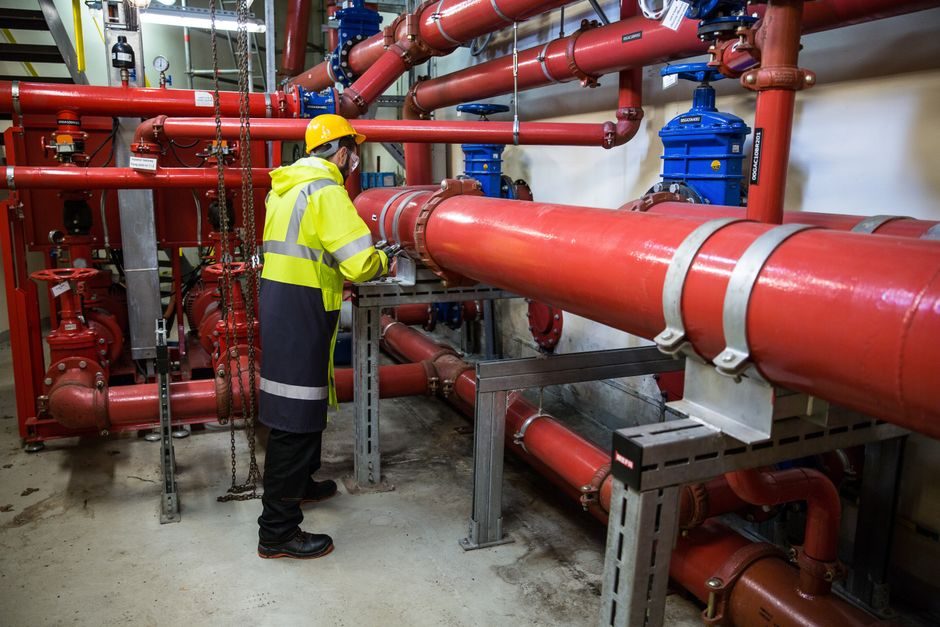
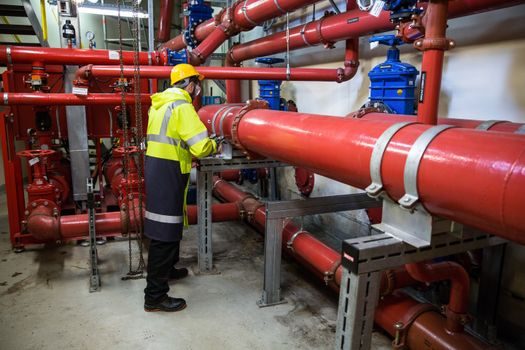
Fire-protection and tank-side: UL/FM-listed wafer butterfly valves with tamper-proof supervisory switch, often a geared manual operator; lightweight, EPDM-seated, rated for 250 psi (17.2 bar) working pressure on grooved or flanged connections. For dry-pipe and wet-pipe sprinkler risers, lug bodies are typically required for dead-end capability so that downstream sprinkler trim can be removed for maintenance without draining the system — a design gate that you can compare with strainer selection in this side-by-side spec sheet on steam separators vs Y-strainers.
Chemical, petrochemical and oil & gas: high-performance double-eccentric or triple-offset, Class 150 to Class 600, body in WCB carbon steel, CF8M stainless steel or alloy 20/625, seat in PTFE, RTFE, or metal (typically 316 SS stellite-faced); shut-off Class IV-VI, fire-safe API 607 where hydrocarbons are present. Corrosive media (chlorides, acids) tend to push the spec toward fully PTFE-lined bodies and PTFE seats; the ball valve line-up at the same nominal size is the usual alternative when full-bore pigging or higher Cv at the same DN is needed.
Power plant, marine and cryogenic: triple-offset metal-seated in austenitic stainless or low-temperature carbon steel (LCC/LTCS), -196 °C impact-tested per ASME B16.34, with extended bonnet and bellows where fugitive-emission limits apply. The same four-eccentric seat geometry is also adopted on some critical high-pressure isolation duties where minimal seat wear during the open/close cycle is the deciding factor [S6].
Standards, Sourcing and Quality Verification
The standards that govern butterfly-valve procurement are layered: design and face-to-face (API 609, MSS SP-67, ISO 5752, EN 558-1, AWWA C504, EN 593), pressure-temperature (ASME B16.34), testing (API 598 for hydrostatic and seat leakage, FCI 70-2 for control-valve seat classes, ISO 5208), fire-safe (API 607/API 6FA), and material (NACE MR0175 for sour service, EN 10204 3.1/3.2 for mill certificates). [S3]
Sourcing-wise, the 2026 catalogue landscape for butterfly valves is dominated by global majors and a long tail of regional Chinese mills concentrated in Tianjin and Wenzhou; factory audits typically verify casting traceability, hydrostatic-test capacity, and assembly-line actuator integration [S3]. For projects, lock the spec at five gates: seat architecture, body style, pressure-temperature, sealing class, and end-connection standard; then cross-check Cv and torque against the OEM sizing tool before issuing the purchase order.
Common Failure Modes and Field-Gate Checks
Most premature butterfly-valve failures trace to one of three root causes: (1) disc-to-seat wear in modulating service with particulate media — fixed by stepping up to a triple-offset or a lined body with a hardened seat; (2) shaft packing leak from inadequate torque-margin allowance — fixed by upsizing the actuator and adding live-loaded packing or bellows; (3) flange-face damage from over-torquing wafer-style bodies in high-cycle dead-end service — fixed by switching to lug or double-flanged bodies. [S4]
Field inspection should record disc and seat visual condition, shaft seal weep rate, torque to operate at line pressure (compared against the OEM bench value), and the disc-position indicator reading at fully closed — any deviation greater than 2°-3° on a soft-seated unit usually signals seat deformation or disc deformation and warrants refurbishment rather than re-packing. Catalogues for the major 2026 product lines list rebuild kits and seat-replacement procedures by series number, which is the cleanest path to a reliable repair scope [S2].
Both will land inside the next spec-cycle for water-utility tenders and will tighten what passes for "NSF/ANSI 61/372 potable-water" compliant units shipped from Asia. For a quick adjacent reference on the balancing valve variant used in HVAC hydronic circuits, see the related selection guide.