Butterfly valves are quarter-turn rotary control valves that regulate, isolate, and shut off flow with a single disc rotated 90 degrees inside the pipe, with body, disc, seat, stem, and actuator chosen to match pressure, temperature, media, and connection geometry [S1]. The market sorts them along three orthogonal axes: disc-offset geometry (concentric, double-offset, triple-offset), end connection (wafer, lug, flanged, butt-welded), and sealing pair (resilient/soft-seated versus metal-seated) [S1][S2][S4][S5].
Selection is rarely about a single attribute. Engineers align ASME or EN flange class, pressure-temperature rating, seat material, and disc offset against the actual service condition (slurry, seawater, steam, hydrocarbons, clean water), then match an actuator family (lever, gear, pneumatic, electric, hydraulic) to the torque and cycle demand [S1][S3][S7].
Disc-offset geometry: concentric, double-offset, triple-offset
Concentric (zero-offset) butterfly valves place the disc rotation axis on the pipe centerline and on the seat centerline, so the disc edge stays in continuous contact with the resilient seat through every degree of rotation, which makes them economical for low-pressure water, HVAC, and fire-protection duty but limits seat life under high cycle or particulate service [S1][S2][S4].
Double-offset (double-eccentric, high-performance) butterfly valves shift the shaft axis behind the disc face and off the pipe centerline, producing a cam action that lifts the disc off the seat after about the first 10 degrees of opening, reducing seat wear and allowing higher pressure classes and thicker media such as slurries and hydrocarbons [S1][S2]. Triple-offset butterfly valves add a third angular offset that produces a metal-to-metal, wedging line contact only at the final stage of closure, eliminating seat contact during throttling and enabling high-temperature and high-pressure service where resilient seats would fail [S2][S4][S5].
End connections: wafer, lug, flanged, butt-welded
Wafer-type butterfly valves sandwich between two pipe flanges and are held in place by flange bolts passing through the pipeline, giving the shortest face-to-face length and lowest cost, but they cannot be used as a true dead-end valve because removing the downstream flange would release the wafer [S2]. Lug-type butterfly valves have threaded lugs cast into the body so each flange half can be bolted independently, allowing dead-end service at the full pressure class and one-sided removal for downstream maintenance [S2].
Flanged butterfly valves integrate flanges directly on the valve body, bolting independently to each pipe flange, which distributes mechanical loads across the joint and is the standard choice for large-diameter lines (commonly above 12 inches), high-vibration systems, and bidirectional dead-end service, and the body itself is cast either as a U-type (single piece) or double-flanged (two pieces bolted together) [S5]. Butt-welded butterfly valves are welded directly into the pipeline and are specified where zero leakage paths at the joint and high-temperature or high-pressure integrity outweigh the cost of future removal, common in power and petrochemical headers [S2].
Sealing pair: resilient-seated versus metal-seated
Resilient-seated (soft-seated) butterfly valves achieve bubble-tight shutoff through elastic deformation of the seat against the disc edge, with EPDM seats typically rated from roughly -40 degrees Celsius to 120 degrees Celsius for water and HVAC service, NBR seats from about -30 degrees Celsius to 100 degrees Celsius for oils and fuels, and PTFE seats reaching up to around 180 degrees Celsius for corrosive media, the exact upper limit depending on valve design [S4].
Metal-seated butterfly valves rely on precision-machined metal-to-metal contact, often combined with a triple-offset geometry that produces a wedging line seal at closure, and the seating surfaces are commonly stainless steel or Stellite hard-facing, which trades higher actuator torque and machining cost for tolerance of high temperatures, high pressures, and particulate media that would chew up a resilient seat [S4][S6]. Within resilient-seated designs, rubber compounds age faster above their rated temperature and in particulate-laden streams, so periodic seat inspection or replacement is built into the maintenance plan, while metal-seated designs demand accurate torque control from the actuator to avoid galling the sealing surfaces [S4].
Comparison: offset geometry on pressure, temperature, leakage, and cost
Concentric designs are the lowest-cost option and give bubble-tight shutoff in clean, low-pressure utility service (typically water and air under about 16 bar class), but the constantly engaged seat limits both temperature ceiling and cycle life [S1][S4]. Double-offset designs extend both the pressure class and the temperature envelope, lift the disc off the seat during rotation, and are the workhorse for hydrocarbons, seawater, and slurries in mid-range process service [S1][S2]. Triple-offset designs add metal-to-metal sealing that pushes the operating ceiling into high-temperature steam and high-pressure hydrocarbons, at a higher unit cost and with stricter actuator torque discipline [S2][S4][S5].
Actuation and operation: lever, gear, pneumatic, electric, hydraulic
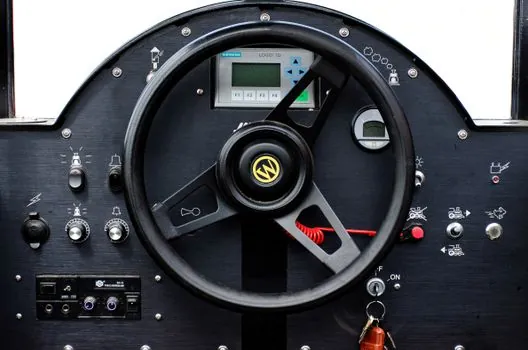
A lever-operated butterfly valve drives the stem directly through a handle for fast manual quarter-turn action on small-diameter, low-torque valves, while a gear-operated butterfly valve uses a handwheel and gearbox to multiply torque, making manual operation practical on larger sizes and higher pressure classes where lever effort would be excessive [S7]. Automated butterfly valves use pneumatic, electric, or hydraulic actuators, and pneumatic actuation is most common in hazardous-area service because it can be paired with solenoid valves and positioners for fast, repeatable remote control without requiring electrical equipment in the valve cavity [S1][S2].
Service-specific selection: marine, water, and process duty
Marine butterfly valves are specified for seawater cooling, ballast, HVAC, fire main, bilge, and desalination systems, with lug-type bodies typical for cooling and ballast lines, duplex stainless steel bodies preferred for long-term seawater exposure in desalination service, and classification-society certification required alongside pressure, temperature, and material selection [S3]. General water and wastewater service typically uses concentric, resilient-seated wafer or lug bodies in ductile iron with EPDM seats, which is also the most economical pairing for HVAC chilled-water isolation and fire-protection loops [S1]. Process and hydrocarbon service shifts toward double- and triple-offset bodies with metal or PTFE seats, ASME B16.34 pressure-temperature ratings, and actuators sized for the higher breakaway torque of offset geometries and heavier discs [S1][S2][S4]. For a broader view of how butterfly valves sit alongside other quarter-turn options, the ball valve classifications spec map covers the comparison points engineers usually weigh, and resilient seat material behavior in seawater service is detailed in the EPDM rubber selection for marine engineering reference. Foundries supplying these cast bodies are mapped in the lost foam line spec map for pump and valve foundries.</h2> <p>Reference depth on butterfly valve architecture, components, and material options is consolidated at the butterfly valve encyclopedia entry; for adjacent flow-control devices in the same quarter-turn family, see ball valve and check valve references, with balancing and throttling variants covered under balancing valve.