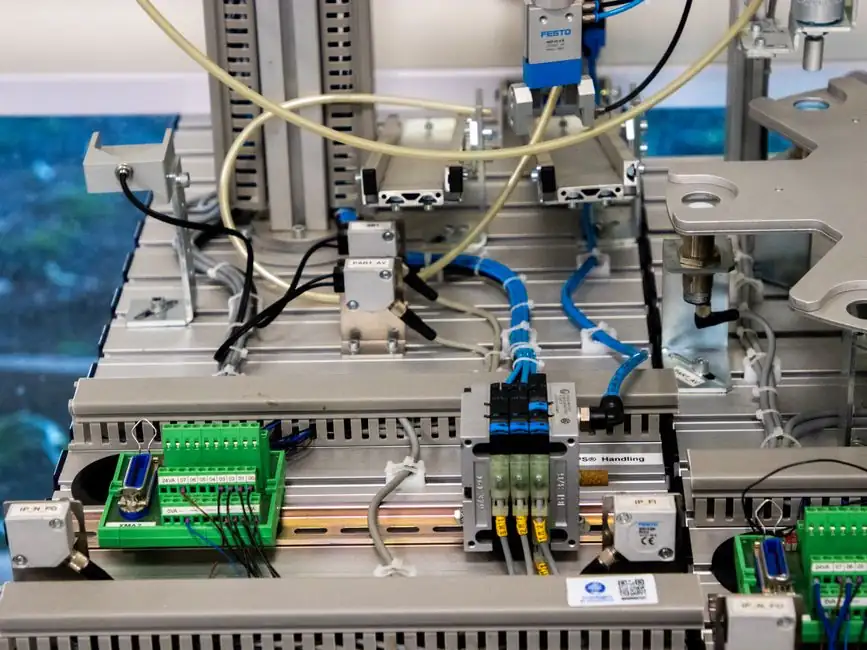
Capacity planning software for industrial automation links demand forecasts, machine availability, and labor shifts into a single scheduling view, replacing the spreadsheet-driven routines that still dominate small and mid-sized plants [S1][S3].
As of June 2026, Epicflow's review of the manufacturing capacity planning market highlights 10 widely deployed tools, with PlanetTogether, Fabrico, Plex, and Netstock appearing across most 2026 shortlists for discrete and hybrid manufacturers [S4].
What capacity planning software actually does on the shop floor
Capacity planning software is the operational layer that converts a sales forecast into constrained production schedules across machines, labor, and shift patterns, with utilization rates typically targeted in the 80–90% band to leave headroom for demand spikes [S1][S3]. The software reads live work-order status from the MES or SCADA software layer, then back-solves whether the current asset footprint can carry the demand plan without overtime or subcontracted capacity [S1][S3].
Rockwell Automation frames capacity planning as the bridge between demand planning and aggregate planning, explicitly listing demand forecasting, supply chain planning integration, and production scheduling as the upstream and downstream processes that consume its outputs [S1]. IBM breaks the workflow into six steps: assess current capacity, forecast demand, identify bottlenecks, develop a strategy, implement solutions, and monitor and optimize [S3]. Epicflow adds that 2026 tools must also handle what-if scenario analysis and predictive analytics, not just static Gantt charts [S4].
Lead, lag, and match: the three strategy families
Capacity planning theory rests on three strategies: lead strategy (add capacity ahead of demand), lag strategy (add capacity only after demand materializes), and match strategy (scale capacity in increments as demand grows), each carrying different capital-exposure and service-level tradeoffs [S3].
IBM notes that high utilization rates signal efficiency, but pushing toward 100% leaves no slack for a demand spike, so most manufacturers operate with a deliberate buffer and use software to model the buffer cost against stockout risk [S3]. Rockwell Automation points out that mismatched capacity forces overtime premiums, excess labor on the shop floor, or stranded warehouse and material-handling assets, all of which raise cost per unit [S1]. In practice, the match strategy is the most software-intensive because it requires continuous re-allocation of resources, not one-shot capex decisions.
Tool categories: APS, ERP add-ons, and dedicated planners

Capacity planning software splits into three architectural camps: Advanced Planning and Scheduling (APS) tools that sit beside the ERP, ERP-native capacity modules, and standalone purpose-built planners optimized for either high-mix discrete or repetitive process lines [S2][S4][S5].
Rootstock and Netstock are ERP-native, delivering capacity planning as a module inside Salesforce-, NetSuite-, Sage-, or Microsoft Dynamics-backed cloud ERPs and leaning on the ERP's master data for bills of material, routings, and inventory positions [S2][S5]. PlanetTogether and Fabrico represent the APS tier, known for finite-capacity scheduling, drag-and-drop Gantt boards, and tight integration with electrical automation layers via OPC UA and REST connectors [S4][S7]. Plex, now part of Rockwell Automation, sits closer to the MES edge, fusing production tracking and capacity planning in a single SaaS instance for discrete manufacturers [S1][S7].
Selection criteria: ERP fit, scalability, and shop-floor data quality
Epicflow's 2026 selection guidance collapses to four filters: alignment with organizational goals, feature coverage (demand forecasting, resource visibility, allocation, workload management, real-time monitoring, utilization tracking, decision support), number of users and resources the tool can handle, and scalability headroom [S4].
Netstock positions AI-driven demand sensing and exception alerts as the differentiator for SMBs, integrating with NetSuite, Sage, Acumatica, Microsoft Dynamics, SAP Business One, Unleashed, MYOB, Cin7 Core, Klipboard ERP One, Klipboard Manufacturing, and SYSPRO [S5]. Rootstock follows the same playbook on the Salesforce platform, with native hooks for Acumatica, Epicor, Microsoft Dynamics, Sage, Infor, Syspro, Plex Systems, Aptean, and Odoo [S2]. A practical spec-floor check: confirm bidirectional ERP integration (not just CSV export), confirm the scheduler can model shift patterns in 15-minute or finer buckets, and confirm the tool exposes a REST or OPC UA endpoint for the plant's industrial camera and vision-based bottleneck analytics.
Real use cases: discrete, process, and engineer-to-order

Discrete manufacturers with high SKU counts and frequent changeovers use APS finite schedulers to compress setup times and balance cell-level labor [S4][S7]. Process manufacturers lean on ERP-native modules for bulk capacity tied to tank, reactor, and line throughput rather than machine-hour accounting.
Engineer-to-order (ETO) shops, where every project is a one-off, use capacity planning to staff design and fabrication against long-lead procurement windows, a pattern Rockett's EV traction motor capacity planning math tracks in the adjacent EV motor segment. Pharmaceutical and food-and-bev plants overlap both worlds, and the pharmaceutical equipment 2026 outlook shows why capacity visibility into filling, packaging, and serialization lines now drives the same software shortlist.
Limits, failure modes, and what still needs a human
Capacity planning software fails when the upstream master data is dirty: wrong routings, stale labor skills matrices, or inventory records that lag the actual shop floor [S1][S6]. Digit's 2026 guide lists the common mistakes as skipping demand-sensing entirely, treating capacity planning as a one-off annual exercise, and over-relying on Excel sheets that cannot model multi-resource constraints [S6].
MachineMetrics notes that data-driven monitoring is what unlocks hidden capacity, meaning the tool's value is only as good as the PLC, MES, and ERP feeds behind it [S8]. A practical guardrail: keep strategic capacity planning (years 1–5) with finance and operations leadership, run tactical planning (weeks 1–26) inside the APS or ERP module, and reserve daily scheduling for the MES or production team, with clear handoff points at each tier.
Sourcing and standards: how to vet a vendor claim

Capacity planning software is not a regulated product in the same sense as pressure transmitters or industrial borescopes, so there is no single IEC or ISO standard that certifies a planning tool. Instead, buyers rely on ERP vendor certification lists (e.g., Netstock's published ERP compatibility roster [S5]), customer references in peer industries, and the tool's documented integration endpoints (REST, SOAP, OPC UA, native ERP connectors) [S2][S4].
The trackable signals to watch between now and the end of 2026 are: vendor releases of AI Pack-style modules for demand sensing, ERP-side acquisitions that fold standalone APS tools into suites (Plex into Rockwell is the precedent), and updated 2026 Supply Chain Planning benchmark reports that quantify realized utilization and on-time delivery deltas after rollout [S5]. Watch also for new Epicflow and Fabrico 2026 tool comparisons that re-rank the top-10 as AI features migrate from add-ons to baseline.