
Global traction-motor volume is on track to grow from 27.423 million units in 2025 to 87.05 million units in 2035, a 3.17x expansion driven almost entirely by electrified passenger and commercial vehicle output, with the segment valued at USD 30.7 billion in 2025 and projected at USD 34.6 billion for 2026 [S2].
China produced over 70% of the 17.3 million electric cars built in 2024, so the upstream constraint is not whether the motors get demanded, but where the stator cores, magnet material, and rotor assemblies will be sourced from at that volume, and how regional content rules will be satisfied [S2]. For the component basics, the stator and rotor anatomy of an AC traction unit is the same induction or PMSM machine most industrial buyers already know.
Motor type mix: where the volume and the value sit
Permanent magnet synchronous machines (PMSM) account for USD 18.224 billion, or 59.4%, of 2025 traction-motor market value, a lead that reflects packaging efficiency, power density, and OEM platform preference rather than raw count, with induction and wound-rotor designs filling the remaining share [S2]. The same architecture pattern is visible in industrial AC motor lines, where inverter-driven PMSM and induction units dominate variable-speed applications.
High-output units above 400 kW are forecast to grow faster than the 200 to 400 kW mainstream, because commercial trucks, performance BEVs, and integrated drive units like Lucid's, specified at 41 hp per liter and up to 20,000 rpm, reward torque density and continuous-duty thermal management over unit cost [S2]. The trade-off is that magnet-free topologies (induction, externally excited synchronous, switched reluctance) gain share in any scenario where OEMs want to dilute neodymium exposure.
Component breakdown: what the capacity numbers have to cover
An EV traction motor breaks into four build-critical elements: stator, rotor, housing, and end-windings plus insulation system, with magnet insertion, rotor balancing, and hairpin or wave winding defining throughput per cell [S5]. The mechanical assembly step is close to industrial motor accessory lines (encoders, resolvers, terminal boxes), so existing tier-1 motor plants can be retooled rather than green-fielded for the lower volume tiers.
Stator and rotor lamination stacks are the bottleneck nobody escapes: Posco International has approved a second motor-core plant in Mexico for March 2025 completion, a Poland plant for May 2026, and a new India site, lifting total capacity to seven plants across five countries with a target of 7 million units per year by 2030, a 3x lift from the 2024 baseline [S3]. For context, the 2025 global traction-motor market is sized at 27.423 million units, while Posco is tripling its traction motor core capacity by 2030 [S2][S3].
Raw material ceiling: rare-earth processing concentration
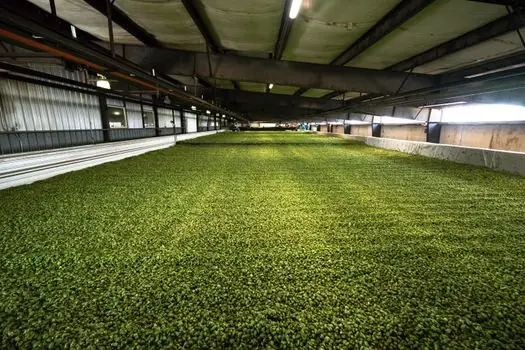
China holds approximately 90% of rare-earth processing capacity globally, which makes PMSM-heavy traction-motor programmes materially exposed to a single jurisdiction for sintered NdFeB magnet feedstock, even when motor assembly is localized [S2]. That exposure is why auto OEMs have publicly funded magnet-free development tracks (Tesla primary reluctance, Renault EESM, BMW/ZF externally excited synchronous) and why non-Chinese OEMs are qualifying second-source magnet and recycling supply in parallel.
Electrical steel for stator and rotor laminations is the second material pinch point, since Posco's own growth plan implicitly assumes that thin-gauge, high-silicon, and domain-refined non-oriented electrical steel supply scales in lockstep with motor core output, a non-trivial assumption given transformer and industrial motor demand competing for the same mill [S3]. The Chinese electrical-steel ecosystem is also covered in our galvanized and silicon steel baseline, where the same 2025 capacity questions apply to traction cores.
Plant capacity math: units, cycle time, and cell count
A modern hairpin stator winding cell runs at roughly 90 to 120 seconds per stator at automotive takt, which gives one cell approximately 240,000 to 300,000 stators per year on two shifts, meaning the 2025 global market of 27.4 million units alone requires a baseline of 90 to 115 stator winding cells before rotor assembly, magnet insertion, and end-of-line are counted [S2]. Magnet insertion is typically the gating station, since automated magnet placement runs slower than winding and requires non-magnetic tooling.
The same scaling logic explains why hydraulic motor and linear motor suppliers are also being pulled into adjacent EV programmes for thermal management and actuator subsystems.
Regional split: where the production lines are being built
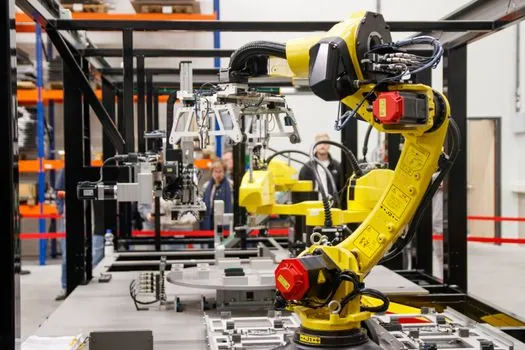
Asia Pacific is both the largest and fastest-growing regional market, with the top 5 players (Bosch, BYD, Magna, Nidec, ZF) collectively holding 61.5% of 2025 market share and Bosch alone above 20.3%, a concentration that maps almost one-to-one to in-region assembly of motor, inverter, and gearbox as a single integrated drive unit [S2]. BYD's plan to bring EV production facilities online with 150,000 vehicles per year of capacity at an investment just under USD 500 million illustrates the integrated model: motor, power electronics, battery, and vehicle on one capex line [S6].
Europe and North America are catching up on assembly but not on upstream content, which is why Posco's Mexico and Poland plants are structured to ship finished or near-finished motor cores into regional OEM assembly without crossing a magnet or rare-earth border twice [S3]. For related Chinese materials sourcing, our molybdenum spec map and abrasives sourcing field map cover adjacent raw-material exposures on the same sourcing risk axis.
Market signals worth tracking over the next two quarters
Trackable signals for Q4 2026 and Q1 2027: (1) any OEM disclosure of magnet-free or reduced-rare-earth traction-motor SOP dates, since that is the single largest swing factor on PMSM's 59.4% value share; (2) Posco's India plant go-live and the actual 7 million unit per year run-rate at the seven-country footprint by 2030 [S3]; (3) any downward revision to the 87.05 million unit 2035 forecast from GMI, since the 13% CAGR through 2035 is anchored to 2024 EV production growth of about 25% year-on-year, a pace that cannot repeat indefinitely [S2].
For a process engineer, the practical question is not "is there enough demand," but "is there enough lamination steel, magnet, hairpin copper, and stator winding capacity, in the right geography, with the right cycle time, between now and 2030?" The current evidence says: demand is locked in, lamination steel and cores are scaling on a published timeline, magnet feedstock is the unresolved chokepoint, and cell-level cycle time will determine whether the 27.4 to 87 million unit range is met on schedule or slips right.