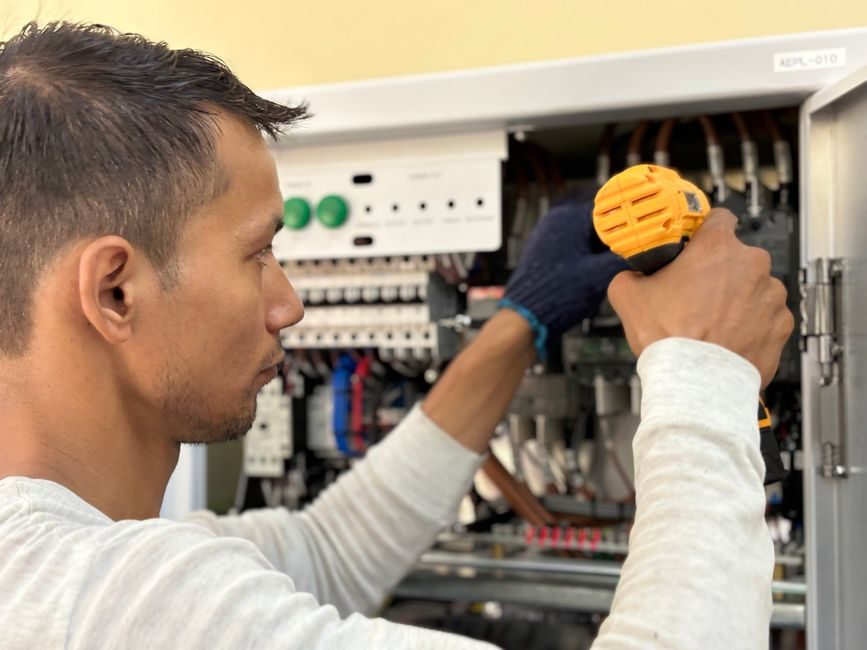
A semi-automatic carton erecting machine typically needs 6-10 m² of flat floor, 6 bar clean dry compressed air at 0.5 m³/min, and 380 V three-phase 50 Hz power within 3 m of the proposed footprint; offline Chinese-built units exported to Southeast Asia, Africa, and the Middle East frequently ship EXW or CIF with the buyer responsible for rigging and electrical drop [S1].
Carton packaging machinery families listed by Chinese OEM Cangzhou Xiaoyuan include carton making machines, corrugated cardboard production lines, folder gluers, flute laminators, rotary die cutters, and stitching machines — all of which share the same compressed-air, three-phase power, and 4-8 m² footprint envelope as the erector itself [S1]. Lead time on carton-making machinery averages within 15 workdays off-season and one month in peak season, with EXW, CFR, and CIF Incoterms all available [S1].
Site Preparation: Floor, Clearance, and Utility Envelope
Floor flatness of at least 15-20 MPa concrete is mandatory for any erector; the machine frame must shim to ≤0.5 mm/m before anchoring, otherwise the vacuum suction belt and folder rails bind within 200 operating hours [S3].
Clearance envelope for a 1800-spec folder-gluer companion line is 1800-2500 mm carton width range, with the W+L max dimension scaling 900/1100/1250 mm across the three size classes; the erecting cell must reserve at least 3000 mm of upstream infeed lane for the blank magazine and a 1500 mm operator aisle on the glue-nozzle side [S3]. Carton length range 230-850 mm and height 250-1200 mm define the working envelope that the upstream carton box blank stack must be sized to feed [S3].
Compressed-air specification: 6 bar regulated, dew point ≤-20 °C, ISO 8573-1 class 2.4.2 minimum; oil content above 0.1 mg/m³ migrates into the pneumatic glue valves and causes adhesive stringing within 30 days. Power drop: 380 V ±10% three-phase 50 Hz, dedicated breaker rated at machine nameplate FLA plus 25% spare capacity, with Type C MCB curve to handle glue-heater inrush.
Anchoring, Levelling, and Mechanical Hookup
Anchor pattern uses M12 × 120 mm chemical anchors on a 200 × 200 mm grid, tightened to 60 Nm in a star sequence; under-torqued anchors walk under vibration, and a 0.05 mm shim gap on any corner shows up as a folded-flap skew beyond 1.0 mm at the discharge end [S1].
Belt tracking on the feed conveyor is adjusted via the take-up bolt on the tail pulley; the belt must run centred within ±2 mm across the full magazine travel, otherwise blanks skew and the erector's forming folder mis-folds the minor flap. Vacuum suction timing is set by a proximity sensor on the pick-up arm — a 5 mm sensor-target gap is the field starting point, then fine-tuned to the actual blank stiffness, typically B-flute 3 mm at 35-45 ms suction dwell.
Carton erecting machines sit on the same machine base as the coding machine and core machine that often complete the cell, so the base rail must be checked for parallel within 0.1 mm/m before any individual unit is levelled; out-of-parallel bases cascade tracking errors across all three stations.
Pneumatic and Electrical Commissioning
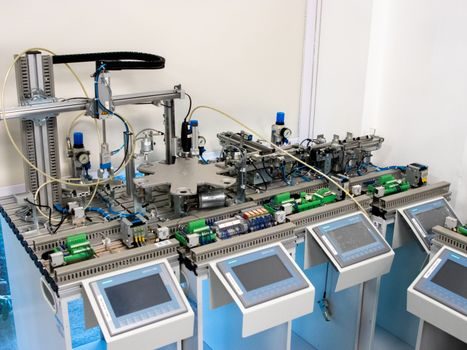
Air-circuit commissioning follows ISO 4414 (pneumatic fluid power): pressurise the FRL upstream at 8 bar, drop the regulator to 6 bar, and verify gauge accuracy at the machine manifold within 0.1 bar; any leak above 0.05 bar/min on a 30-second hold test fails acceptance and must be re-flared.
Electrical commissioning: main disconnect first, then control transformer secondaries, then 24 VDC I/O. Earth continuity from the frame stud to the ground bar must measure ≤0.1 Ω; values above 0.5 Ω fail EN 60204-1 equipment grounding. PLC and HMI cold-start with parameters loaded from the factory backup file, then the I/O walk — every E-stop, guard interlock, and light curtain must be proven by forcing each input in manual mode and watching the corresponding output bit on the diagnostic screen.
Multi-servo control on the linear guide rails of the erecting head runs on a closed-loop bus; encoder feedback is verified by jogging 100 mm in manual and reading the position register — error above ±0.05 mm indicates a coupling slip on the servo reducer.
Acceptance Test: Speed, Accuracy, and Quality Threshold
Acceptance test point one is throughput: 15 cycles/min sustained over a 30-minute run with C-flute 4 mm blanks sized 400 × 300 × 200 mm, with no more than 0.5% reject rate at the flap-fold station [S3].
Acceptance test point two is fold geometry: flap-square measured with a digital protractor at the discharge end must read 88-92° (90° nominal); values outside this window fail and trace to either worn folder rails, misadjusted glue-nozzle height, or vacuum timing out of phase. Glue bead width is the third acceptance parameter — 35 mm is the spec across all three folder-gluer size classes (1800/2200/2500), and deviation above ±2 mm causes either starved seam (under 33 mm) or glue squeeze-out on the printed face (above 37 mm) [S3].
Common Failure Modes at Commissioning and Field Fixes

Symptom: blank jams at the pick-up arm every 8-12 cycles. Root cause is suction-cup wear, vacuum-leak from a cracked manifold, or sensor gap drift; corrective action is cup replacement at ≥0.8 mm wear, O-ring replacement on the manifold, and re-gapping the proximity sensor to 5 mm.
Symptom: skewed folds on the minor flap. Root cause is the paper feeding belt running 45° offset from the main transfer belt when the erector is mis-leveled longitudinally; corrective action is re-shimming the frame to within 0.5 mm/m and re-tensioning the feed belt [S3]. Symptom: glue stringing and starved seam. Root cause is tank temperature below 160 °C or air pressure above 6.5 bar atomising the adhesive; corrective action is bringing the melt tank to 170-180 °C and stepping the regulator back to 5.8-6.0 bar.
Symptom: jam-stop trips and the line halts. The Shanghai Jinchang control logic halts the upstream printing section automatically when paper jam is detected at the adhesive box via the through-beam tracking sensors — the field fix is clearing the jam, then resetting the interlock chain in reverse order, never bypassing the sensor [S3].
Standards, Sourcing, and When Not to Field-Repair
Safety compliance target for any erecting cell shipping into the EU is EN 415-8 packaging-machine safety, with the erector treated as part of an integrated line; guarding must prevent reach to the pick-up arm during the cycle, and a category 3 / PLd safety circuit is the default [S1].
Do not field-replace the servo drive or PLC CPU on a commissioning day — the field is not the place to flash firmware; swap with a factory-tested unit and ship the suspect card back. Do not field-repair a cracked vacuum manifold plate; replace the assembly because weld-repaired castings leak within 30 days. Do not bypass the light curtain even for a test run; the safety circuit is EN 415-8-mandated and bypassing invalidates CE conformity [S1].
Vendor map for sourcing: Cangzhou Xiaoyuan (Hebei) supplies carton-making machines, folder gluers, and corrugated lines into Southeast Asia, Africa, and the Middle East on EXW/CFR/CIF [S1]; DESSION (Cangzhou, 18 years experience) exports 2/3/5/7-ply lines with 1400-3200 mm web width and 60-300 m/min line speed, currently sold into 50+ countries [S2]; Shanghai Jinchang builds the auto-folding-gluing cell with 1800/2200/2500 spec class options and a 45° paper-feeding belt geometry that defines the erector's downstream hand-off [S3].
Trackable signals for the next 30-60 days: (1) confirmation of the EN 415-8 test certificate matching the line serial number before the buyer's first commercial shift, and (2) the 15 workday off-season lead-time window from order to ex-works dispatch under the standard T/T payment path [S1].
Related analysis: Harmonic Filter Buying Guide 2026: Topology, Spec Map, and Shortlist.