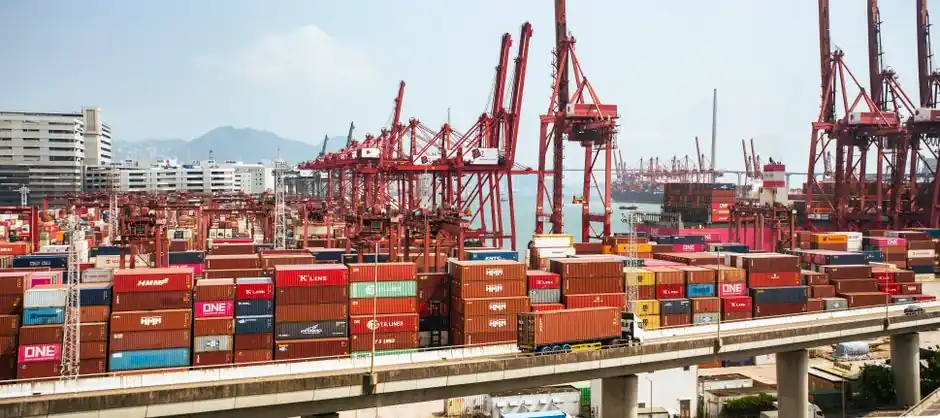
Port and cross-dock case packers are end-of-line work cells that form a corrugated shipping case, load collated product, and seal the case to a distribution-ready unit, sitting between primary packaging and the palletizer on export lines bound for ocean container stuffing [S1].
Selection at a port logistics build hinges on three measurable axes: case format range (FEFCO 0201 RSC, 0200 HSC, 0203 FOL, or wrap-around blanks), throughput in cases per minute, and SKU changeover time, with each axis carrying a specific failure mode that operators usually discover only after commissioning [S5].
Definition and Scope: What a Port-Logistics Case Packer Actually Does
A case packer is the secondary-packaging machine that takes flat corrugated blanks from a magazine, erects them into cases, loads collated primary packs (cans, bottles, cartons, pouches, or bags), and top-seals the loaded case so it can move downstream to a palletizer or robotic stacker [S1]. A complete system performs three jobs: case forming, product loading, and top sealing; on an erect-and-load line these are three distinct zones, while on a wrap-around machine they collapse into a single folding-and-gluing pass around pre-grouped product [S1].
For a port or container-terminal application, the case packer is typically fed by an automatic carton erector that supplies a continuous stream of formed cases, and its discharge feeds a case sealer and then a robotic palletizer that stacks sealed cases onto a pallet for dispatch [S3]. Safety references for these cells are ANSI/PMMI B155.1 and ISO 12100, and a properly guarded robotic top-load cell with infeed, collating conveyor, and discharge typically occupies 12 to 25 m² of floor area plus guarding to ISO 13849-1 PL d [S1][S5].
Selection Criteria: Throughput, Format Range, Board, and Product Fragility
For export-bound lines where a single SKU dominates a vessel cut, wrap-around or side-load packers deliver throughput up to 200 cases per minute at the lowest per-case board cost, but they are limited to rigid products and a narrow case-footprint window [S5]. For high-mix port operations where vessel manifests shift every few days, servo-driven top-load packers cut SKU changeover to under 5 minutes on machines that store recipe parameters in the PLC, eliminating the 20 to 40 minutes of mechanical retooling a hand-fed cell demands [S5].
Board selection for palletized export is governed by the Edge Crush Test (ECT) per TAPPI T811, the Mullen burst test per TAPPI T810 for puncture resistance from the flat side, and box-compression validation per ASTM D642 with a full distribution sequence per ASTM D4169 or the ISTA series [S1]. For fragile product (bottles, glass jars, blister packs) a top-load pick-and-place head with soft-grip end-effector running at 10 to 40 cycles per minute is safer than a wrap-around drop packer even at lower capex, because the pick path eliminates drop-impact damage to the load [S5]. For a port-logistics buyer, the practical decision is to lock case style, ECT grade, and product fragility first, then size the cell; the case packing machine reference outlines how blank caliper, flute, and ECT range accepted by the magazine constrain the rest of the spec.
Who the Configuration Is For: Four Layouts Mapped to Port Use

Top-load pick-and-place cells run 10 to 40 cpm with the highest SKU flexibility, the highest capex per case, the gentlest product handling, and a footprint of 15 to 25 m², suiting a port warehouse that consolidates mixed-carton export orders for multiple shippers [S5]. Side-load horizontal cells run 30 to 80 cpm, suit cartons, bags, and flow-wrapped pouches entering on edge, carry moderate capex, and occupy 10 to 18 m², fitting a port-side FMCG line where flow-wrapped pouches or bagged rice are the dominant primary pack [S5].
Wrap-around cells run 60 to 200 cpm at the lowest per-case board cost but are limited to rigid products and a narrow format window, which fits a port beverage-canning operation where one SKU fills a container [S5]. Robotic pick-and-place on a six-axis arm typically targets heavier rigid formats above 2 kg per primary pack, while SCARA arms cover high-cadence light-payload work below 1 kg, and both share stainless contact parts, GMP-ready hygiene, and recipe-driven HMI changeover on a common automation platform [S4]. Buyers mapping a port build should review the case packing machine types spec map cell by cell before locking a footprint.
Capex Bands, Footprint, and Sealing Method
Capex for a servo top-load case packer with a 4-axis robot typically falls in the USD 150,000 to 500,000 band before integration, and a full wrap-around shrink-style cell with conveyors and case erector commonly lands at USD 350,000 to 900,000 installed [S5]. Footprint is the second hidden cost: a single robotic top-load cell with infeed, collating conveyor, and discharge often occupies 12 to 25 m² of floor area plus guarding, which is roughly 4× the floor demand of a manual case-loading station and the single most common reason buyers de-rate a line during the layout phase [S5].
For port-export sealing, hot-melt adhesive is stronger and cleaner than tape for export and automated palletizing, with a higher machine cost but lower per-case consumable cost at volume; specifying both sealing methods on a datasheet does not mean both are in the quoted price, so the choice must be written into the URS before RFQ [S9]. Case-form dimensions for mid-range erectors, fillers, and sealers in this segment typically fall in 200 to 450 mm L × 150 to 400 mm W × 100 to 350 mm H bands, with sealer throughput around 20 m/min of tape travel and filler throughput 1 to 6 cases/min, which is why the erector is usually the line bottleneck rather than the sealer on a balanced port cell [S2].
Comparison: Four Main Configurations Against Four Decision Criteria
Top-load pick-and-place: 10 to 40 cpm, highest SKU flexibility, highest capex per case, gentlest product handling, footprint 15 to 25 m². Side-load horizontal: 30 to 80 cpm, suited to cartons, bags, and flow-wrapped pouches entering on edge, moderate capex, footprint 10 to 18 m². Wrap-around: 60 to 200 cpm, lowest per-case board cost, limited to rigid products and narrow footprint. Robotic six-axis or SCARA: 10 to 50 cpm, best for heavy or mixed-format rigid loads, premium capex, footprint 12 to 20 m² [S4][S5].
The decision grid is straightforward. Choose wrap-around when one SKU fills a container and throughput above 60 cpm matters more than SKU flexibility. Choose side-load horizontal when primary packs are flow-wrapped pouches, bags, or edge-fed cartons at 30 to 80 cpm. Choose top-load pick-and-place when product is fragile, SKU count is high, and changeover time dominates the operating cost. Choose robotic six-axis when primary packs exceed 2 kg or formats are mixed beyond three footprints, and accept the higher integration cost. A port warehouse that re-packs mixed shipper orders for export will most often land on top-load or robotic, while a captive beverage or canned-food line will most often land on wrap-around.
Limitations, Failure Modes, and Standards Discipline
Format changeover is the third measurable disadvantage: a packer specified for a single case size and product pattern will run efficiently for years, but the same machine asked to handle five case footprints and three product patterns will spend 8 to 15% of available time in changeover, and a mis-set pick-and-place gripper becomes the leading unplanned-downtime cause on multi-SKU lines [S5]. Hygiene and compliance language for pharmaceutical and food lines must be specified in the URS rather than left to defaults, since corrosion-resistant contact parts, washdown ratings, and GMP documentation packages vary widely between vendors and are not interchangeable at the same capex band [S9].
For an export cell heading through a port warehouse, board validation per ASTM D642 plus a full distribution sequence per ASTM D4169 or the ISTA series is the practical gate, and any machine that cannot accept the blank caliper, flute, and ECT range the case spec demands should be rejected before FAT rather than after [S1]. Safety interlocking must be checked against ANSI/PMMI B155.1, ISO 12100, and ISO 13849-1 PL d, and the FAT plan should verify that the line, not just the case packer, holds OEE under sustained multi-SKU conditions [S1][S3][S5].
Trackable Signals for the Next 6 Months

Two signals are worth watching: (1) the spread of unified PLC + SCADA architectures that hold full-line recipes for every SKU, where a correctly designed port cell should switch the entire line between products in under five minutes; (2) the convergence of OEE data showing a 15% or larger uplift when an integrated case-packing line replaces standalone machines stitched together with manual transfers, since this is the most defensible ROI argument for port-logistics buyers comparing capex against labor cost [S3]. A practical next node is the warehouse robotics procurement matrix for downstream pallet-side automation, and a back-reference to the case packer specs for warehouse automation gates for the cell-level format, throughput, air, and board checks that the FAT plan should validate.
For component-level specifications, see logistics packaging, and gland packing.