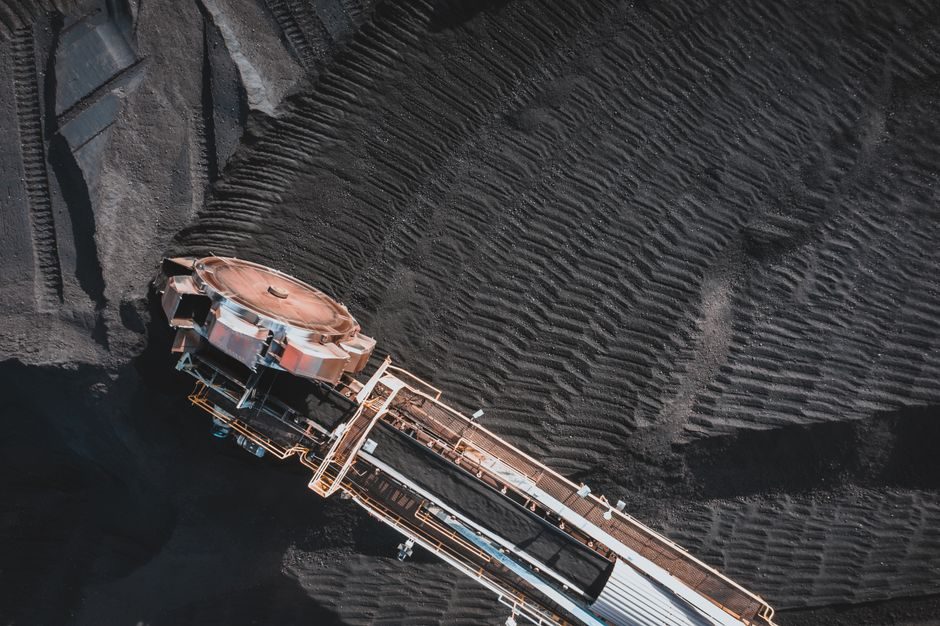
A chain conveyor is a powered material-handling line whose working element is a chain — slat, roller, apron, bucket, overhead link, or plate-link — sized by tensile rating and matched to the product's weight, abrasiveness and geometry, with operating envelopes spanning 8 kg per carrier (NSM Magnettechnik overhead, 2026-04) up to 1000 t/h at 0.8 m/s in trough bulk-grain service (Mysilo Y series, 2026-05) [S7][S8].
Buyers in 2026 select from five distinct chain-conveyor families — overhead enclosed-track power-and-free, floor-mounted slat/apron, flexible spiral modular, vertical bucket, and trough en-masse — and the wrong pick is the most common capex error on packaging, grain and finishing lines (directindustry index lists 18 chain-technology OEMs on 2026-05-30) [S3]. The conveyor chain and chain conveyor reference pages anchor the component and system-level vocabulary used in this guide.
Five Chain Conveyor Types: Geometry Decides Application
Overhead enclosed-track power-and-free conveyors (Daifuku Webb Unibilt) carry loads up to 113 kg (250 lb) per carrier on an inverted monorail and allow accumulation, switching and vertical lift inside a single track — the format most often specified in paint lines, appliance assembly and tier-1 automotive body shops [S4]. Floor slat and apron chain conveyors run horizontal at 0.45–0.8 m/s for 20–1000 t/h of granulate, grain or concrete aggregate; the Mysilo Y series covers 12.248–612.395 lb/s throughput in a troughed chain-and-flight geometry suited to silo discharge [S8].
Modular flexible chain conveyors (Euroflex 195, 190 mm effective width; Binks Spindle King; M.H. Material Handling Biflex up to 500 kg) handle packaged food, pharmaceutical trays and lightweight automotive totes on horizontal, vertical and spiral runs in stainless-steel or aluminium construction [S1][S5][S9]. Overhead plate-link conveyors (NSM, 8 kg/carr.) serve parts feeding in machining cells, while vertical bucket elevators (Shanghai Clirik TH series) lift powder, granule and small lump bulk vertically in mining, food and construction [S6][S7]. For the geometry choice upstream of chain selection, the comparison in Belt vs Overhead Conveyor: Picking the Right Transport Geometry in 2026 maps when an inverted monorail beats a belt.
Selection Criteria: Load, Pitch, Speed, Environment
Four engineering numbers drive the spec sheet: (1) per-carrier or per-metre load, (2) chain pitch (the centre-to-centre distance between pins, typically 38.1 mm / 50.8 mm / 76.2 mm / 101.6 mm / 152.4 mm for roller chain and attachments), (3) linear speed (0.45–0.8 m/s in bulk service, up to ~2 m/s in clean food packaging), and (4) environment (food-grade stainless, ATEX dust zone, wash-down, ambient −20 to +80 °C). The 8 kg NSM overhead plate-link unit and the 113 kg Daifuku Unibilt power-and-free carrier illustrate how the same chain technology spans 14× in load rating [S4][S7].
For sanitary lines, the Euroflex 195 ships in stainless steel or aluminium at 190 mm effective width; for abrasive bulk, a drop-forged silent chain or double-pitch roller chain with hardened flights is more common than a polymer modular belt, because the steel chain tolerates cutting wear that destroys plastic links within months [S9]. Buyers routing lines through a cleanroom or wash-down cell should also confirm IP65 motor enclosures and food-grade H1 grease on drive chains, since the chain is the lubrication point most often skipped in audits. Bulk-tonnage and per-carrier lines diverge sharply on capital: a 1000 t/h trough conveyor is sized by chain pull and sprocket diameter, not by carrier pitch, and a single drive motor can exceed 30 kW.
Capacity vs Conveyor Family: Where the Numbers Bite
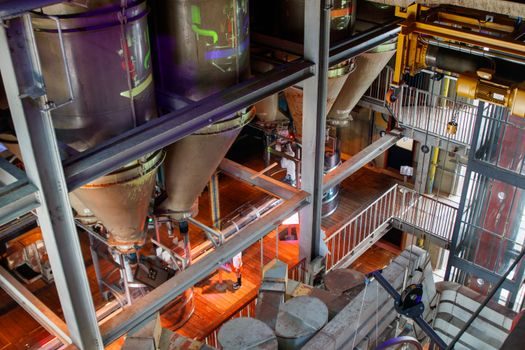
Throughput scales with the conveyor family, not just the chain. Overhead inverted-rail lines (Daifuku Webb) move discrete carriers at 113 kg each, so a 60 m line with 3 m carrier pitch delivers roughly 22 carriers/min — high-value, low-mass product. Floor slat/trough lines (Mysilo Y series) move 20 t/h to 1000 t/h of granulate at 0.45–0.8 m/s, an order of magnitude higher tonnage at the cost of footprint [S4][S8].
Modular flexible chain conveyors (Euroflex 195) sit in the middle, with a 190 mm effective width and 500 kg max load in the Biflex line, serving accumulation buffers and spiral lowers at 30–60 carriers/min [S5][S9]. For lighter packaging of less than 5 kg per unit, a flat-top linear guide or chain-track system outpaces an overhead power-and-free on cost-per-metre. Conversely, when the line must rise more than 6 m vertically, a bucket elevator (TH series) replaces the chain conveyor entirely; trying to lift bulk on a slat conveyor saturates chain pull within the first 4 m of lift [S6].
Drive, Sprocket and Chain Specification
Three drive architectures dominate 2026 builds: (a) gearmotor with VFD for horizontal slat and modular lines, (b) inverter-controlled centre drive for power-and-free accumulation, and (c) hydraulic or direct-coupled gearmotor for high-pull bulk lines. The MINDA horizontal chain conveyor for cardboard boxes uses frequency-controlled drives specifically to enable smooth reverse operation and a "no sheet-walk" start/stop ramp, which is the same control reason cited in Binks Spindle King modular curves [S1][S2].
Sprocket selection follows chain pitch: a 76.2 mm (3-inch) pitch roller chain typically runs on 8-tooth to 21-tooth sprockets, with the larger diameters preferred for high-speed, low-noise operation. Bucket elevators (TH series) use matched double-strand chain or belt with deep-drawn steel or HDPE buckets, while the Biflex modular line uses an electric drive sized to the 500 kg max-load envelope [S5][S6]. Mating chain and sprocket to a linear guide carriage is the standard pattern where the carrier has to register to a workstation without play.
Standards, Materials and Compliance Anchors
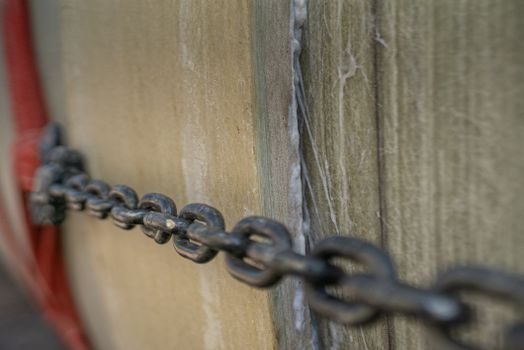
Buyers in regulated environments should map the line to the governing rule set: ATEX 2014/34/EU for EU dust/gas zones, FDA/EC 1935/2004 for food contact surfaces, ISO 9001 for OEM quality systems, and OSHA 1910.219 for general mechanical power-transmission guarding. Stainless-steel construction in Euroflex 195 and Biflex lines is the default for food and pharma, while painted carbon steel dominates mining, cement and grain service [S5][S9].
For high-temperature service (oven entry, paint bake, foundry), the silent chain and inverted-rail power-and-free formats (Daifuku Webb Unibilt, 250 lb) tolerate ambient conditions that destroy plastic modular belts and standard polymer-roller chains [S4]. The 1000 t/h Mysilo Y trough chain in food-grade silo service also runs in stainless for edible-oil and flour lines, where the chain-to-sprocket wear surface must not shed carbon into the product [S8].
Where Chain Conveyors Are Wrong: Limits and Failure Modes
Chain conveyors are a poor fit when the product is irregularly shaped, low-friction, or requires zero back-pressure accumulation. A flexible spiral modular line (Euroflex 190 mm) is a stronger choice than a power-and-free for accumulation buffers; an overhead crossed-roller guide is a better match for indexing parts to a CNC than a chain conveyor with worn dogs. Chain conveyors also fail in cleanroom ISO Class 5+ environments where the chain is an oil and particle source — a belt or magnet-driven track is preferred. [S1]
For abrasive bulk, specify a chain pull 1.5–2× the calculated steady-state draw to absorb slug loads; the 0.8 m/s Mysilo Y maximum is the realistic ceiling above which bucket spillage becomes a measurable yield loss [S8]. Buyers comparing line geometry to capex should also review the broader Roller Conveyor Buying Guide 2026: Six Gates That Decide Spec — many lines that look like chain-conveyor jobs end up as motorised roller builds at lower installed cost.
Specification Workflow and Sourcing Checklist
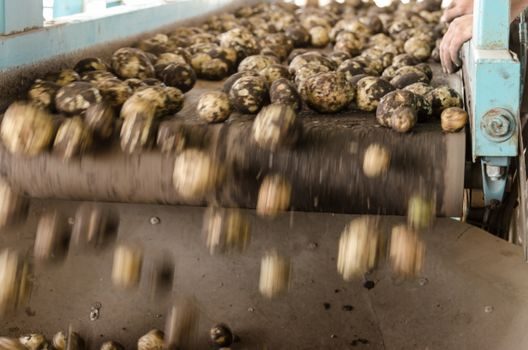
A reproducible 2026 spec flow: (1) define product mass and footprint per unit, (2) fix layout (horizontal / inclined / vertical / spiral) and required throughput in t/h or carriers/min, (3) pick chain family from the five-type matrix above, (4) size chain pitch and drive power with 1.5–2× service factor, (5) lock material (stainless / galvanised / carbon steel) to environment, (6) confirm standards (ATEX 2014/34/EU, FDA, ISO 9001, OSHA 1910.219), (7) request drawings showing sprocket diameter, chain pull, take-up travel and lubrication points. The directindustry index lists 18 chain-technology OEMs in 2026-05 and groups them by roller, chain, rail-mounted, screw, wedge and pneumatic, which is the fastest cross-reference for a second-source audit [S3].
For high-tonnage bulk service, the Mysilo Y series and Shanghai Clirik TH series are the most quoted Chinese-built trough and vertical units; for high-value discrete product, Daifuku Webb Unibilt and NSM Magnettechnik overheads remain the global default [S4][S6][S7][S8]. Cross-check the conveyor's drive and frame steel against the Roller Conveyor Price 2026: Roller Diameter, Load Class, and Frame Steel Drive the Quote reference, since frame section, not chain, is often the line-item that moves a quote by 20%.
Next signal to track: OEM-published 2026-H2 lead times for stainless flexible spiral chain (Euroflex 195 class) and 76.2 mm pitch roller-chain bulk lines, both of which stretched through 2025 on stainless bottlenecks. A second watch-item is ATEX 2014/34/EU-certified chain-conveyor SKUs from the 18 OEMs listed in the directindustry 2026-05-30 index — a count above 10 indicates the European food/pharma retrofit wave has broken the supply logjam [S3][S9].