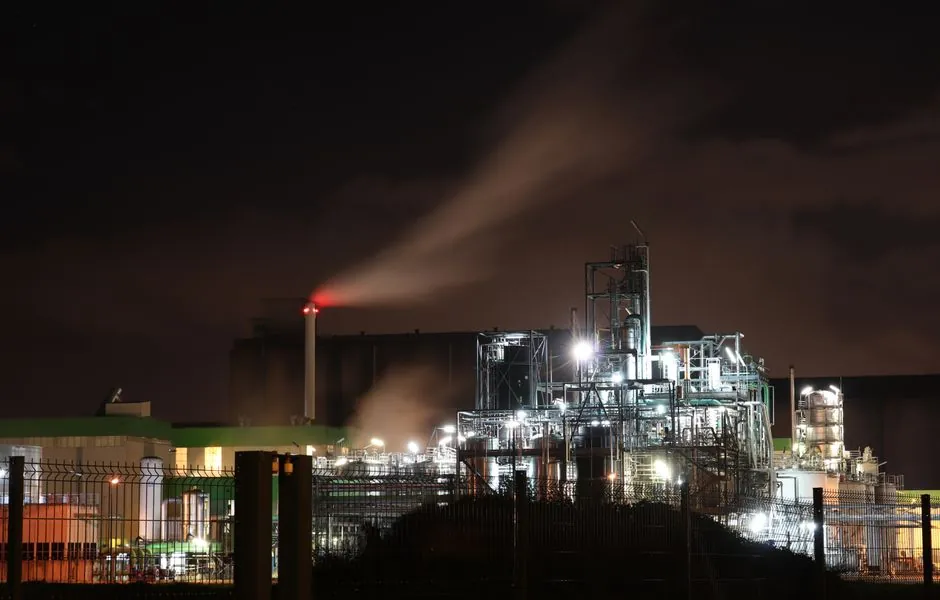
UBS Securities forecasts Chinese petroleum demand will peak in 2029 and enter negative growth after 2030, with gasoline and diesel, the two largest refined products, having already hit their respective peaks [S1][S2].
The same base scenario projects new energy vehicles, hybrids included, reaching 83.5% of China's vehicle sales by 2030 (up from around 40% in 2024), driving gasoline demand down at roughly 3% per year to 138 million metric tons by 2030 [S1][S2]. Diesel, which peaked at 203 Mt in 2019, is projected to fall to about 157 Mt by 2030, a 22% reduction from the 2013 baseline [S1][S2].
Gasoline and Diesel: Decline Curves Already Locked In
The decline curves are not speculative: UBS analyst Amily Guo's team models 3% per year gasoline contraction and a 22% drop in diesel from the 2013 level, anchored to a vehicle mix in which new energy vehicles (NEVs), hybrids included, reach 83.5% of Chinese sales by 2030 [S1][S2]. Liquefied natural gas (LNG) heavy trucks and hydrogen adoption reinforce the diesel-side compression, since LNG fuel substitution alone removes a structural layer of on-road diesel offtake. Refiners reading the curve should treat the 2024 vehicle mix as the pivot point for unit-level decisions on distillation, hydrotreating, and reformer throughput. Continued reliance on pressure transmitter loops tied to legacy gasoline blend headers will leave assets under-utilised by 2028, well inside the 2026-2030 window.
Chemical-Grade Growth: Kerosene, LPG, and Naphtha
Gasoline and diesel together still account for nearly half of China's total petroleum demand, so their contraction is partially offset by aviation kerosene, LPG, and naphtha, the three product pools UBS identifies as new growth drivers [S1][S2]. Aviation kerosene demand rises with domestic and international turnover recovery; LPG benefits from residential and petrochemical cracking feed; and naphtha scales with new steam cracker capacity that is already under construction. The implication for industrial valve and flow meter specifiers is a portfolio rotation: from road-fuel hydrotreater and reformer control valves toward cryogenic LPG handling, naphtha splitter overhead systems, and jet-fuel filtration skids. Process units tied to gasoline/diesel withdrawal will increasingly need turndown-rated or re-purposed service rather than greenfield replacement.
Refining Throughput and Crude Supply Direction

China's National Bureau of Statistics reported a 2% year-on-year increase in industrial crude oil production from large enterprises (annual revenue above 20 million yuan, roughly $2.76 million) through the first three quarters of 2024, even as petroleum's share of total energy consumption fell by 0.9 percentage point [S1][S2]. That divergence, more domestic crude at a time of falling product share, signals an export and chemicals-led configuration rather than a road-fuel-led one. Teapot and integrated refiners are already pivoting to chemical-grade outputs; the 2026-2030 horizon is when the rebalance shows up in unit utilisation tables.
State-Owned Energy Majors: Green Capex as a Demand Hedge
China National Petroleum Corp (CNPC) reported material progress in integrating new energy ventures and constructing new energy hubs in its Q3 financial report, while China Petrochemical Corp (Sinopec) scaled up hydrogen-powered transport and expanded charging and refueling networks; China National Offshore Oil Corp (CNOOC) advanced offshore wind plus oil and gas co-location and industrialised CCUS [S2]. For instrumentation buyers, this translates into instrument orders for hydrogen compressor skids, CCUS custody transfer, and offshore wind substation monitoring, all of which need pressure sensor and PLC architectures that differ from refinery DCS norms. Plan accordingly when qualifying vendors for 2026-2028 awards.
Adjacent Industrial Signal: Shipboard Cable Demand 2026-2030
The Business Research Company's July 2026 Shipboard Cables Market Report 2026, covering the 2026-2030 outlook, segments the global market by type (fiber-optic cables, electric cables), voltage (medium voltage cable, low voltage cable), and application (marine and offshore, oil and gas and petrochemical, other applications) [S3]. Oil and gas plus petrochemical applications form one of the three named end-uses, directly relevant to specifiers sizing medium-voltage ship-to-shore power and offshore platform cable runs. For a 250-page, $4,490 commercial report [S3], the key takeaway is that petrochemical-adjacent cable demand is being forecast as a discrete line item, not a refinery-only spend category, which corroborates the chemicals-led reweighting UBS has mapped on the demand side.
What the 2026-2030 Curve Means for Spec-Driven Buyers
For process engineers and procurement leads, the 2026-2030 forecast window compresses three decisions into a short planning horizon. First, gasoline/diesel hydrotreater and reformer I&C budgets should be scheduled for turndown, not expansion: a servo motor or control valve specified today for a 2027 retrofit will likely serve a lower throughput envelope by 2029. Second, naphtha splitter, kerosene filtration, and LPG cryogenic skids are the credible growth pools, so material selection (low-temperature carbon steel, 300-series stainless for chloride service) and ATEX/IECEx zoning should be locked in for 2026-2027 awards. Third, NEV substitution is a structural, not cyclical, input: any project whose internal rate of return depends on 2024-2025 gasoline or diesel offtake volumes is exposed to the 3% per year gasoline and 22% diesel-reduction curves UBS has published. [S2]
Two trackable signals to watch through the next two reporting cycles: the monthly China Petroleum and Chemical Industry Federation (CPCIF) product-mix tables, which will show naphtha and kerosene share gains against gasoline, and the Q4 2026 capex disclosures from CNPC, Sinopec, and CNOOC for hydrogen and CCUS project sanctions, which will confirm whether the 2024 green-capex direction [S2] is converting into 2026-2027 procurement orders.
Related analysis: Sorting system selection for port logistics: spec criteria, architectures, and 2026.