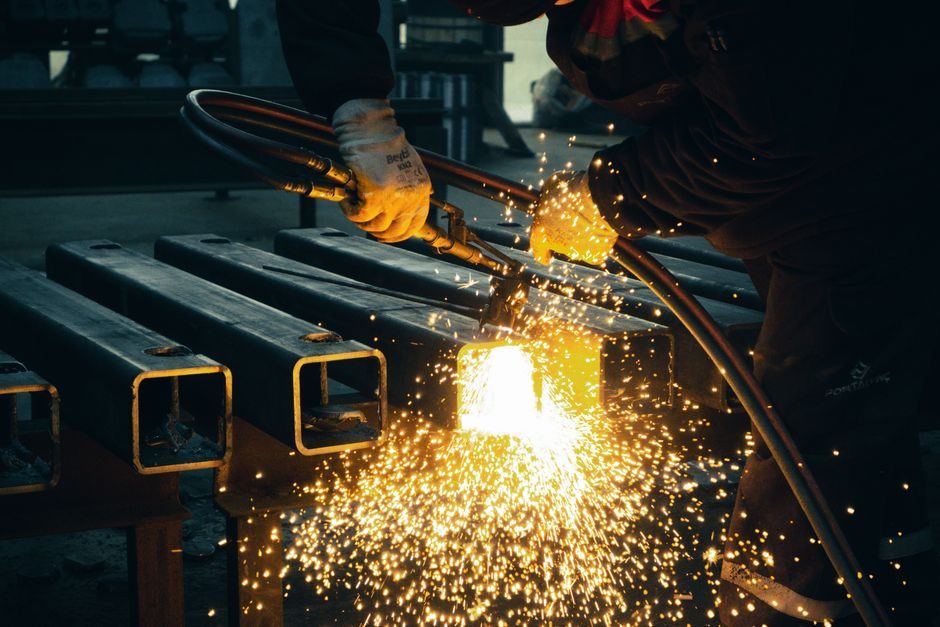
Defining the two on the same bench clears most spec confusion: a circular saw is a rotary-blade subtractive tool, while a stud welder is a resistance- or arc-based fusion tool that bonds a fastener to a base metal. They do not compete on any single spec axis — one is sized in blade diameter, kerf, and no-load RPM, the other in weld current, weld time, and stud diameter.
Process engineers in metal fabrication routinely spec both. Comparing them side-by-side forces the question of what job is being done: material removal before fit-up, or fastener attachment after fit-up. The remainder of this article maps each tool's working envelope, its primary spec axes, and the practical gate that decides which one belongs on a given work order.
Working principle: material removal vs metallic bonding
A circular saw removes material by feeding a toothed disc — typically HSS, TCT (tungsten-carbide-tipped), cermet, PCD, or diamond — through the workpiece at a defined peripheral speed. Cold-saw variants run the blade slowly enough that the cut is essentially chipless at low RPM, with coolant carrying heat away; the standard product families in industrial supply (TCT, cermet, PCD, rip, trim, and strob blades) map directly to different feed/speed envelopes [S3]. Industrial-blade suppliers in India list TCT, dado, and diamond circular saw blades as discrete product lines for wood, aluminium, and non-ferrous cutting [S1].
A stud welder joins a metallic stud to a base plate by passing a controlled current pulse through the stud tip until the contact zone melts and the stud is plunged into the molten pool. Two variants dominate: drawn-arc stud welding (ARC) and capacitor-discharge (CD) stud welding. ARC is the heavy-duty process for diameter ranges typically above ~3 mm and thicker base metal, while CD is the lighter, fast-cycle process for thin sheet and small studs. A stud welder sized for structural work commonly delivers several hundred to over a thousand amps of weld current for cycles of a few hundred milliseconds, with a duty cycle and stud-diameter range printed on the nameplate.
Spec axes: blade diameter and kerf vs weld current and stud diameter
The circular saw's spec sheet is dominated by three numbers: blade outer diameter (commonly 184 mm to 355 mm for portable cordless/corded models, and 250–500+ mm for stationary metal-cutting saws), no-load speed (typically 3,000–6,000 RPM on portable wood saws, 20–100 RPM on metal cold saws), and kerf — the width of material removed per pass, set by the blade plate and tooth geometry. Tooth count, tooth geometry (ATB, FTG, TCG), and hook angle govern finish and feed rate. Industrial woodworking catalogues segment their offering by application — rip, trim, crosscut, dado — and by tooth material (HSS, TCT, cermet, PCD, diamond) [S3].
The stud welder's spec sheet is dominated by weld current, weld time, and stud diameter range, with stud length, base-material thickness, and duty cycle as secondary gates. CD machines are commonly rated for studs in the 2–10 mm range with sub-100 ms weld times; ARC machines are commonly rated from ~3 mm up to ~25 mm studs, with longer weld times and higher kVA demand. A stud welder for structural steelwork is typically three-phase and floor-standing, while a CD unit is often benchtop and single-phase.
Comparison frame: four decision criteria, two tools

Four criteria make the difference between the two tools obvious to any specifier. First, function: the circular saw is subtractive (it removes material to create a cut), the stud welder is additive (it deposits a metallurgical bond). Second, primary consumable: saw blade (TCT, cermet, PCD, HSS, diamond) vs welding stud and ferrule (for ARC) or stud only (for CD). Third, primary spec axis: blade diameter × RPM × kerf vs weld current × weld time × stud diameter. Fourth, typical work envelope: wood and non-ferrous/ferrous sheet and section cutting vs steel, stainless, and aluminium base-metal stud attachment for electrical, structural, and insulation-lining work. Tools that overlap the chain — say, a chop saw cutting a base plate to length and a stud welder fastening a grounding lug to that plate — are sequential, not interchangeable. [S1]
Who the circular saw is for, and who it is not for
A circular saw is the right tool when the work order contains the words cut, trim, rip, crosscut, bevel, mitre, or score. Cabinet shops, framing carpenters, sign makers, steel-service centres cutting plate and section, and aluminium extrusion fabricators all keep a saw in the cell. It is the wrong tool when the required output is a permanent mechanical or electrical joint — a saw cannot attach a ground lug, hang a conduit clip, fix an insulation pin, or mount a shear connector. For those operations, a stud welder is the dedicated tool, and a saw would be at best a one-step prep tool for the base plate. [S2]
Stationary cold saws and portable circular saws also split by duty. A 14-inch portable cordless with a 184–190 mm TCT blade cutting framing lumber at 4,500–5,500 RPM is a different machine from a 350–400 mm metal cold saw running at 20–60 RPM with flood coolant and a HSS or cermet blade. Both are circular saws in the catalogue sense, but the spec range, the consumable cost, and the safety envelope are not comparable.
Who the stud welder is for, and who it is not for

Stud welding is the right tool when the work order calls for attaching threaded or unthreaded studs, shear connectors, insulation pins, grounding points, or pipe-support anchors to a base plate, beam, or sheet — typically in steel, stainless, or aluminium. Constructional steelwork, shipbuilding, electrical-panel fabrication, HVAC insulation lining, and food-processing equipment all use it because it produces a full-strength fusion bond in a single short cycle without through-holes. It is the wrong tool for cutting, for surface coating, and for any joint that requires a fillet weld longer than the stud's footprint — that is arc-welded territory, and a stud welder cannot lay a continuous bead. [S3]
Two operating points narrow the choice further. CD stud welding is generally limited to thinner base metal and smaller stud diameters and is the go-to process for sheet-metal work where ARC would burn through. Drawn-arc stud welding is the go-to for structural sizes and for studs above the CD ceiling. Misapplying a CD gun to a thick plate, or trying to use an ARC machine on a 0.6 mm stainless sheet, ends the work order early.
Adjacent tools: where the saw and the stud welder hand off to neighbours
Two neighbouring tool categories frequently come up in the same cell planning conversation. For cutting, an arc welder is sometimes deployed for air-carbon-arc gouging to remove a defect or open a root, but it is a metal-removal-by-heat process, not a precision cut — the circular saw is still the spec-driven tool for length accuracy. For joining, a TIG welder handles the precision fillet and butt welds that a stud welder cannot, and an electroslag-pressure welder handles the heavy vertical-section joining that neither tool is designed for. Cell layout that puts the cut station, the stud station, and the TIG station on the same flow line covers most light-to-medium fabrication work without overlap. [S4]
For a deeper breakdown of the saw side — blade selection, power class, and material match — the in-house Circular Saw Buying Guide 2026 walks through the spec frame. For context on adjacent power-tool classes, the side-by-side on angle grinders and demolition hammers maps how 1100–1500 W tools split between grinding and chipping duty. Material selection for the base plate a stud welder will sit on is covered in the aluminium alloy vs carbon steel spec-driven piece and the carbon steel vs cast iron spec and cost comparison.
Limitations, failure modes, and the safety envelope
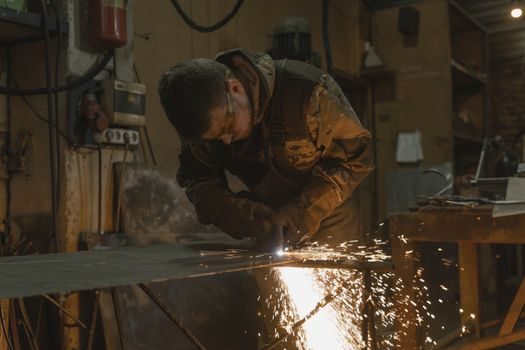
Circular saw failures cluster around kickback, blade pinching in the kerf, and tooth chipping from feeding too fast or from hitting a hidden fastener. Cold-saw blade glazing from insufficient feed or wrong blade grade is a parallel failure that costs a blade per shift if ignored. The circular saw spec sheet's kerf, tooth count, and recommended RPM band are not advisory — exceeding any of them shortens blade life and raises the kickback risk. Stud-welder failures cluster around insufficient weld current (cold/un-fused stud), excessive current (burn-through, expulsion, base-metal distortion), wrong ferrule, and inadequate surface prep. ARC stud welding in particular requires the base metal to be clean, within the stud-welder's diameter-vs-thickness table, and grounded correctly. CD stud welding on dirty or oily sheet lifts the stud immediately. [S1]
Both tools carry a real safety envelope — saw blades throw chips at peripheral speed, and stud welding produces intense UV, hot spatter, and magnetic fields from the weld current pulse. PPE and screen rating differ, but the cell layout is the same: a stable workpiece, a fixed operator station, and a clear view of the weld zone or the cut line. Neither tool tolerates improvisation, and neither is interchangeable with the other for a work order that names cutting or joining specifically.
Verifiable signals to track: a saw cell is sized right when blade changeover is rare and cut quality is consistent; a stud-welder cell is sized right when weld-current setpoints match the published stud-diameter table and ferrule consumption is steady. Either signal drifting is a spec or process gap, not a tool-brand problem.