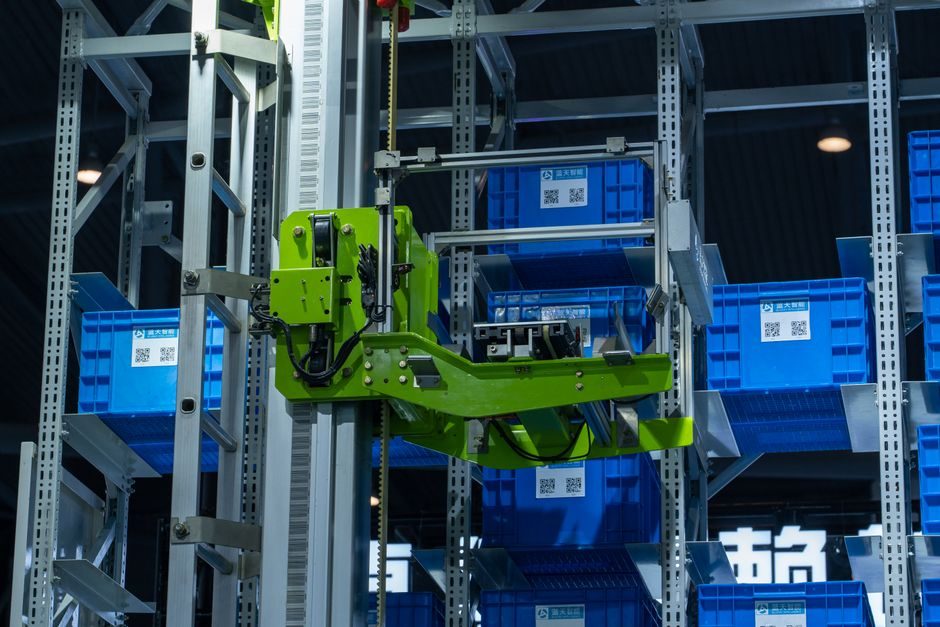
Upstream of a collaborative robot sits a tight component stack — harmonic reducers, joint torque/force sensors, servo drives, and the safety-rated controller — while downstream sits the systems integrator, end-effector supplier, and the end-use cell (assembly, palletizing, machine tending, mobile manipulation) [S1][S3][S7].
The decisive spec gate for every cobot on the market remains ISO 10218-1 plus the technical specification ISO/TS 15066, with safety-function hardware built to ISO 13849-1; OMRON's TM Series explicitly states compliance with all three documents [S3]. That regulatory spine is what allows a 6-axis arm to share workspace with an operator without hard fencing.
Upstream Component Stack: Reducers, Sensors, Servos, and Safety Controller
The upstream stack follows a fixed four-block architecture: harmonic-drive or RV reducer at each joint, a torque or force sensor in the joint or wrist, a low-voltage brushless servo drive per axis, and a safety controller that enforces power-and-force-limiting per ISO/TS 15066 [S3][S5]. A cobot is not a SCARA robot re-labelled — the strain-wave reducer, the redundant encoder, and the safety-rated stop function are mandatory cost items that drive unit price well above a comparable-payload industrial articulated robot [S5].
Selection at the component tier is binary on three criteria: backlash under 1 arc-minute for the strain-wave reducer, single-fault tolerance on the torque sensor, and a safety controller category that supports PL d or higher under ISO 13849-1 [S3]. OMRON publishes patented "body region safety settings" that pre-load ISO/TS 15066 biomechanical limits — quasi-static and transient contact thresholds — into the controller so integrators do not calculate them by hand [S3]. That feature alone shrinks commissioning time on a palletizing cell from days to hours [S3].
Vendor Landscape: ABB, OMRON, Mitsubishi Electric, and the Zibo Cluster
ABB lists its collaborative-robot portfolio under the Robotics product family on new.abb.com, with parallel Italian and Chinese localization pages confirming a globally consistent SKU strategy [S1][S2]. Mitsubishi Electric's MELFA ASSISTA line is positioned for operators without specialist robotics training, with hand-guidance and a graphical programming interface that collapses the integrator dependency [S4].
On the supply side, the China Daily report on Zibo identifies AUBO (Shandong) Robotics Technology Co Ltd as a leading domestic cobot producer in that cluster, with the report explicitly noting a "collaborative robot industry supply chain" has formed in the city — meaning reducer, motor, and controller vendors are co-located within roughly a one-hour drive [S8]. For an OEM sourcing upstream, that cluster compresses lead time on a complete joint module to weeks rather than the months typical of European-sourced equivalents [S8].
Payload Segmentation: 5 kg, 10 kg, and the 10 kg+ Tier
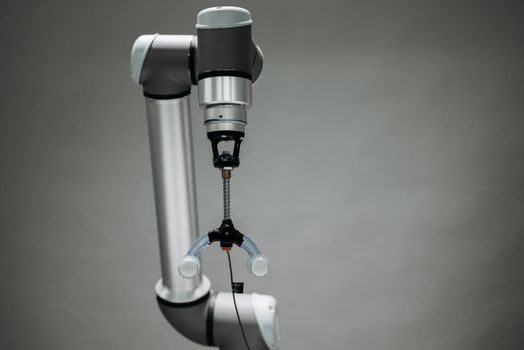
Allied Market Research's published taxonomy splits the cobot market by payload: Up to 5 kg, Up to 10 kg, and Above 10 kg, with applications listed as assembly, pick & place, handling, packaging, quality testing, machine tending, gluing & welding, and others [S7]. That segmentation maps cleanly onto cell choice: 5 kg-class arms dominate electronics assembly and small-parts pick & place, 10 kg-class arms cover packaging and light machine tending, and the 10 kg+ tier goes to palletizing and metalworking.
The OMRON TM Series confirms the mobile-manipulation angle: mounting a TM cobot onto an OMRON LD AGV robot creates a mobile manipulator that automates both transport and picking, and DC-powered variants exist specifically for that mobile-platform use case [S3]. This is a meaningful difference versus fixed-base AMR robot deployments — the cobot brings force-limited contact safety that a pure AGV/AMR cell cannot.
Downstream Integrator Cell: Assembly, Palletizing, Tending, Mobile Manipulation
Downstream, the integrator absorbs risk on four reference cells: assembly, palletizing, machine tending, and mobile manipulation [S3]. For assembly, the value is throughput and consistency on repetitive or complex tasks — part joining, insertion, tool changing — alongside a human operator rather than behind a cage [S3]. For palletizing, the cobot's space-saving footprint and OMRON's built-in palletizing wizard let end-users build their own stacking software rather than paying a systems integrator for a custom stack-pattern library [S3].
Machine tending on CNC, injection molding, stamping, punch press, grinding, and cutting equipment is the highest-ROI downstream cell, because the cobot relieves workers from repetitive, dangerous work near moving spindles and hot dies [S3]. Screwdriving and dispensing (gluing, sealing, painting) close the application set, with hand-guide path recording on the cobot arm allowing complex trajectories to be deployed in minutes rather than programmed via teach pendant [S3].
Comparison Passage: Upstream Cost vs Downstream Cell ROI
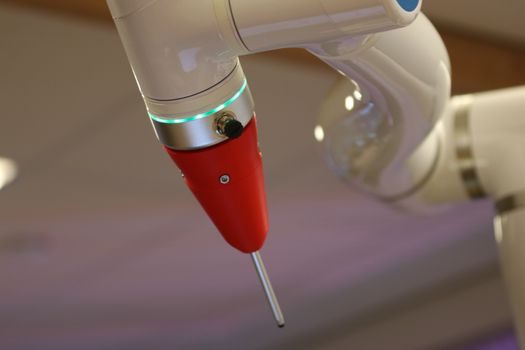
A spec-driven comparison lines the three payload tiers against two decision criteria: upstream unit cost (dominated by reducer + sensor stack) and downstream cell payback (dominated by labor displacement and footprint saving). The 5 kg tier scores lowest on upstream cost but limits downstream to electronics assembly and small pick & place. The 10 kg tier is the crossover — upstream cost roughly doubles versus the 5 kg tier, but downstream expands into machine tending and packaging where labor displacement is larger [S7].
The 10 kg+ tier pushes upstream cost another 1.5–2x because RV reducers typically replace harmonic drives above ~8 kg, and joint torque sensors scale with payload, but downstream opens palletizing and metalworking cells where one cobot can replace two operators on a three-shift schedule [S7]. The Zibo cluster compresses upstream lead time for the 5 kg and 10 kg tiers specifically — its component base is built around harmonic-drive volume, not RV [S8].
Standards, Safety Limits, and Where Specs Get Hard
ISO 10218-1 is the parent industrial robot safety standard, ISO/TS 15066 is the collaborative-mode technical specification that defines quasi-static and transient contact limits by body region, and ISO 13849-1 governs the safety-related control system's performance level (PL) [S3]. The hard part for any integrator is the biomechanical limit calculation under ISO/TS 15066 — maximum permissible robot speed, maximum permissible kinetic energy, and maximum permissible quasi-static force are all coupled to the body region being contacted [S3].
OMRON's patented "body region safety settings" sidestep that calculation by pre-loading validated parameter sets tied to specific body regions (hand, finger, arm, chest, etc.), so the integrator selects a region and the controller enforces the corresponding limit [S3]. For an integrator with no in-house safety engineer, this feature is the single biggest risk reducer on a project — without it, every cell needs custom biomechanical calculation and third-party validation, which adds weeks and significant cost to commissioning [S3].
Downstream Constraints: Vision, Footprint, and Mobile Power
Built-in vision is now a default requirement on most cobot cells. OMRON's TM Series ships with an integrated camera and lighting that supports pick & place, inspection, and landmark-based navigation; the landmark feature lets the cobot re-locate objects within the workspace without full vision recalibration during high-mix, low-volume changeovers [S3]. For mobile manipulation, the DC-powered variant of the TM cobot is the relevant SKU because it accepts battery power from an AGV robot platform [S3].
Failure modes downstream are dominated by three issues: payload mis-specification (a 5 kg arm is asked to handle a 6 kg part plus gripper), cycle-time pressure that pushes the cobot above its ISO/TS 15066 speed limit, and integrator under-specification of the safety controller's stop categories (the difference between a category 0 and a category 1 stop is the difference between an immediate power cut and a controlled stop — getting this wrong voids ISO 13849-1 compliance) [S3][S5].
The next node to watch is the explicit 2026 cut of vendor, spec, and standards data for cobot supply chains — the Collaborative Robot Supply Chain Map: 2026 Vendor, Spec, and Standards Cut article lines up the same component architecture discussed above against specific 2026 SKUs from ABB, OMRON, Mitsubishi, and AUBO. The second trackable signal is the publication cadence of ISO/TS 15066 revisions — any tightening of the quasi-static and transient contact limits flows directly into the safety controller's pre-loaded parameter set and changes the upstream sensor specification for new arm designs [S3].