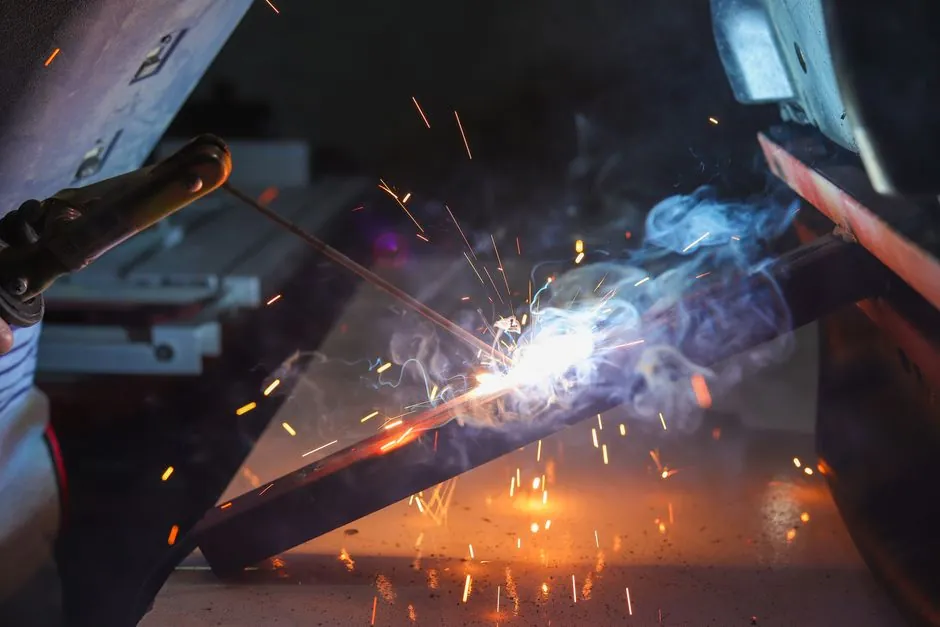
A cobot welder is a 6-axis or 7-axis collaborative arm fitted with a MIG/MAG or TIG torch that shares workspace with a human operator, and it is now specified for batches as small as five pieces in high-mix job shops [S5].
Why this matters to small fabricators: the American Welding Society has projected a need for over 330,000 new welders by 2028, and collaborative welding cells are positioned as the most accessible automation bridge for shops that cannot justify a fenced industrial robot [S3]. Job shops that have already installed cobot cells report stacking multiple units, with one example facility running seven Vectis Automation cobot welding systems across steel and aluminum work [S4].
What a cobot welding cell actually contains
A cobot welding cell typically packages four subsystems: a 6-axis or 7-axis collaborative arm, a professional MIG/MAG or TIG power source from makers such as Fronius, Miller, or Lincoln, a torch-and-wire-feeder assembly mounted to the robot flange, and a light enclosure or curtain set that blocks arc flash and spatter even though the arm itself is force-limited and collaborative-rated [S3]. The 7-axis variant adds an extra elbow joint, which is the configuration most job shops pick because it reaches around fixtures and into tight subassemblies without a positioner [S3].
Most cells in 2026 are sold as preconfigured packages with the power source, table, and software already mapped to the arm, which removes roughly 60 to 80 percent of the integration hours a traditional robot cell would need [S1]. The collaborative safety rating still does not waive the need for fume extraction or arc-eye protection, so spec sheets should be read for the arm's payload and reach, not for a waiver of welding PPE [S3].
When a cobot welder fits, and when it does not
Cobot welding is appropriate for shops running high-mix, low-volume work with batches in the 5 to 50 piece range, repetitive fillet or lap welds that consume senior welder hours, and parts that fit on a 1.2 m by 0.8 m table without a positioner [S5][S3]. It is not appropriate for high-deposition thick-plate work above roughly 6 mm root passes with multi-pass choreography, for assemblies needing rotary positioners larger than the cell footprint, or for code-critical pressure-vessel welds that demand full traceability and a fixed robotic cell under ASME Section IX qualification rather than a teach-pendant workflow [S1][S3].
Process fit, not headcount, is the real gate. A shop whose bottleneck is fit-up, layout, and tack time will not see arc-on time climb from a cobot alone, which is why integrators now run a two-stage audit: first standardize fixturing and part flow, then introduce the cobot, otherwise the arm waits for parts just like the welder did [S4].
Selection criteria: cobot vs traditional robot vs manual welding
Travel speed, often the headline spec on a cobot data sheet, is the least useful number for a high-mix job shop; setup time per new part dominates the cycle-time math, and a four-hour teach on a 20-minute weld kills the return on a small batch [S5]. The criteria that actually decide the purchase are teach-pendant simplicity, footprint, reach, payload, and the welding-process license bundled with the power source.
Compared against the other two options a job shop typically weighs, the picture looks like this. Manual welding has the lowest capital cost but the highest variable labor cost and the worst consistency on long repetitive joints; a traditional industrial welding robot has the fastest cycle and the heaviest payload, but it needs a fenced cell, a dedicated programmer, and pays back only on long runs of identical parts; a cobot welder sits in the middle, with a footprint of roughly 2 m by 2 m, a payload commonly in the 10 to 16 kg range, and a no-code teach interface that lets a senior welder hand-guide the path instead of writing code [S5][S3][S1].
For a one-shift job shop running repetitive fillets, industry guidance puts cobot welder payback in the 12 to 24 month band, and multi-shift operations or shops replacing high-cost contract welders can compress that further, though exact months depend on local labor rates and arc-on time [S9].
Pre-automation housekeeping that decides ROI
Part consistency, fixturing, and workflow structure are the three upstream variables that determine whether a cobot delivers its quoted throughput, and fixing them is a precondition, not an optional extra [S4]. One reference shop, Caltech Manufacturing, traced its early arc-on-time losses to inconsistent part flow and poor fit-up, then rebuilt fixtures so components could only load one way before any cobot was installed [S4].
Breaking complex weldments into smaller repeatable subassemblies is the second lever, because it lets less experienced welders master defined joints while the cobot runs the long repetitive seams, and it raises overall arc-on time without adding headcount [S4]. The practical gate for any shop is simple: if your senior welders still spend more than 30 percent of the day on layout, fitting, and grinding, those tasks must be reassigned to support staff before the cobot arrives, otherwise the cell will sit idle waiting on preparation [S4].
Programming model and operator skill path
The defining workflow change versus a traditional robot is the no-code or hand-guiding teach method, where the operator physically moves the torch to waypoints and the software records the path, removing the need for a specialist programmer or external integrator for most new parts [S5]. For job shops this is the single largest cost-of-ownership reduction, because a four-hour manual teach replaces what would otherwise be a half-day to multi-day offline programming session on a conventional robot [S5].
The operator skill path typically runs one to two days of vendor training for a welder who already reads a WPS, and the learning curve is dominated by torch-angle discipline and stick-out, not by code, which is why most shops assign their best welders to be the cobot's first programmers and shift them into supervisory roles once the cell is in production [S1][S7]. For deeper integration with line control and shop-floor data, the same welder-supervisor team often pairs the cell with a PLC for sequencing fixtures, lights, and interlocks so the cobot handshake mirrors the rest of the cell.
Real shop data and failure modes
Documented field outcomes from cobot deployments point to four recurring failure modes: poor fit-up tolerance that forces constant re-teaching, fixturing that was not designed for the cobot's specific reach envelope, fume extraction undersized for the arc-on time the cell actually runs, and an over-reliance on the collaborative safety rating in workcells where pinch points exist between the part and the table [S3][S4]. Each of these is fixable in spec, not in service: tighten fit-up to roughly plus or minus 1 mm, design fixtures to the cobot's reach map rather than the human's, and size fume extraction for sustained, not nominal, duty cycle [S4].
A useful pre-purchase test from working integrators is the on-site mobile demo: run three of your real parts through the cobot for a full shift before signing, with your own welder doing the teaching, and measure arc-on time, teach time per part, and any re-teach events, because those three numbers drive payback more than the spec sheet does [S5][S3].
Standards, safety, and sourcing signals
Collaborative robot safety is governed by the ISO 10218 and ISO/TS 15066 family, which define the force, speed, and pressure limits under which a robot can operate without a cage, and cobot welding cells must still meet the welding-side arc-flash, fume, and ventilation requirements applied to any welding station, regardless of collaborative rating [S3]. Buyers should confirm that the quoted payload, reach, and collaborative mode are documented to those ISO clauses, not just described as "collaborative" in marketing copy [S3].
For a related reference on adjacent joining processes that often share the same job-shop floor, this stud welder versus resistance projection welding decision guide lines up the duty-cycle and thickness ranges where fastener-attach automation competes with a cobot MIG cell. Two trackable signals through Q4 2026: AWS regional chapter reports on cobot-trained welder counts, and the next round of FABTECH cobot-cell exhibits, which historically set the practical benchmark for new no-code software releases and preconfigured power-source bundles [S4][S8].
The underlying component specifications are covered under welding cutting tool, and pressure transmitter.