For high-temperature or chilled-line traceability, an industrial barcode scanner with an IP65+ housing, 0–50°C operating window, and 1D/2D imager is the safer spec than a generic code reader, with the gap widening as conveyor speeds exceed 1 m/s.
Generic code readers — including software-only kits such as the DataSymbol Barcode Reader SDK (20,000+ test images, Windows/Android/Linux/Raspberry Pi targets) and the Barcode-Reader.App Android client — are decoder engines, not field-hardened devices [S3][S4]. The 2026 reviews of Chromebook scanner apps and the RS Components accessories catalogue both separate "barcode scanner apps/software" from industrial reading hardware [S1][S2].
Decision Frame: Reader Type vs Use-Case
An industrial barcode scanner is a sealed imager or laser gun built for line-side mounting: IP65–IP67, drop-rated 1.5–2.0 m, and typically 0°C to 50°C ambient, with ruggedized variants reaching –30°C to 70°C [S2]. A code reader is the broader software/device category that includes SDKs, keyboard-wedge apps, and embedded decoder libraries running on generic hardware [S1][S3]. On a temperature-limit tracking point — bakery, retort, freezer tunnel, paint cure oven — the industrial unit wins on three hard gates: read distance, code damage tolerance, and fail-state interlock wiring.
Pick an industrial barcode scanner when the code is laser-etched, dot-peened, or thermally printed, the line runs in condensation or washdown, or a miss must trigger a hard interlock through a limit switch coil or PLC input. Pick a code reader (SDK or app) when scanning is done by an operator on a tablet in a dry office, the data feeds a MES only, and a missed scan is recoverable by re-entry.
Spec Comparison Across Four Gates
1) Temperature window. Consumer code readers quote 0°C–40°C, with many Android scanners derating above 35°C. Industrial imagers list 0°C–50°C as standard, with –30°C–70°C extended variants; heated optics prevent condensation fog at sub-zero infeed [S2]. 2) Read distance and field of view. Handheld apps depend on the tablet camera (typically 5–25 cm). Industrial fixed-mount imagers run 10–300 cm on 1D Code 128 and 5–80 cm on 2D DataMatrix, with liquid-lens autofocus holding focus under thermal drift [S2]. 3) Code damage tolerance. Industrial imagers use algorithms tuned for low-contrast and damaged marks; SDKs such as DataSymbol claim "highest speed and reliability" but their value-add is decode logic on clean images, not optics [S3]. 4) Connectivity to control. Industrial units ship with discrete I/O, RS-232, TCP/IP, PROFINET, or 4-20 mA trigger outputs that a temperature controller or limit switch box can read directly; software scanners expose only keyboard or HTTP [S1][S2].
A useful one-line summary for sourcing: industrial = optics + IP + control I/O; code reader = decode engine + UI. The two are complementary, not substitutable, on a real line.
Wiring the Missed-Scan Interlock to a Temperature Limit
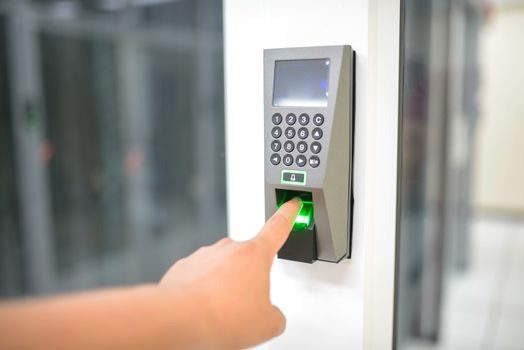
A temperature-limit tracking point typically pairs the scanner's "good read" output with a safety relay, so a failed decode drops the line before the temperature monitor sees a valid part ID. Industrial scanners expose a PNP/NPN "OK" pulse (24 VDC, 20–100 ms) that maps cleanly to a digital input on a temperature controller or a safety PLC; the controller then latches the oven or chiller off via a relay until the next good read. Generic code readers cannot drive this loop because they have no hardware output — they only type a string or call an API [S1][S2].
For conveyor-cell retrofits where a barcode miss must stop the line, the scanner-to-relay chain is the same as a limit switch selection criteria for packaging line retrofits build: dry-contact output, 24 VDC coil, fail-safe wiring so a cable break also trips the limit switch box. The shared spec map across these blocks keeps the BOM coherent.
Failure Modes and Limits
Industrial barcode scanners fail in three temperature-driven ways: lens fogging on chilled lines (mitigated by heated housings rated to –30°C), LED derating above 50°C (red 660 nm LEDs lose contrast on hot steel), and cable insulation breakdown near ovens (spec silicone-jacketed cable, not PVC) [S2]. Code readers fail differently: app crashes on Android updates, decode latency under heavy CPU load, and no interlock path when the host PC hangs [S1]. For a temperature-limit point, a host-PC failure is unacceptable; a hardened imager with local I/O and a watchdog relay is the correct fail-state architecture.
Standards and Sourcing Notes

Industrial bar code equipment is typically built to IEC 60079 for hazardous-area zones when specified near solvent lines, and to ingress ratings IP65/IP67 per IEC 60529 for washdown; the RS Components accessories line lists stands, interface cables, and power supplies matched to those ratings [S2]. Software-only readers carry no IP or hazardous-area rating because they are libraries, not devices [S3][S4]. When the spec demands both — for example a freezer tunnel in a Zone 2 area — pair an ATEX/IECEx industrial imager with a barrier, not a tablet app.
Related control-panel wiring on the same line should follow a consistent BOM: choose the scanner family first, then size the limit switch box, cable duct, and UPS branch around its load and ambient — the same spec-first logic used in the relay module selection criteria and control cable selection guide maps.
Buyer Recommendation
Spec an industrial 2D imager (0–50°C minimum, IP65+, 24 VDC, PNP good-read output, PROFINET or TCP/IP) for any temperature-limit point above 1 m/s line speed or below 0°C ambient, and wire its good-read pulse into a safety relay so a decode miss opens the line through a limit switch box. Reserve code readers — SDKs, Android apps, Chromebook utilities — for operator-led MES stations where temperature, washdown, and interlock are not in scope [S1][S2][S3][S4]. When in doubt, the code reader category page clarifies the boundary between decode software and industrial reading hardware.
Track three signals over the next sourcing cycle: PROFINET and OPC UA support on new industrial imagers (rising), heated-optic variants at the 0°C boundary (still a 2-week lead time from major distributors), and SDK-side AI-assisted decode for damaged DPM marks (already shipping in 2026 dev kits).