
Selection starts with five hard numbers: core count, cross-section, jacket material, screening construction, and temperature rating, because every later electrical decision (voltage drop, EMI, flex life) drops out of them. A screened 4-core 16 AWG PVC-jacketed cable such as Lapp OLFLEX CLASSIC 110 CY (1135304) is a workable default at RMB 42.712/m for a 50 m reel, with a maximum operating temperature of 80 °C and an acc. to IEC 60811 / EN 60811 / EN 50395 / EN 50396 compliance profile [S1].
Distributors are stocking a wide spread around that baseline on 2026-08-04: from 0.56 mm² 20 AWG 6-core Xtra-Guard 4 TPE-jacketed cable (Alpha Wire 45466) at RMB 167.166/m, to 2.5 mm² 13 AWG 4-core Lapp LSZH flame-retardant cable (1135404) at RMB 57.196/m, to 305 m reels of 4-pair 0.81 mm² Alpha Essentials communication cable (2244C SL001) at RMB 108.53/m [S9][S10][S7]. The same screening requirement can therefore be met across a roughly 4× price band once jacket and conductor size move.
Cross-Section and Core Count: The First Spec Gate
Cross-section is set by ampacity plus allowable voltage drop, not by panel aesthetics; 0.75 mm² (≈ 18 AWG) Belden CY cable (CYSB03.01100) is the most common 3-core entry point stocked at 100 m reels, and an equivalent 4-core 18 AWG Lapp CY (1136104) lists at HK$ 27.816/m on the Hong Kong catalog [S5][S3]. Going up one size to 16 AWG (1.5 mm²) gives roughly 50 % lower voltage drop on the same 50 m run, which matters for long trunk pulls back to a control valve manifold in a process skid [S1].
Core count should match the I/O list with one common return, not a round number picked early. A 6-core 20 AWG TPE cable (Alpha Wire 45466, 0.56 mm²) is the right size when you need three switched outputs plus three returns inside one jacket, while a 4-core cable is enough for most single-axis two-hand control stations where the safety relay only watches two channels plus a monitored reset [S10]. For data, a 4-pair 0.81 mm² 305 m reel (Alpha 2244C) is closer to a linear guide encoder bus than a discrete I/O run, and should be specified on the data-cable line, not the control line [S7].
Jacket Material: PVC, LSZH, or TPE
PVC is the cheapest and most stocked jacket, and the OLFLEX CLASSIC 110 CY transparent PVC sheath survives oil and chemical splash well enough for the inside of a control cabinet [S1]. Where fire load, tunnel air, or passenger-area rules apply, switch to LSZH: Lapp 1135404 is a 4-core 2.5 mm² 13 AWG halogen-free, flame-retardant screened cable at RMB 57.196/m, and it is the default pick for European machinery going into EN 45545 rail or public-building projects [S9].
For moving machinery, hot zones, or any cable that flexes more than a few times a month, TPE or thermoplastic-elastomer jackets outperform PVC on both temperature and oil resistance. Alpha Wire Xtra-Guard 4 (45383, 3-core 18 AWG screened) is rated to the FT1 vertical-flame test and is jacketed in black thermoplastic elastomer, which holds at higher continuous temperatures than PVC and resists the cutting fluids common around a crossed-roller guide assembly [S8]. Xtra-Guard 2 (25384) sits between the two, with a PVC jacket but upgraded oil and abrasion resistance, and shows up as the mid-tier choice in 4-core 18 AWG builds [S2].
Screening: Braid, Foil, or Both
Screening controls EMI immunity and emission, and the construction matters as much as the metal. Lapp's CY series ships as braid-only screened stranded, and the 16 AWG build is speced at 30 × 0.25 mm strands (30 AWG strands), which keeps DC loop resistance low [S1].
Shielded cable selection does not stop at "screened yes / no" — coverage percentage, drain-wire gauge, and the grounding method at the gland all show up in field failures. A useful companion read is the engineering map for shielded cable selection criteria, which lines coverage values against typical VFD and encoder use cases.
Temperature, Voltage, and Standards Anchors
Three ratings drive derating: maximum conductor temperature, minimum bend radius, and rated voltage. The OLFLEX CLASSIC 110 CY tops out at 80 °C, which matches the EN 50395 / EN 50396 / IEC 60811 test profile cited on its datasheet [S1]. Lapp's LSZH 2.5 mm² cable is rated to 500 V, which is the common 300/500 V control-circuit class in IEC 60204-1 industrial machine wiring. Where UL 758 AWM style numbers apply (Xtra-Guard 2, Xtra-Guard 4), the additional FT1 vertical-flame mark appears on the print legend and is the right anchor for North American machinery panels [S2][S8].
For installations that touch a safety PLC or an access control panel, the cable jacket should also be checked for any plenum (CMP) or riser (CMR) rating demanded by the building code, because the control-circuit cable and the safety-bus cable can fall under different fire classes in the same tray. Always cross-check the cable's datasheet against the panel's listing before terminating.
Options Compared Side by Side
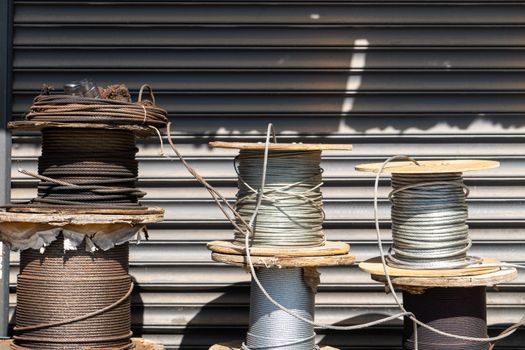
Five representative control-cable options are still in stock on 2026-08-04 across the major regional catalogs, and they map cleanly onto common duty profiles:
• Lapp OLFLEX CLASSIC 110 CY 4×16 AWG PVC screened, 50 m, 80 °C, ~RMB 42.7/m — default dry cabinet and light-industrial trunk [S1].
• Lapp OLFLEX 4×2.5 mm² 13 AWG LSZH flame-retardant screened, 50 m, 500 V, RMB 57.196/m — public-building, rail, and confined-space pulls [S9].
• Belden CYSB03.01100 3×0.75 mm² 18 AWG PVC screened, 100 m, ~RMB 25.3/m at 50 m equivalent — small I/O blocks and sensor manifolds [S5].
• Alpha Wire Xtra-Guard 4 3×18 AWG TPE screened FT1, 30 m, RMB 167.686/m — moving machinery, hot zones, cutting-fluid exposure [S8].
• Alpha Wire Xtra-Guard 2 4×18 AWG PVC screened, 30 m, TWD 621.533/m — mid-tier oil/abrasion duty without the LSZH cost [S2].
Decision rule: if the run moves, is hot, or touches oil, spend the 3–4× premium on TPE/LSZH; if the cable sits clipped inside a panel back to a fixed control valve, the PVC screened default is still the right answer.
Who Should NOT Pick the Cheap PVC Default
Three use cases break PVC screened cable and are not worth revisiting. First, any run that flexes more than a few cycles per day (robot dress packs, crossed-roller guide carriages, drag chains): PVC jacket will cut through quickly, and the cable needs TPE or PUR with a documented flex life. Second, any run inside a public-building riser or any EN 45545 rail vehicle: LSZH is mandatory for the low-smoke, low-toxicity requirement, and the additional RMB 14–15/m per core is far cheaper than re-pulling later [S9].
Third, any VFD output run longer than 5 m on a 400 V drive: PVC screened braid-only is not enough, and the cable must be specified as a symmetrical VFD cable with full foil + braid screening and an overall drain, with the screen grounded at both ends through 360° EMC glands. For power and data coexistence, the power cable vs wiring duct write-up gives a useful view of the segregation rules that go alongside this.
Sourcing Signals and Watch Items

Two trackable signals stand out on 2026-08-04: first, multi-vendor distributors are still back-ordering on a 50–80 day cadence for some LSZH 2.5 mm² reels (the Lapp 1135404 listing still shows 6 pieces queued for a 2026-06-12 ship window at the time of the catalog snapshot), so any large project should confirm reel-level availability before locking the BoM [S9]. Second, the TPE-jacketed Xtra-Guard 4 line (Alpha Wire 45383, 45466) is back in stock with 2-piece and 34-piece top-up shipments dated within 5–8 days, which suggests flex-grade supply has normalised after the 2024–2025 squeeze [S8][S10].
Next node to track: the 2026-08-10 replenishment of the 305 m 2244C communication cable reel (2,135 + 610-piece drop scheduled) is the most concrete near-term data-point for control cable availability into the back half of August 2026 [S7].