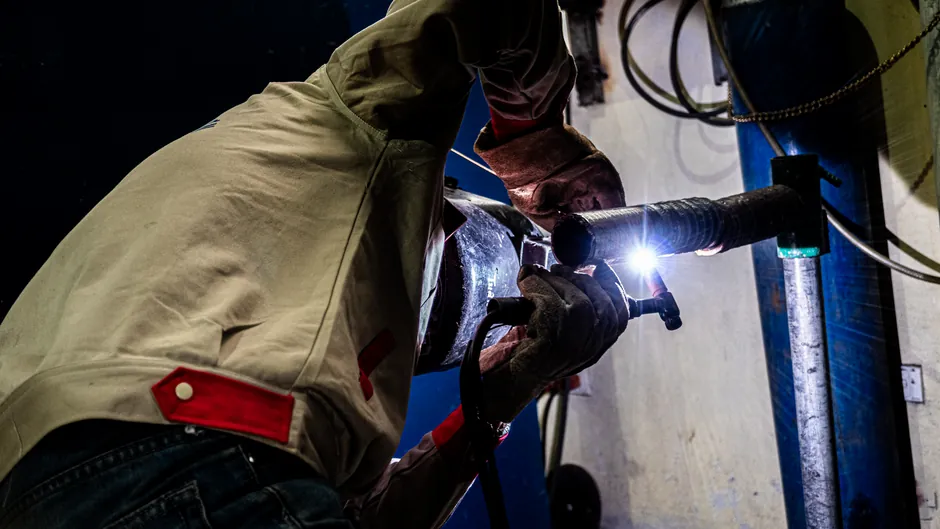
An electroslag pressure welder used in interior-finishing column and core-wall work must deliver no-load voltage in the 70-90 V band to strike an arc through HJ431-type granular flux, and current capacity above 1,000 A for bar diameters above 32 mm [S1].
For interior vertical column rebar the workable diameter window is 16-40 mm without filler wire, while the related electroslag welding (ESW) variant on thick plate covers 25-300 mm in a single vertical pass at DC 40-50 V and roughly 600 A with slag near 1900 °C [S2][S3].
Process Definition and the Two ESW Variants Most Sites Confuse
Electroslag pressure welding (EPW) and electroslag welding (ESW) both use current flowing through a molten conductive slag pool, but only EPW applies axial upset pressure to forge a bar-to-bar joint inside a flux-filled mold, while ESW deposits consumable wire between water-cooled copper shoes to join plate [S2].
EPW works on vertical or inclined bars within roughly a 4:1 gradient, joining diameters typically 16-40 mm without separate filler wire and producing a visible weld collar that is later ground flush before concrete placement, whereas ESW (including the modern narrow-gap NGI-ESW) runs in a vertical seam in one continuous pass on plate that historically reached 75 mm and beyond, with NGI-ESW operating in an approximately 19 mm gap [S2]. For an electroslag pressure welder on interior column work the rebar EPW process is the relevant code path, governed in China by JGJ 18-2012 and in the US by AWS D1.4/D1.4M, while plate ESW on built-up members is governed in the US by AWS D1.5 (Bridge Welding Code) [S1][S2].
Selection Criteria That Decide the Purchase: Diameter, Current, Voltage, Upset Force
Four specifications must be locked before quoting an EPW rig for interior column work: maximum bar diameter the welding head accepts (commonly 16, 20, 25, 32, 40 mm), welding current rating and duty cycle of the power source, upset (forging) force the head can deliver, and the control sequencing of arc stage, electroslag stage, and upset stage [S2].
A no-load voltage of 70-90 V is required to strike the arc through the flux, well above a general arc welder, and welding current plus time both rise with bar diameter per JGJ 18-2012 table 4.6.6 for HJ431 flux; above 32 mm bar a 1,000 A source is needed to heat the largest joint quickly enough to avoid lack of fusion [S1]. The weld-collar quality limits in JGJ 18-2012 set axial offset, bar-diameter mismatch, and visible defect thresholds the equipment must hit under production rate, not just in the lab [S2]. For interior finishing crews already familiar with stud fastening, the procedural logic is close to that of a stud welder: clamp, control sequencing, and per-diameter parameter window are the same triad.
Comparison of Main Equipment Options an Interior-Finishing Buyer Faces
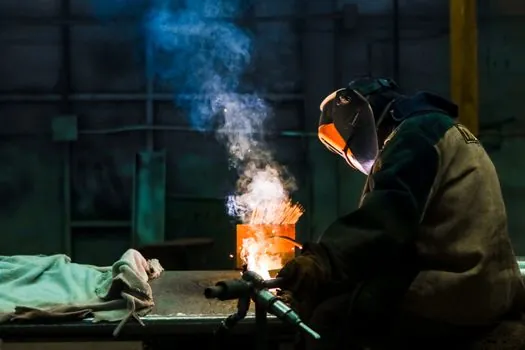
Manual clamp, AC transformer welder, single bar range 16-32 mm: lowest cost, light head, suited to small interior pier columns, but operator skill drives weld-collar quality; manual clamp, inverter DC welder, 16-40 mm range with programmable arc-to-upset timer: higher first cost, more repeatable collars, preferred on tall cores where the worker climbs with the head; semi-automatic dual-operator rig, 25-50 mm range with hydraulic upset: best collar consistency on large-diameter bars, heavier, needs crane lifts [S2].
For interior thick-plate splices in built-up transfer girders or core-wall embedments the option set is NGI-ESW (AWS D1.5 accepted for non-fracture-critical members), submerged arc welding (SAW) for horizontal plate, and shielded metal arc welding (SMAW) for short or field repair joints [S2]. Where a finishing crew must fasten anchorage embed plates to a steel beam before concrete pour, the same flux-arc principle shows up in a stud welder selection for interior finishing decision, though stud welding runs at much lower heat input than a rebar EPW cycle.
Process Parameters and Operating Envelope for ESW on Thick Plate
ESW runs on DC at 40-50 V with welding current around 600 A, scaling upward for thicker plate, and slag temperature sits near 1900 °C, well above the melting point of the consumable wire and the parent plate edges [S3]. The consumable guide tube and wire feed travel vertically upward at a controlled rate matched to the melt-off, while copper retaining shoes on each side of the joint contain the molten pool and slag bath so the cavity does not run off [S3].
Deposit rate reaches 20 kg/h, a figure that lets a single ESW station replace multiple multi-pass arc bays on heavy plate, and flux consumption is low because the molten slag bath is reused as the heat source and shielding medium, with per-kilogram electric-power demand correspondingly below many comparable fusion processes [S3]. Uniform heating across the thick plate reduces the residual-stress gradients and distortion that plague multi-pass welds, which is why ESW is widely specified for thick low-carbon-steel plate and heavy structural sections [S3].
Limitations, Failure Modes, and Who Should Not Specify EPW or ESW
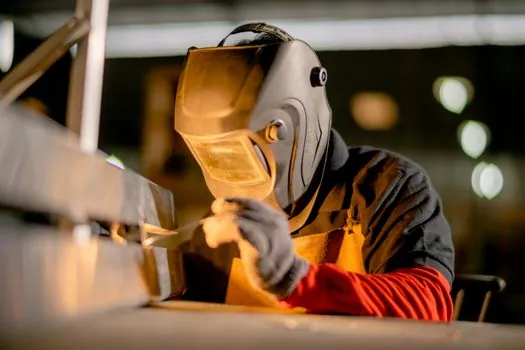
ESW is restricted to vertical or near-vertical orientation because the molten pool and slag must be held by gravity and copper shoes, so out-of-position work is mechanically impractical with a standard rig, and plate below roughly 25 mm cannot reliably establish and hold the slag bath, pushing thin-gauge fabrication onto TIG welder or arc welder processes [S3].
Coarse prior-austenite grain and a wide heat-affected zone are inherent to the slow cooling produced by the large slag mass, and on some quenched-and-tempered or alloyed grades this drives HAZ hardness above the bands that sour-service or low-temperature toughness regimes will accept, while stainless, high-alloy, and aluminum grades are not in the documented operating window for generic ESW [S3]. For interior column rebar, EPW is the right tool where bars run true and the crew can stage a column cage, but it is the wrong tool where bars are pre-tied in a mat that cannot be rotated, where horizontal splices dominate, or where the structural engineer has specified mechanical couplers for fatigue or seismic detailing [S2].
Standards, Code Path, and What Auditors Will Ask For
Rebar EPW on interior columns is governed in China by JGJ 18-2012, the Specification for Welding and Acceptance of Reinforcing Steel Bars, with test methods in JGJ/T 27 and the comparable US framework being AWS D1.4/D1.4M Structural Welding Code for steel reinforcing bars, sitting alongside ACI 318 splice provisions for development length and splice class [S1]. Plate ESW on US built-up girders runs under AWS D1.5 (Bridge Welding Code), constrained on fracture-critical members by the FHWA memorandum dated 2018-05-10, after FHWA rescinded tolerance on main structural tension members in notice N 5040.23 dated 1977-02-16 following brittle fracture on a fracture-critical I-79 member near Pittsburgh [S2].
For procurement work, the practical record to demand from a vendor is per-diameter current and time schedule per JGJ 18-2012 table 4.6.6 for HJ431 flux, the no-load voltage and rated current at the stated duty cycle, the upset force at the rated hydraulic or mechanical pressure, and a sample weld-collar macroetch that meets the JGJ 18-2012 defect limits [S1][S2]. Where a project also needs drilled anchorage, a pressure calibrator is not part of the welder itself but is part of the QA chain if hydraulic upset pressure is the controlled variable.
Signals Worth Tracking Before the Next Quote
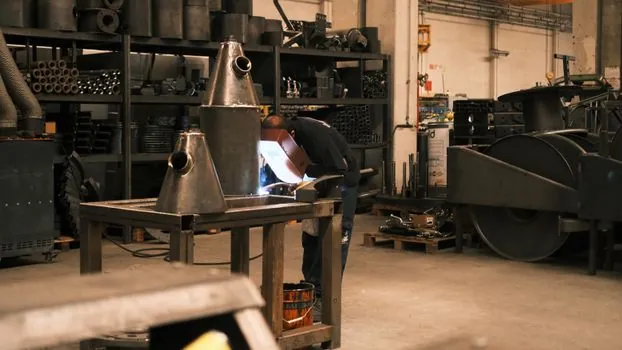
Two trackable signals before the next interior-finishing welder purchase: confirm the latest published revision of JGJ 18-2012 and any companion test-method change in JGJ/T 27, and confirm AWS D1.4/D1.4M revision currency against the project specification, since column splice class in ACI 318 and the JGJ weld-collar defect limits are the two thresholds a finishing contractor is most often failed on at handover [S1].