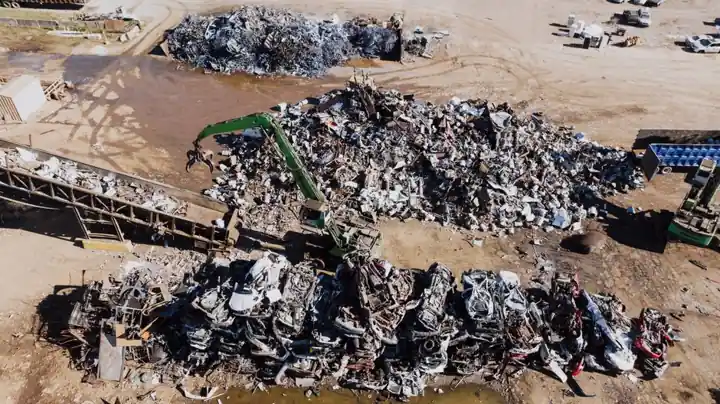
For landfill cells, leachate lagoons, and contaminated-site cut-off walls, the diaphragm wall grab is the most common primary tool in the 0.6–1.5 m wall-thickness range, with trench cutters reserved for deeper, harder, or boulder-rich sections [S1][S3].
Landfill work typically falls between 10 m and 40 m depth where mixed fill, alluvium, and weathered strata dominate; this is squarely inside the DHG operating window described by Bauer for its DHG V (panel lengths up to 3,800 mm, widths up to 1,500 mm) [S1]. Keller North America lists diaphragm walls as a standard earth-retention and groundwater cut-off technique used across environmental and CCR (Coal Combustion Residuals) projects [S2].
Why a grab, not a cutter, for most landfill cells
Hydraulic grabs win on mixed urban fill, demolition debris, and clay-rich liners because the grab teeth can break through obstructions and rebar fragments that would jam a cutter wheel, and the cyclic bite-and-lift cycle is forgiving on heterogeneous ground [S1][S4]. Bauer states that the choice between grab and cutter is driven first by soil conditions and trench depth, with cutters preferred only in hard or very hard soils and at large trench depths [S1].
For a typical leachate lagoon cut-off, panel widths of 2.5–3.5 m at 0.6–1.0 m thickness are standard, matching the small-panel end of the DHG range rather than the long-panel cutter range [S3][S4]. Where boulders or rebar-laden demolition fill are expected, the grab's clamshell geometry lets the operator clear obstructions panel by panel without shutting down the slurry desander for a wheel change [S1].
Panel geometry, depth, and grab sizing
Panel width is set by the grab's bite length, not by carrier weight, and most landfill jobs run 2.5–4.0 m panels to keep verticality tolerance tight in loose fill [S3][S4]. Istasazeh documents a reference case where a 7 m panel was built in three sequential bites (barts) of ~2.7 m and ~2.5 m, matching common grab models like the C800 and B250 [S4].
Wall thickness drives the grab body width. Common landfill cut-off spec is 0.6–1.2 m, with ScienceDirect citing 1.0–1.2 m diaphragm quay walls at 14–19 m depth for aggressive chloride environments [S5]. For 1.5 m applications the DHG-class hydraulic grab from Bauer covers the upper end; thinner 0.6 m cut-offs usually need a lighter mechanical or rope-suspended grab rather than a heavy DHG [S1].
Slurry circuit and bentonite management on a landfill site

Leachate-sensitive sites demand a closed-loop slurry circuit; the displaced bentonite or polymer slurry must be captured, desanded, and either reused or disposed as contaminated liquid, not discharged [S1][S3]. Bauer's DHG cycle is described as: insert grab, loosen soil at base, lift spoil, with support slurry stabilising the trench throughout [S1].
Key slurry control parameters, density, viscosity, sand content, and filter-cake thickness, must be logged every panel, because contamination from landfill leachate or CCR pore fluid changes the slurry rheology quickly [S3]. The Darda reference explicitly identifies watertightness of joints and concrete, verticality tolerance, adequate cover, and structural continuity at connections as the four performance criteria that decide panel acceptance [S3].
Carrier, base machine, and rigging considerations
Most landfill DHG spreads ride on a duty-cycle crawler crane or a dedicated diaphragm wall grab base carrier with 200–400 kN-m class swing torque, rigged with a free-fall winch for clean panel bottom cut [S6]. Sennebogen markets its 80–130 t duty-cycle crane range specifically for diaphragm wall grab and cutter duty in special civil engineering, including excavation support and deep foundations [S6].
Ground-bearing pressure matters more than engine power on a landfill cell, where subgrade is often placed engineered fill or capped waste. Wide crawler shoes, outrigger pads, and a separate guide-wall pour at 0.8–1.2 m above working grade are the standard way to keep the grab vertical in the first 3 m where most deviation accumulates [S3][S4].
When NOT to specify a grab for landfill work

Cutter-based construction is the right call when the cut-off has to extend below competent rock or through bouldery till at depths past ~60 m; Bauer's BC cutter family has recorded trench depths beyond 250 m [S1]. For a 15 m deep clay-lined leachate pond, a heavy DHG is overkill; a rope grab on a smaller carrier cuts mobilisation cost without hurting wall quality [S1][S4].
Grab selection is also wrong when the spec demands a single-pass 6+ m panel with no internal joints; that is cutter or hydrofraise territory [S1][S3]. If the site has aggressive chloride or sulfate chemistry, lean on concrete cover and mix design first (the 28-day 45 MPa chloride-resistant concrete cited for the Al Raha quay wall is a useful benchmark [S5]) rather than upgrading the grab itself.
For whom this selection works (and where it does not)
This DHG-first selection fits: new municipal landfill cells, industrial leachate lagoons, CCR-compliant cut-off walls, and contaminated-site perimeter walls at 10–40 m depth in mixed fill. It does not fit: deep mine shafts, hard-rock dam cut-offs, or very thin 0.4 m cut-offs where a lighter rope grab is the economic answer [S1][S2][S3].
Track the following signals on the next bid: (1) confirm whether the specification allows a 3-stage panel bite at 2.5–2.7 m per bart, which is the practical DHG maximum in landfill conditions [S4]; (2) verify slurry disposal routing, since landfill-site bentonite usually goes to a separate liquid-waste manifest rather than a clean desander out [S3]; (3) check that the crane's free-fall winch is rated for grab-plus-panel weight, not just for static hoist, because the grab cycle is dynamic [S6]. For related equipment pairings on landfill jobs, the landfill storage rack spec map and the skid steer loader selection for landfill operations cover the supporting equipment side of the same site.
Component reference pages worth checking: diaphragm pump, and diaphragm valve.