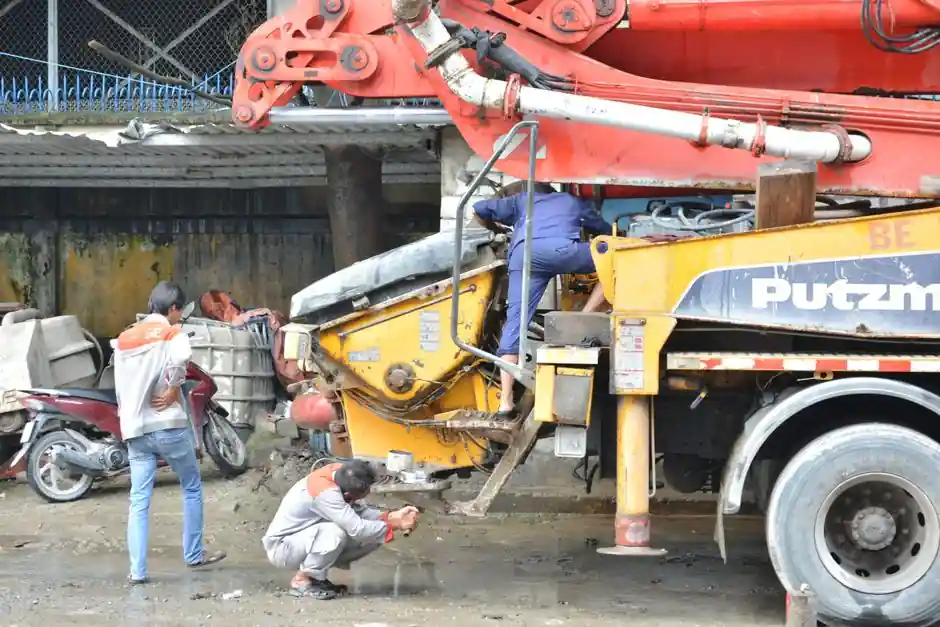
A self-priming centrifugal pump and a truck-mounted concrete boom pump rarely compete for the same scope: one moves liquids and slurries, the other places structural concrete. The decision between them is decided by medium, reach, and site access, not by horsepower or flow rate alone [S1][S2].
For 2026 procurement, the practical question is whether the job calls for a fluid-handling asset or a concrete-placement asset. A self-priming pump evacuates air from its suction line and re-primes after interruption, sitting dry above the liquid [S2]. A concrete pump truck mounts a hydraulic pump plus a multi-section boom arm on a truck chassis for high-volume, high-reach pours [S1][S4].
Definition and Operating Envelope
A self-priming centrifugal pump is installed above liquid level; on start-up, it draws air out of the suction line, builds vacuum, and pulls the medium up to the impeller, then re-primes automatically after a loss-of-prime event. Solids handling on common series reaches up to 100 mm depending on impeller and wear-plate geometry [S2].
A truck-mounted boom pump is a self-contained unit: a truck chassis, a diesel-driven hydraulic pump, a twin-cylinder concrete pump, a multi-section articulating boom, and outriggers for stability. High-volume models like the CIFA K42L and K56L move concrete at 180 m3/hour with automatic fold/unfold booms [S4]. The two machines share the word "pump" and little else in operating physics.
Selection Criteria Side by Side
Self-priming units win on maintenance access: components sit above ground, no confined-space entry, no hoisting from a wet well, and troubleshooting can read both suction and discharge pressures [S2]. A boom pump truck wins on concrete placement rate, vertical reach, and the ability to pour at height without a separate line distribution crew [S1][S4].
On solids, a self-priming centrifugal pump is typically specified for fluids carrying up to 100 mm solids depending on series, while a concrete pump handles coarse aggregate constrained to no more than one-third of the line diameter per ACI pumping guidelines [S2][S5]. On noise, the self-priming unit runs audibly above ground, while a boom pump's diesel and hydraulics dominate site noise and require coordination with the pour schedule [S2][S4].
Who Each Machine Is For, and Who It Is Not

A self-priming pump fits contractors, utilities, and dewatering crews who need dry-installed service, mobile redeployment, and rapid maintenance turnaround in sumps with fluctuating levels [S2]. It is the wrong choice when the pump must sit submerged, when above-ground footprint is the binding constraint, or when confined-space work is not feasible at the site.
A truck-mounted concrete pump fits high-rise, bridge, and large industrial pours where the boom replaces a line crew and where a concrete mixer truck cannot approach the form directly [S1][S4]. It is the wrong choice on narrow residential sites, in fenced backyards, or where obstacles block truck approach, all common reasons a line pump is specified instead [S1].
Comparison: Decision Criteria Mapped
On installation, the self-priming pump is dry-installed above ground; the boom pump truck is a mobile chassis requiring outrigger set-up space [S2][S4]. On priming, the self-priming unit re-primes automatically after air ingestion; the boom pump requires manual priming of the boom pipeline with slurry or gel and cannot tolerate interruption, as the first yard is the hardest and a stop separates water from solids, causing a plug [S2][S3].
On maintenance, the self-priming design is service-friendly with inspection covers and shimless adjustment, while the boom pump needs line cleaning, hose inspection, and reducer inspection at every pour [S2][S3]. On TCO drivers, the self-priming side sees lower labour per service event because the unit is accessible without hoisting, whereas the boom pump's TCO is dominated by pipeline wear, boom maintenance, and truck chassis upkeep [S2][S4].
Real Use Cases and Field Constraints
For high-rise and large industrial pours, a boom pump truck places 180 m3/hour at boom tip and removes the need to extend a line manually across the deck [S4]. For residential foundations, sidewalks, driveways, and swimming pools, line pumps and trailer pumps move fine concrete through narrow access and around obstacles where a boom truck cannot physically set up [S1].
For dewatering, sewage bypass, and industrial fluid transfer with solids up to 100 mm, a self-priming centrifugal pump stays above the wet well, re-primes after each cycle, and avoids confined-space entry [S2]. For applications needing submerged placement, a submersible pump takes over, a different decision branch covered separately [S2]. The two equipment families intersect only when a construction site needs both concrete placement and fluid or slurry handling on the same project.
Limitations, Failure Modes, and Sourcing
Self-priming pumps are limited by suction lift and the need to correctly size the suction line; undersized suction piping starves the pump and breaks prime repeatedly [S2]. Boom pump trucks are limited by approach geometry, the rule that aggregate size should not exceed one-third of line diameter, and the operator's discipline during prime: a horizontal boom section leaves the upper half of the pipe dry and invites plugging [S3][S5].
Specifying either asset should reference ACI guidance on pumpable mixes and pipeline sizing for concrete placement, and should weigh confined-space rules, lifting facilities, and maintenance access for fluid service [S2][S5]. A practical cross-check is the self-aligning bearing and self-cleaning filter options on the fluid side, both of which reduce maintenance stops without changing the pump selection logic. For a similar TCO-driven comparison on a different machine class, see this mining dump truck trade-off map; for selection on cranes by reach and terrain, the crawler crane vs gantry crane spec map uses the same criteria-driven structure. The next trackable signal is the 2026 release of refreshed CIFA K-series boom models with higher folding automation, and the wider rollout of solids-handling self-priming units above 75 mm in the European rental fleet.