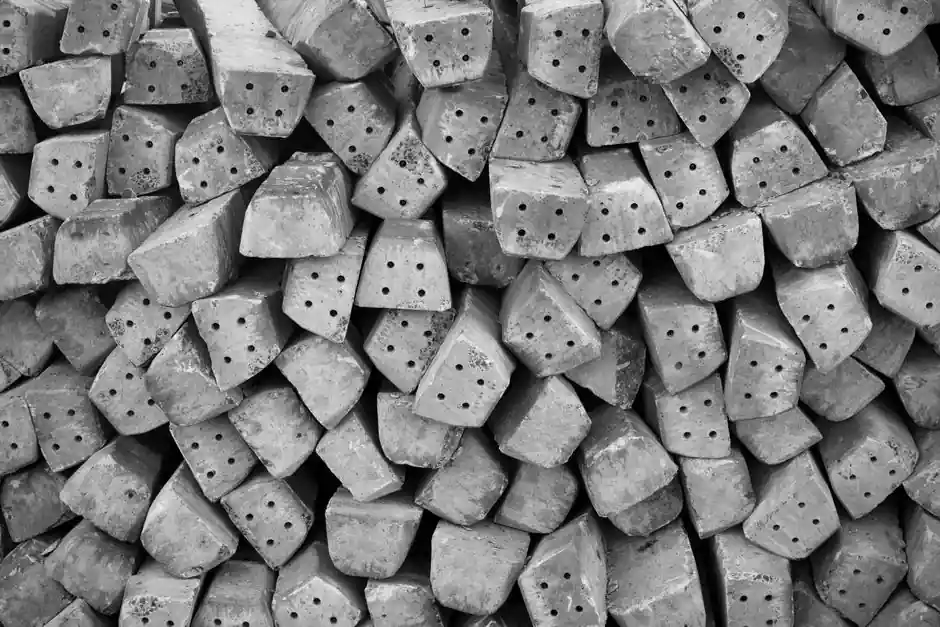
Concrete vibrators are classified by where the oscillating force is delivered into the mix: inside the pour (internal), through the formwork (external), along the top surface (surface/screed), or through the entire mould on a vibrating table, with internal immersion units accounting for the majority of field placements [S1][S2].
Effective head diameters span 25-100 mm, typical operating speeds fall between 2,800 and 15,000 rpm, and proper consolidation can raise concrete density by up to 5% compared with non-vibrated placement, per American Concrete Institute guidance cited in manufacturer literature [S3][S4]. The four-way taxonomy drives every selection decision on a slab, column, precast, or repair site, which is why engineers should treat vibrator class as a hard specification, not an accessory.
Internal (Immersion / Poker) Vibrators
Internal vibrators place a cylindrical eccentric-weight head directly into the fresh concrete, producing oscillations that liquefy the mix locally and release trapped air, with a typical radius of influence of 1-2 ft (roughly 300-600 mm) around the head [S3]. Poker diameters run 25-100 mm in standard civil practice, with 25-35 mm heads reserved for roof slabs, 40-60 mm heads for columns and beams, and 75-90 mm heads specified for mass concrete, deep footings, and bridge elements where higher force input is required to displace air in stiff mixes [S2][S4]. The dominant mechanical layout is the external-motor shaft style (also called a stick vibrator), with a flexible or rigid shaft length of 1-8 ft and power supplied via 120/240 V single-phase electric, pneumatic, or a small petrol/diesel engine, while a motor-in-head variant carries the prime mover inside the head itself for higher-amplitude, lower-fatigue work in low-slump concrete [S3].
External (Form / Shutter) Vibrators
External vibrators clamp to the formwork and transmit oscillating force through the form walls into the concrete, and are preferred when an internal head cannot physically reach the pour: thin sections, heavily congested reinforcement, tunnel linings, arches, and closed precast moulds [S1][S4]. Standard practice is to mount the clamps at spacings not exceeding 90 cm in both horizontal and vertical directions, shifting the units as the pour rises, and the casing is typically cast aluminium alloy driven by a three-phase induction motor with a four-core rubber-sheathed power cord for site durability [S1][S2]. Because a significant fraction of the input energy is lost into the form rather than the concrete, external units are specified only when internal vibration is genuinely impractical, and the trade-off in efficiency is balanced against access gains.
Surface (Screed / Pan) Vibrators
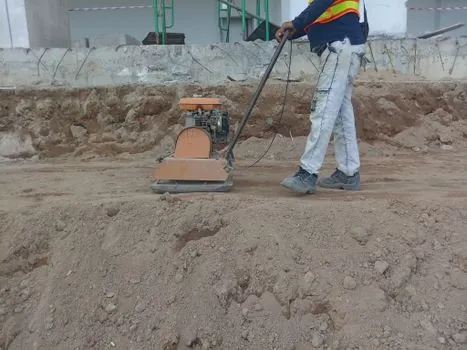
Surface vibrators ride on top of the concrete and consolidate the upper layer as the screed strikes off the mix, and they are effective only on lifts up to approximately 20 cm deep; for deeper sections they are paired with internal immersion heads in a layered compaction sequence [S1]. The format covers both vibratory screeds (beams spanning the slab width) and plate-style pans, and they are the standard tool for pavements, floor slabs, and other large horizontal surfaces where the operator needs finish and compaction in a single pass. For vibrating-screed specification and beam-type trade-offs, see the laser-level selection guide.
Vibrating Tables for Precast and Lab Work
Vibrating tables are rigid steel platforms mounted on springs and driven by counter-rotating eccentric weights, typically using two shafts spinning in opposite directions to produce circular motion, and the mould is rigidly clamped to the table so the form and concrete vibrate as one body [S1][S2]. The application envelope is stiff and harsh zero-slump or low-slump mixes used in factory precast members and laboratory cube/cylinder specimens, where the table can deliver compaction energy that a hand-held poker cannot reach without damaging the mould. This category overlaps directly with broader concrete-machinery and equipment selection on a precast line, but is governed by mould size, table amplitude, and frequency limits rather than by reach or head diameter.
Selection Criteria and Head Size Mapping

The selection logic between the four types hinges on five criteria: pour geometry, rebar congestion, lift depth, slump, and finish specification, and a typical mapping is given below based on the research sources [S2][S3][S4].
<strong>Vibrator class vs. site conditions:</strong>
- Internal 25-35 mm head: roof slabs, thin walls, SCC mixes; gentle force, high finish quality.<br>- Internal 40-60 mm head: columns, beams, standard walls; general-purpose field workhorse.<br>- Internal 75-100 mm head: mass pours, deep footings, bridge elements, low-slump mixes; high force input.<br>- External / form: thin sections, congested rebar, tunnel linings, closed precast moulds; access-driven, energy-inefficient.<br>- Surface / screed: horizontal slabs and pavements up to 20 cm lift depth; combines strike-off and compaction.<br>- Vibrating table: precast factory production and lab specimens with stiff, harsh mixes; mould-clamped, not mobile.
Operating-frequency band is the second decision point: published vibration frequencies range from 2,800 to 15,000 rpm, with a working sweet spot of roughly 3,000-6,000 rpm on most immersion heads, and the chosen amplitude must be high enough to liquefy the mix within the slump on site [S2][S3]. For self-consolidating concrete, smaller heads with lower amplitude are preferred because the mix already flows and only needs light vibration to release residual air.
Who Each Class Is (and Is Not) For
Internal immersion vibrators are the default for cast-in-place walls, columns, beams, footings, and slabs on virtually every commercial site, and they are the right tool whenever an operator can physically insert a poker into the form [S1][S4]. External form vibrators are explicitly for situations where internal heads cannot reach or where surface finish on thin precast is critical, and they are the wrong choice for deep mass pours because too much energy is absorbed by the form. Surface vibrators are not suitable for sections deeper than about 20 cm unless used in combination with immersion heads, and vibrating tables are not a field tool at all, they belong in precast plants and testing labs where moulds can be clamped to a rigid platen [S1][S2].
Operating Rules and Common Failure Modes
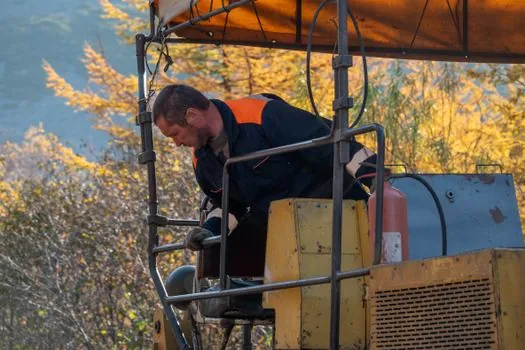
Correct technique is as important as the right class: the head must be inserted vertically and withdrawn slowly to allow concrete to reflow, and successive insertions must overlap so the 1-2 ft radius of influence around each head covers the full pour without leaving unconsolidated bands [S3]. Common failure modes on a real site include over-vibration of SCC (causing segregation of the aggregate paste), under-vibration of low-slump concrete (leaving honeycomb and rebar shadowing), and form-mount spacing beyond 90 cm on external units, which produces inconsistent surface finish [S1][S2]. A useful adjacent spec on many concrete pours is rebar handling, and the rebar bender selection guide maps bar size to bending radius in a way that complements head-size selection above. For crews moving between pours and embeds, the TIG welder spec map for concrete-site embed work covers the adjacent welding side of the same workflow.
The four-class taxonomy (internal, external, surface, vibrating table) is stable across the civil and precast literature, and the next trackable signal is the gradual migration from flexible-shaft petrol-driven immersion units toward higher-frequency electric and battery-powered heads on noise- and emissions-restricted urban sites, alongside wider adoption of high-frequency motor-in-head designs for low-slump, high-strength mixes. For the broader material context, see the cement and concrete properties entry and the concrete admixture selection page, which determine the slump and workability window the vibrator must be sized against.