Shielded cable selection is governed by three independent decisions: the electromagnetic environment, the shield construction, and the grounding topology — and getting any one of the three wrong voids the value of the other two [S3].
The build that fits a 10 m encoder drop in a panel shop is not the build that fits a 600 V variable-frequency drive feeder in a chemical plant, and the same part number reused across both jobs is a documented source of intermittent faults and warranty disputes [S3][S5].
Shield Construction Types and Where Each One Earns Its Keep
Foil (aluminized polyester) shields give 100 % coverage of the conductor bundle and are the cheapest way to reject high-frequency radiated EMI above roughly 15 MHz, but they tear at the flex point of a drag chain and they cannot carry fault current [S3][S6].
For mixed-noise environments — encoder signal sitting next to a motor phase conductor — the practical build is an overall foil + braid combination: the foil blocks common-mode RF, the braid handles low-frequency interference and mechanical life [S3]. A spiral-wound shield (serve shield) is a fourth option optimised for frequent flexing on a cable drag chain, where its open helix recovers from bend stress better than a closed braid, at the cost of lower coverage (typically 70–85 %) [S3].
Grounding Topology: Both Ends vs One End vs Hybrid
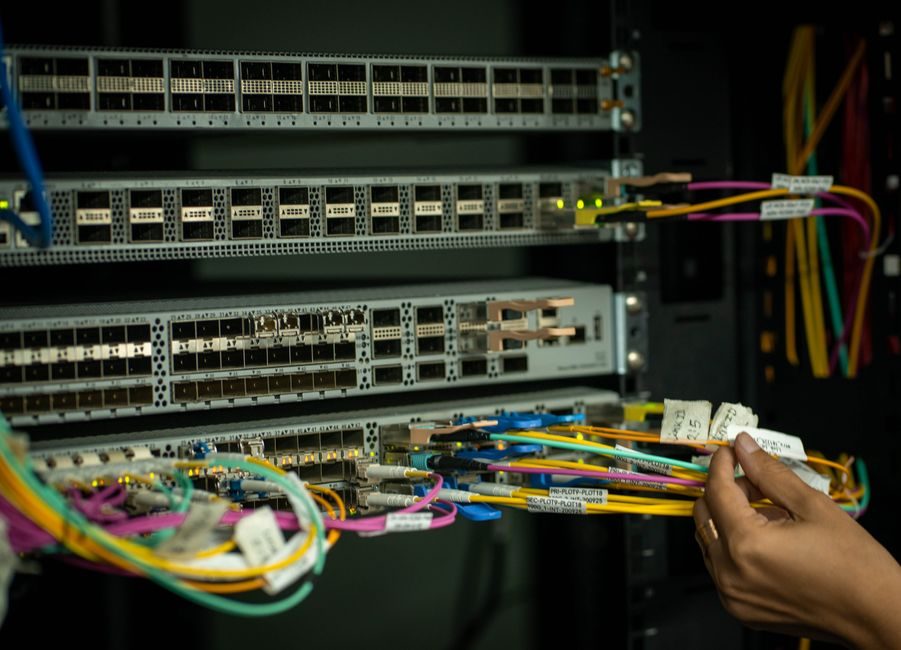
Telcordia GR-1089 requires shielded cables on Cisco ASR 901 Type 2 and Type 4 ports to be grounded on both ends for NEBS compliance — a verbatim manufacturer rule that translates directly into Ethernet, DSL, and high-speed serial practice [S5]. The reason is that at radio and Ethernet frequencies, the drain wire forms a transmission-line return path whose impedance is too high to bond at only one end.
For 4–20 mA loops, RTD leads, and especially thermocouple compensation runs at millivolt levels, the opposite rule applies: ground the shield at the instrument end only, or use a small capacitor (typ. 10 nF, 100 V) across the far-end shield to ground, to break the DC ground loop that would otherwise inject 50/60 Hz interference into the measurement [S3]. Hybrid grounding — one end direct, the other end through a capacitor — is the standard fix where you need both HF shielding and LF loop rejection, and it is the wiring practice recommended in most control cable data sheets for process plants [S3][S6].
Drive, Encoder, and Analog Signal: Three Different Selection Paths
A VFD output feeder — between inverter and motor, typically 3 × phase + 3 × symmetric PE — should be specified as a symmetric power cable with an overall foil + braid shield, 600 V or 1000 V rating, XLPE insulation, and a transfer impedance curve published by the manufacturer. Symmetric construction (three phases 120° apart with a concentric PE) is the published cure for the high dv/dt common-mode current that otherwise burns motor bearing races on long motor leads [S3].
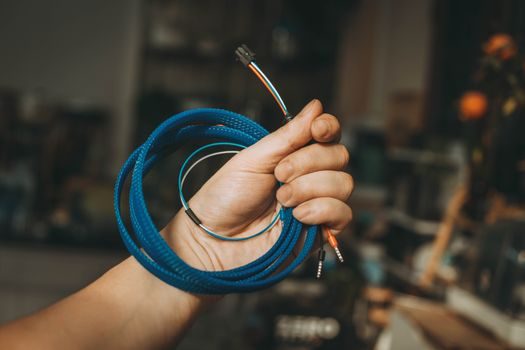
An encoder or resolver drop — the case Baumer documents for industrial-camera accessories — is a 4-wire shielded cable in fixed lengths such as 10 m, with twisted pairs, an overall foil + braid, and a drain wire bonded at the driver end [S2]. For proximity-sensor output, OMRON's E2E NEXT DC 2-wire PUR-cable line shows the alternative pattern: the PUR jacket is specified for oil and coolant resistance, and the cable shield is bonded through the connector thread, not the drain wire, which is a different grounding problem to solve [S4].
For instrumentation — the signal cables category on a typical shielded-cable vendor's catalogue — the criteria shift to pair count (2, 4, 8, 12, 16, 24), individual pair shielding (each pair foil-wrapped) plus an overall shield, and jacket material rated to the chemical environment (PVC, FRLS, LSZH, PE) [S6]. A process engineer buying control cable for a new DCS marshalling cabinet should also flag the cable's capacitance per metre, since capacitance above roughly 90 pF/m will round off a 4–20 mA signal on long runs and force a re-spec to lower-capacitance construction.
Mechanical and Environmental Criteria That Override Electrical Spec
Three mechanical facts decide the part number before the electrical spec is even drawn: bend radius, flex life, and jacket material [S3]. A cable rated for a static bend of 8 × OD will not survive a 6 × OD bend radius on a moving track, and dragging a foil-only cable into a flexing chain tears the foil at the first stress point. Drag-chain-rated cable typically carries a manufacturer-declared cycle life of 5–10 million strokes at a stated bend radius, and that number belongs in the procurement spec, not in the after-the-fact warranty claim [S3].
Jacket material is the second override. PVC is fine for an indoor panel run, FRLS (fire-retardant low-smoke) is the default for occupied indoor spaces, LSZH (low-smoke zero-halogen) is mandatory for confined public areas, and PE or PUR is the answer for outdoor, oil-exposed, or drag-chain service [S6]. The wrong jacket fails long before the wrong shield, and a PVC cable laid next to a hydraulic line on a machine tool will soften and split inside two years.
Termination is the third override. A shielded cable terminated without the cable gland bonding the shield 360° to the enclosure is functionally an unshielded cable at the panel penetration, because the gap in the shield at the gland becomes the aperture that lets noise in. EMC-rated cable gland types — with an internal conductive spring or cone that grips the braid under torque — are the published fix, and they are usually called out by a separate line item that procurement sometimes drops in error [S3].
Comparison: Foil vs Braid vs Foil+Braid vs Spiral
The pick is therefore not a single number but a matrix: for a fixed-instrumentation panel run with VFD interference, foil + braid wins on coverage and cost; for a gantry robot cable drag chain, spiral or braid-only wins on flex life; for a substation feeder, braid-only wins on fault-current capacity; for a screened control cable inside a single cabinet, foil-only is the cost-effective answer. The matrix is also the answer to the "what if the price is the dominant criterion" question — foil-only fails the moment the cable moves.
Who Should NOT Default to a Foil + Braid Cable
Foil + braid is the default answer in most white papers, and that is exactly why it fails in three specific cases. A millivolt thermocouple loop, an RTD lead longer than 50 m, or any analogue measurement where the cable runs parallel to a power conductor for more than a few metres — the default foil + braid will, single-ended grounded, still inject 50/60 Hz common-mode into the measurement, and the cure is individual pair shielding (each pair foil-wrapped) with the overall shield grounded at the instrument end only [S3].
And a low-speed digital signal under 1 MHz on a panel wiring loom, the noise source is usually crosstalk inside the bundle, not external EMI — individual pair shielding helps, but the dominant fix is simply to separate signal and power looms at the cable tray entry, not to up-spec the shield. Each case is a published counter-example to the "always specify foil + braid" reflex.
Standards and Sourcing Discipline

Shielded cable selection is constrained by a small set of standards, and the spec sheet should cite the one that governs the installation. Telcordia GR-1089 is the EMC and safety baseline for telecom-grade shielded Ethernet and serial cabling, and it requires both-end grounding for Type 2 and Type 4 ports as the verbatim wording in the Cisco ASR 901 hardware guide shows [S5]. For hazardous-area process plants, the shield and its termination must coexist with the ATEX / IECEx gland and the equipotential bonding rules on the power cable — a shielded cable does not change the zone classification, but an improperly bonded shield becomes an ignition path that the certifying engineer will reject at FAT [S3][S6].
For nuclear and oil-and-gas service, NACE MR0175 and the relevant IEEE / API rules restrict jacket and insulation materials (no PVC above a stated temperature, no halogens in confined areas), and these material rules apply independently of the shield spec. Procurement should treat shield construction, jacket material, and standard compliance as three separate line items on the same part number, because vendors do not always combine them, and the audit trail at handover needs to show that all three were checked. The next node to track is the 2026 update to vendor datasheets adding transfer-impedance curves in dB-Ω/m over 1 MHz–1 GHz, since that curve is the single figure that predicts the shield's real-world performance in the field [S3].
Related analysis: Busway vs Fuse: Spec-Driven Selection Map.