
Industrial counters in 2026 fall into two main families — electromechanical pulse counters and electronic totalizers — with selection driven by counting speed, signal type, ingress protection, and ambient temperature range.
This guide maps the main counter types against decision criteria, names the typical voltage and signal envelopes, flags where counter meter terminology overlaps with industrial totalizers, and points buyers toward the right duty cycle for panel builders, machine builders, and process instrumentation engineers.
Counter Types and How They Differ Mechanically
Electromechanical counters use a solenoid-driven ratchet that indexes a numbered wheel one step per pulse, with typical pull-in voltages of 12 V DC, 24 V DC, 110 V AC, or 220 V AC and a 10 Hz to 25 Hz upper counting limit per digit bank [S1]. Electronic counters replace the ratchet with a microcontroller, support preset and reset logic, and routinely accept 10 kHz to 50 kHz input frequencies when wired to NPN, PNP, or dry-contact pulse sources [S1]. Mechanical stroke counters are hand-reset, no-voltage devices that tally machine strokes or pump cycles; they carry an IP40 to IP54 rating and operate from roughly -10 °C to +55 °C, which is too narrow for outdoor panel doors [S1]. Across all three, the common error in 2025-2028 catalogs is to specify an electromagnetic pulse counter where an electronic totalizer is needed because the pulse rate exceeds the electromechanical bank's 25 Hz ceiling.
Length, voltage, and digit count are the next hard constraints: panel-mount electromagnetic units commonly ship as 24 V DC 6-digit modules with 50 mm × 25 mm bezels, while electronic totalizers in DIN 48 × 48 mm or DIN 72 × 72 mm housings carry 6- or 8-digit LCDs, dual preset relays, and accept pulse, 4-20 mA, or serial inputs depending on the model code.
Counting Speed, Signal Type, and Resolution
Counting speed is the single sharpest dividing line between counter technologies. Electromagnetic counters saturate at 10 Hz for AC coils and 25 Hz for DC coils, so a bottle-filler encoder at 600 pulses per minute (10 Hz) is the practical ceiling, while a flow-meter pulse from a turbine meter at 1,000 Hz requires an electronic counter with a 10 kHz or higher input stage [S1].
Signal-type matching matters as much as raw speed. Electronic counter inputs can be ordered as PNP (sourcing) 24 V DC, NPN (sinking) 24 V DC, dry contact, or 4-20 mA scaled, and the model-code suffix typically identifies the input class. A PNP input wired to an NPN sensor will read zero pulses; the failure mode is silent miscount, not a fault, which is why buyers pair a pressure transmitter scaled output with a 4-20 mA counter input rather than a pulse input when the source is already analog.
Resolution is set at the sensor, not the counter: a 1 L/pulse flowmeter feeding a 6-digit counter in litres will overflow at 999,999 L, so totalizers used on bulk tank batching are almost always paired with decade-scaled dividers or reset on a daily shift cycle rather than allowed to roll over silently.
Duty Cycle, Environment, and Ingress Protection

For washdown and outdoor panels, IP65 front-face sealing is now the default specification on DIN 72 × 72 mm electronic totalizers, with operating temperature from -10 °C to +55 °C and storage to -25 °C to +70 °C [S1]. Panel builders mounting counters inside a control cabinet can drop to IP54 front-face when the door gasket handles the wet side. Electromagnetic pulse counters in panel-mount form rarely exceed IP50, and stroke counters drop back to IP40, which puts them indoors only.
Vibration is the underrated constraint: electromagnetic counters with mechanical number wheels chatter audibly above 5 g RMS, and the chatter can self-advance the count by one or two digits on heavy stamping or forging presses. For those duties, electronic counters with solid-state outputs are the only credible option, and buyers should confirm the manufacturer's shock and vibration test data rather than assume panel-mount equals rugged.
EMC immunity is a 2026 buyer concern because VFD-driven cabinets radiate noise that can latch or count extra pulses on unprotected counter inputs. Look for IEC 61000-4-2 / 4-4 surge and burst compliance on the counter's data sheet, especially when the counter is fed from a flow meter pulse output sitting next to a motor contactor.
Comparison of Main Counter Types Against Selection Criteria
Side by side, the four mainstream options line up against the criteria that drive a 2026 buy: electromagnetic pulse, electronic totalizer, mechanical stroke counter, and panel-mount LCD preset counter. [S3]
On counting speed: electromagnetic caps at 10-25 Hz, electronic totalizer 10-50 kHz, mechanical stroke counter is hand-driven (under 2 Hz), and LCD preset counters span 10 Hz to 30 kHz. On IP rating: electromagnetic IP50 typical, electronic IP65 typical, mechanical stroke IP40, LCD preset IP54-IP65. On power input: electromagnetic takes 12/24 V DC or 110/220 V AC; electronic totalizer takes 24 V DC or 100-240 V AC universal; mechanical stroke takes no power; LCD preset takes 24 V DC or 100-240 V AC. On price tier in 2026 wholesale lists: electromagnetic is lowest (under USD 30 for 6-digit panel-mount), electronic totalizer is mid (USD 80 to USD 220 for 6-8 digit DIN units), mechanical stroke is low-to-mid (USD 15 to USD 60), LCD preset is highest (USD 150 to USD 450 for two-relay preset units).
The decision rule is short: specify mechanical stroke counters only for hand-tallyed cycles on legacy machines, electromagnetic pulse counters only when counting rate is below 25 Hz and the audible click is acceptable, and electronic totalizers everywhere else. When a linear guide axis needs travel counting via encoder feedback, an electronic counter is mandatory because encoder pulse rates routinely sit in the 100 kHz range during rapid traverses.
Who Should NOT Pick the Electromagnetic Counter
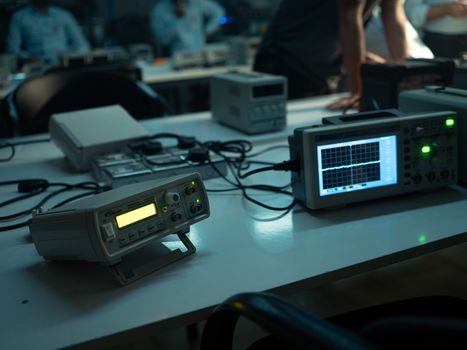
Electromagnetic counters are wrong for any of three duties: pulse rates above 25 Hz, installations needing preset-based auto-stop, and any application where silent operation is required because the solenoid click is loud enough to be objectionable in a cleanroom or laboratory. Buyers who want preset functionality — stop at a target count, trigger a relay, then reset — must step up to an electronic counter with two relay outputs, since electromagnetic units are tally-only with no native preset or output stage. [S3]
Electromagnetic counters are also wrong for battery-powered or remote-site installations because the solenoid coil draws 200 mA to 500 mA on each pulse, which destroys coin-cell budgets. Electronic counters with CMOS inputs draw under 10 mA quiescent, and a lithium-backed EEPROM retains the count for 10 years across power loss, which is closer to what a crossed-roller guide stage end-of-travel sensor needs on a metrology bench.
If a 2026 buyer is tempted to use an electromagnetic counter because the unit price is one third of an electronic totalizer, check the lifetime cost first: replacement electromechanical units on a high-cycle press line typically fail at 50 million to 100 million counts, while electronic counters do not have a mechanical wear-out in the same duty.
Standards, Sourcing, and Watch-outs
Counter selection sits inside a wider standards envelope: panel builders specify DIN 43700 (72 × 72 mm cut-out) and DIN 43718 (48 × 96 mm) for the mechanical form factor, IEC 61010-1 for electrical safety on electronic counters, and CE / UL listing for North American and European cabinets. Buyers should confirm the exact certification on the data sheet because a 24 V DC unit listed to UL 508 is not automatically the same as a 100-240 V AC universal-input unit listed to the same standard. [S1]
Sourcing channels in 2026 split between authorized industrial distributors, OEM-direct for machine builders buying 500+ per year, and web catalogs for small-quantity prototyping. Lead time in 2026 wholesale channels runs 4 to 8 weeks for non-stocked DIN 48 × 48 mm electronic totalizers, and 2 to 4 weeks for stocked 6-digit electromagnetic units; the gap is widening, so plan ahead. Buyers comparing counters against motion-control alternatives like servo drives and stepper drives should note that counters are typically the lowest-cost node in a positioning loop and rarely the bottleneck on delivery.
One shortlist rule: pick electronic totalizer with 4-20 mA scaled input for any flow-meter or pressure transmitter-driven batching job, pick electromagnetic 24 V DC 6-digit for any tally-only job under 25 Hz on a 24 V control panel, and pick mechanical stroke counter only for retrofit tally wheels on legacy hand-cranked equipment. Counter-tied panel accessories like wiring ducts and industrial valves sit downstream of the counter in the BOM and should be confirmed for stock before the counter order is released.
Closing note: track two signals over the next 90 days — IEC 61010-1 amendment updates for low-voltage electronic counter safety, and the 2026 EN 61000-6-2 EMC immunity revisions — both of which will shift the data sheet line on panel-mount electronic totalizers before year-end. For buyers evaluating industrial Ethernet switches to network their counters in a IIoT retrofit, confirm Modbus TCP or Ethernet/IP support on the counter before locking the panel layout.