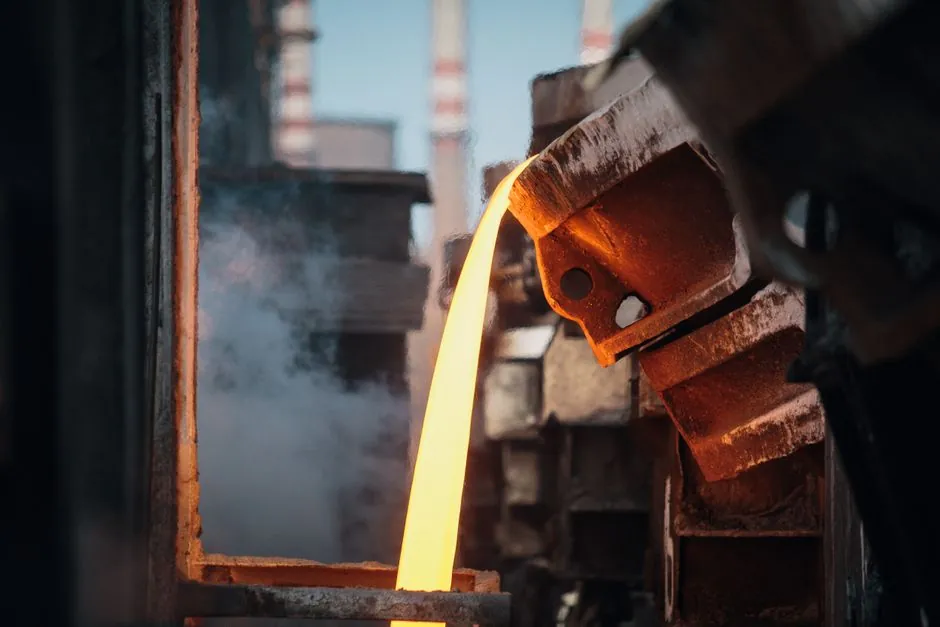
Cupola furnaces still account for approximately 32% of U.S. foundry iron output, about 4.7 million tons per year, and the top 10 producers alone melt near 3 million tons annually, so the failure modes of these shaft units remain a live production concern [S1].
Across a cupola furnace the dominant failure clusters are refractory chemical attack, tuyere/cooling-zone shell erosion, crucible reaction when the cupola is paired with an induction holding furnace, and downstream emissions-train fouling from CO-rich off-gas, with prevention centered on TPK efficiency discipline, hot-blast recuperation, and slag chemistry control [S1][S2][S4].
Refractory Lining Wear and Chemical Attack
Lining life is the single largest maintenance cost driver on a cupola, and the most common chemical attack comes from FeO carried in the slag, sulfur alkalis from coke, and zinc vapor re-condensing just above the tuyere band. The duplex-process study by Nikolaev et al. (2025) shows that melt leaving a cupola at an average T=1355°C (S_T=6°C) with C=3.47% (S_C=0.14%) and Si=2.05% (S_Si=0.21%) does not trigger a crucible reaction in the downstream induction furnace, but once the holding temperature rises above 1480°C the rules flip and the lining becomes vulnerable unless C>0.3% and Si<0.3% are enforced at the spout [S2].
Operators reading the same dataset see a 96% probability that carbon will sit between 3.33-3.75% and silicon between 1.84-2.46%, which is exactly the high-C / moderate-Si window that suppresses FeO generation and protects the magnesia-spinel or alumina-silica lining zones. The Boudouard equilibrium inside the shaft (C + O2 ↔ CO2, ΔH = -33,260 kJ/kgC; CO2 + C ↔ 2CO, ΔH = +14,009 kJ/kgC) means any local oxygen excess raises CO2, which then endothermically reduces back to CO, and that thermal cycling is what spalls the hot-face lining brick [S4].
Tuyere, Shell, and Cooling-Zone Erosion
Tuyere failure shows up as a hot spot on the outer shell, a runaway in shell-spray flow, or a measurable drop in blast pressure, and it traces back to one of three root causes: coke fines plugging the nozzle, a water-spray nozzle that has scaled up and lost atomization, or refractory washout upstream of the tuyere. Cupola shells are typically monitored with skin thermocouples, and any single point reading above 200°C on a water-cooled section is treated as a tuyere or refractory breach in waiting [S3].
Hot-blast operation, where the recuperator preheats blast to about 400-600°C, moves the combustion zone closer to the tuyeres and shortens the tuyere-zone residence time, which reduces the peak shell temperature and is the single biggest reason hot-blast cupolas show longer tuyere campaigns than cold-blast units. Cold-blast cupolas, typically small 2-10 t/h furnaces, sit at around 60% thermal efficiency and tend to push higher coke rates to compensate, which accelerates tuyere-zone refractory dissolution [S4].
Crucible Reaction in the Cupola-Induction Duplex
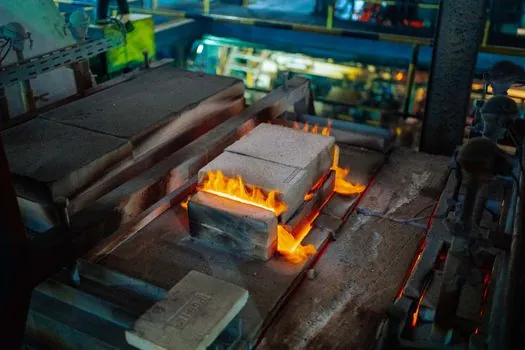
The duplex route, cupola for primary melt and induction for superheat and holding, has its own failure mode: the crucible reaction, where FeO in the bath attacks the acid or basic lining once the bath temperature climbs and the melt chemistry drifts. Nikolaev et al. (2025) measured the equilibrium constant for the FeO-C-Si system at 0.15-0.21 with 97.8% probability at T=1355°C, and showed that below 1480°C the risk of crucible attack is minimal, but above that threshold the operator has to hold C>0.3% and Si<0.3% in the high-temperature melt to keep the lining from being chemically eaten [S2].
Practical prevention is a tight metallurgical spec at the spout: pour temperature below 1480°C, Si kept high (1.84-2.46% range) at cupola discharge to suppress FeO formation, then trim down inside the induction unit if a lower-Si final iron is required. A crucible furnace lining in the induction stage will still fail in months rather than years if these ceilings are missed, regardless of slag practice.
Off-Gas, Emissions, and Afterburner Fouling
Modern U.S. cupolas run against the NESHAP/MACT standard, and the failure pattern here is baghouse blinding from condensed zinc and lead, afterburner chamber burnout, and broken bags that the broken-bag detector downstream catches. The MACT-compliant rebuild packages now include a main blower with automatic air-weight control, a proportional afterburner, a combustion-chamber water-spray with proportional flow, a hot-blast recuperator, a flue-gas cooler and fan, a TETS dust system for heavy-metals injection, six-module baghouse with automatic module cleaning, VFD fan control, broken-bag detectors, and a PLC with data logging [S3].
On the holding furnace side of the train, the same off-gas handling logic applies: a high-CO slip past the afterburner is a refractory problem, a high-particulate slip is a baghouse or spray-nozzle problem, and a high-NOx slip is usually a residence-time or excess-air problem. The standard cure on U.S. rebuilds is to pull the CO-rich exhaust below the throat (extraction below throat), post-combust it in an external afterburner, and then route the gas through a heat exchanger so the recovered heat goes back into the blast at 400-600°C [S3][S4].
TPK Efficiency and Operating Discipline
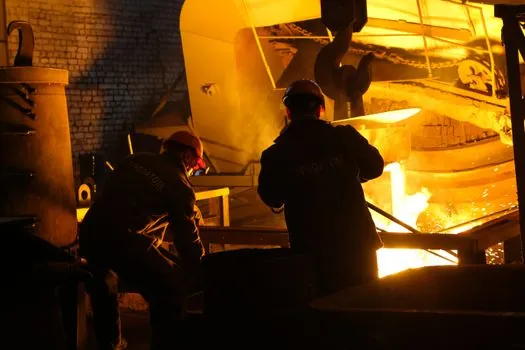
The TPK metric, tons of hot metal per hour per 1,000 standard cubic feet of Equivalent Blast Rate, is the single number that tells an operator whether the cupola is drifting into a failure-prone zone. U.S. operations cluster in three bands: low 2.3-2.8 TPK (unlined shell, cold blast, short stack, poor charging), medium 2.8-3.3 TPK (refractory-lined, hot blast, average charging), and high above 3.3 TPK (well-insulated, hot blast, optimized burden), and staying above 3.0 TPK is the operational marker for low tuyere-zone attack and stable FeO at the spout [S1].
The lamps and light fittings on a cupola charging deck are a non-obvious secondary reliability item: LED high-bay retrofits cut charging-floor heat gain and let operators work the charging door longer without fatigue, which directly reduces cold-charge drops and bridging, both of which are root causes of CO excursions and stack-pressure spikes. Charging practice is the lever that keeps a cupola in its safe operating band, since bridging and drops create local oxygen deficits that push the Boudouard reaction toward CO and overheat the upper stack [S1].
Hot-Blast Repair and Long-Campaign Recovery
Long-campaign hot-blast cupolas reach an end-of-life state when the lower stack, tuyere zone, and well are chemically and mechanically spent, and the historical repair route, as documented in the Georg Fischer US5217658A patent, is to drop the bath, drain residual slag, reline the worn zones, and feed liquid nitrogen into the furnace to inert the bed before tear-in. The patent covers the sequence of slag removal, relining, and N2 inerting specifically to let a hot-blast cupola come back online without the cold-start refractory crack risk that a full cool-down would create [S5].
On a 2026 spec, a planning engineer should treat the TPK ceiling, the recuperator 400-600°C blast window, the C=3.33-3.75% / Si=1.84-2.46% spout-chemistry band, the C>0.3% / Si<0.3% high-temperature rule for any downstream induction step, and the MACT emissions train (afterburner, baghouse, TETS, broken-bag detector) as a single coupled set rather than five independent spec items, because moving any one of them moves the failure mode of the other four.
See also our earlier report, Marine Screw Pump Selection: Viscosity, GVF, and Duty Envelope.