
Cut-off machines divide into three functional families — abrasive-wheel cutoff saws, swing-frame gate/riser cutters, and CNC-controlled diamond-wheel table saws — and the first 30 seconds of any spec review should be spent matching the wheel bond and abrasive to the workpiece, not shopping wattage [S1].
For metalwork, abrasive cut-off wheels (typically Al₂O₃ or SiC, 250-400 mm diameter, 1.6-3.0 mm thickness) run on 2.2-7.5 kW induction motors at 2800-3800 rpm; for stone, concrete, and refractories, diamond-segmented wheels on water-fed CNC tables dominate because dry abrasive wheels glaze and burn on masonry [S1].
Wheel Type and Bond Selection by Workpiece
Resin-bonded Al₂O₃ wheels are the default for mild and carbon steel sections up to ~80 mm solid or 6 mm wall tube, with a typical 350 × 2.5 × 25.4 mm spec running at 80 m/s surface speed on a 3 kW direct-drive spindle [S1]. For stainless and tool steel, SiC or aluminum-zirconia grains reduce heat tint and surface work-hardening, and the wheel must be rated "for stainless" — a carbon-steel wheel contaminates austenitic grades and violates common ASTM A967 passivation practice.
Foundries spec vitrified-bond wheels for gate and riser removal because they tolerate intermittent high-load cuts without softening; swing-frame units like the Fox 2-C use 16-24 inch (406-610 mm) wheels at 1800-2200 rpm to shear heavy cross-sections and sprues in 5-15 seconds per cut [S2]. Diamond wheels on CNC bridge saws are reserved for stone, composites, and ceramics — pairing them with ferrous metals is destructive, the carbon dissolves the diamond grit at cutting temperatures.
Power, RPM, and Spindle Sizing Gates
Wheel peripheral speed is the binding constraint, not raw wattage: an abrasive wheel rated 80 m/s must see a specific (rpm × diameter) product, so a 350 mm wheel needs roughly 4370 rpm and a 400 mm wheel needs ~3820 rpm — going slower wastes cut time, going faster shatters the wheel. Direct-drive 3-phase induction motors in the 2.2-7.5 kW band are the industry default for bench and pedestal cutoffs; single-phase 1.5-2.2 kW universal motors suit portable and low-duty trim cuts but lack the torque reserve for solid bar stock over 50 mm [S1].
Arbor size and wheel thickness are mechanical gatekeepers: 25.4 mm (1 inch) arbors dominate North American 350-400 mm metalworking saws, 32 mm arbors appear on European 400-500 mm machines, and wheel thickness under 2.0 mm demands a vibration-classified "precision cut" wheel to prevent wandering kerf. CNC stone saws step up to 50-60 mm arbors to carry 600-1200 mm diamond blades driven by 11-15 kW spindles running 1400-1800 rpm with water flood at 15-25 L/min [S1].
Frame Architecture: Chop-Stroke, Swing-Frame, and CNC Table
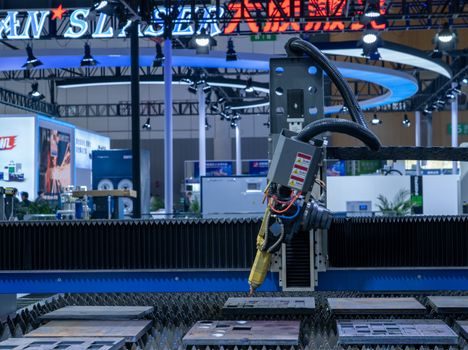
Chop-stroke cutoffs (horizontal pull-down or vertical pull-through) are the right answer for shop-floor repetitive length cutting of bar, billet, and tube — repeatable within ±0.1 mm when fitted with a length-stop and vise clamp. Swing-frame cutters are the correct pick for foundry gate and riser removal on castings too heavy to bring to a saw; the operator swings a counterbalanced arm carrying the wheel into the casting, which lets the wheel work in the operator's preferred stance rather than dragging the casting to a fixed blade [S2].
CNC bridge and gantry tables take over when straightness, miter accuracy, or production throughput matters: 5-axis stone saws hold ±0.1 mm/m straightness, 3-axis metal saws deliver ±0.05 mm length repeatability, and both need a flooded cutting zone to clear swarf and cool the bond. For buyers weighing abrasive vs diamond vs swing-frame options against the same job, the practical decision matrix is: abrasive chop-stroke for steel bar under 80 mm, swing-frame for foundry gate/riser, CNC diamond table for stone and composite plate.
Cooling, Dust, and Safety Integration
Dry abrasive cutting of steel above 3 mm wall thickness rapidly heats the workpiece past 200 °C at the kerf, which work-hardens austenitic stainless and burns through paint on the offcut; water-soluble cutting fluid at 8-12 % concentration, flooded through twin side nozzles, drops kerf temperature below 80 °C and roughly doubles wheel life on mild steel. Stone and concrete cutting always requires water feed — dry diamond cutting produces respirable crystalline silica dust that exceeds OSHA's permissible exposure limit of 50 µg/m³ averaged over an 8-hour day, and water suppression is the lowest-cost path to compliance [S1].
Mechanical safety gates are non-negotiable on every modern cutoff: a wheel guard covering at least 180° of arc, a positive-stop vise that clamps both sides of the cut, and a no-load spin test before each shift. CE-marked machines sold into the EU additionally require a brake that stops the wheel within 10 seconds of power cut and a residual-current device on the supply; missing either is a spec fail on a European plant audit.
Selection Criteria: Match the Spec to the Job, Not the Brochure

The selection checklist that survives the most plant audits: (1) wheel type and bond matched to workpiece material, (2) motor power and rpm giving 60-80 m/s peripheral speed at the chosen wheel diameter, (3) arbor and flange size matching readily available wheels in the local market, (4) flood coolant or dust extraction built in, (5) CE/UL electrical package and wheel-guard coverage verified on the nameplate. Buyers who skip straight to price typically pay it back in cracked wheels and rejected first articles [S1][S2].
A 3 kW chop-stroke with a 350 mm Al₂O₃ wheel is the right spec for a general metal-fab shop cutting mild-steel bar and angle; a 11 kW CNC bridge saw with a 600 mm diamond blade is the right spec for a stone countertop shop. A 5.5 kW swing-frame with a 500 mm vitrified wheel is the right spec for a foundry cutting gates off steel castings up to 300 kg — that is the job the Fox 2-C swing frame was designed for, and substituting a chop-stroke on the same casting is a slow, dangerous workaround [S2].
Comparable Industrial Cutting Formats
Cut-off machines sit inside a wider family of abrasive and tooth-based cutting tools, and a thoughtful procurement often compares a dedicated cutoff against an angle grinder with a cutoff disc, a marble cutter, or an oxy-fuel torch. The angle grinder wins on portability and one-off trim cuts but loses on repeatability, wheel life, and operator fatigue past ~50 cuts per shift — see the angle grinder selection 2026 spec cut for the wattage and RPM gates that decide which is which. For stone and tile, a marble cutter on a water-fed rail is faster and safer than a dry angle-grinder cutoff on the same slab. For thick steel plate above 25 mm, an oxy-fuel or plasma torch usually beats a chop-stroke abrasive saw on cut time and kerf width — the oxy-fuel cutting torch 2026 spec guide covers the gas-mix and nozzle gates. [S1]
A useful side-by-side: chop-stroke abrasive vs swing-frame abrasive vs CNC diamond — chop-stroke is cheapest and most repeatable for bar stock, swing-frame handles the largest castings the shop can't move, CNC diamond is the only sensible pick for stone and engineered composites. For buyers who also need a wider cut-off line overview, the power mixer vs cut-off machine 2026 use-case cut lays the divergence out by job site rather than spec sheet.
Limitations, Failure Modes, and What to Spec Out
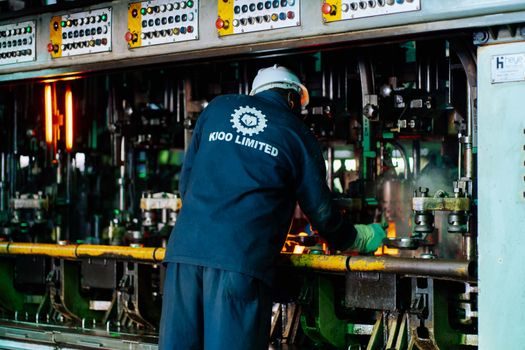
The most common cutoff failures are wheel cracking from peripheral-speed overspeed, workpiece burning from insufficient coolant, and vise deflection on thin-wall tube that lets the wheel grab and kick. Spec a wheel guard rated for the wheel's maximum rpm (not the spindle's), a vise with serrated hard jaws for round stock, and a flood nozzle directed at the wheel-workpiece interface on both sides. Avoid universal-motor portable cutoffs for production work — the brushes and armature are the first items to fail at duty cycles above 30 %. [S2]
For stone and refractory cutting, dry operation is a hard spec-out: silica-dust exposure, glazed diamonds, and cracked segments are the predictable consequences. For stainless, spec iron-free (Fe + S + Cl ≤ 0.1 %) dedicated cut-off wheels to keep the cut surface passivation-clean.
Track these signals going into the second half of 2026: direct-drive 3-phase motor pricing on 4-15 kW induction frames (still the dominant cutoff drive), resin-bonded wheel lead times from European and Chinese producers, and CE/UL re-certification of imported chop-stroke saws under the updated EN ISO 16089 machine-tool safety standard. Each one moves the total landed cost of a new cutoff cell by single-digit percent and is worth a quarterly check.
For component-level specifications, see coding machine, core machine, and cutting machine.