Data center cooling manufacturing in 2026 is dominated by liquid-loop assemblies built around Coolant Distribution Units (CDUs) rated near 100 kW per skid, with secondary-loop envelopes now standardised to ASHRAE W17 through W45 [S3].
The capacity inflection comes from AI and HPC racks: a 2026-06-03 strategic partnership between Wiwynn (cloud server OEM) and Showa Denko (Showa Control) is delivering fully validated server liquid-cooling infrastructure to global hyperscale cloud buyers, after three years of co-engineering [S2].
Liquid-Cooling Topology: From CRAH to Immersion
Liquid cooling is not a single product; it is a stack of topologies whose thermal efficiency scales with how close the coolant gets to the silicon [S1]. At the far end, Computer Room Air Handlers (CRAHs) move air across building chilled water and sit in the same room as the IT load; field retrofits of CRAH controls and fans at a Digital Realty colocation site cut facility energy roughly 8% year-over-year [S1].
Closer to the source, in-row units from Schneider Electric (APC InRow) and overhead pumped-refrigerant units from Emerson/Liebert shorten the air path and reclaim floor space; refrigerant-based overhead units exploit phase change and the dielectric safety of the working fluid, evaporating harmlessly on leak [S1]. Closest to the die, immersion cooling submerges IT in dielectric fluid so heat transfers on the component surface, allowing the secondary loop to run warmer and unlock free-cooling hours [S1]. Iceotope's precision liquid-cooling chassis uses a sealed, closed dielectric loop that hands heat off to a warm water circuit at ASHRAE W-grade temperatures, with no fans or evaporative stage in the IT path [S6].
CDU Build Specs: 100 kW Skid Anatomy
A 2026-class single-rack CDU is engineered around a 100 kW thermal envelope at a 6 °C approach, with a minimum approach temperature of 4 K and a 100 LPM primary flow [S3]. Pump redundancy is specified as 2 pumps in N+1 configuration; power input is 100–240 V at 50/60 Hz, drawing 10–15 A, fed by two N+1 2500 W PSUs, and idling near 820 W default draw [S3]. The unit ships in two build states — empty with quick-couplings, or factory-filled and pressure-tested with couplings — both designed for field swappable rack-side hoses.
These skids are the manufacturing deliverable for the Wiwynn–Showa Denko programme: the partnership's deliverable scope covers matched server platforms, validated cooling hardware, and supply-chain scaling to global OEM standards, explicitly framed around rising power density and tighter PUE targets for cloud buyers [S2]. Sensors (temperature, humidity, flow, leak) are integral to the skid, not optional, because closed-loop dielectric and water-glycol systems cannot be commissioned without flow and leak telemetry [S8].
Process Map: From Plate to Live Rack
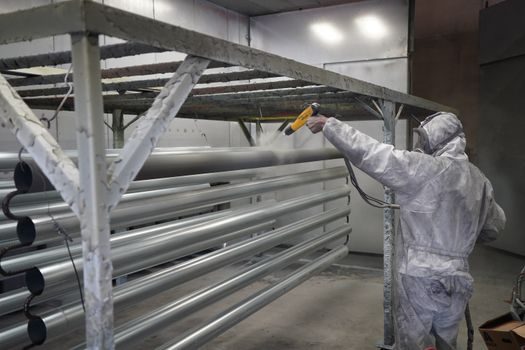
The manufacturing flow on a 2026 liquid-cooling line runs: (1) frame weld and surface treatment on the skid base; (2) pump and reservoir assembly onto the skid; (3) brazed or vacuum-brazed stainless plate-frame heat-exchanger integration (typical secondary side 316L); (4) PSU, controller, and sensor harness fit-out; (5) factory fill with dielectric or water-glycol, pull vacuum, and pressure-decay leak test; (6) closed-loop thermal performance test at 6 °C approach against a calibrated load bank; (7) firmware flash for BMS / DCIM hand-off; (8) ship as either a dry empty unit with quick-couplings or a wet, pre-commissioned skid [S3][S8]. A 6 °C approach is the production gate because it is the threshold that allows the secondary loop to stay inside the W17–W45 envelope for most of the year, which is what unlocks free-cooling mode and hits hyperscaler PUE targets.
Immersion tank lines follow a parallel flow: tank fabrication (typically stainless or coated carbon steel), dielectric fluid fill, IT rack lowered and bolted, top manifold and pump skid integration, and a burn-in soak at full load. Microsoft Azure's published cooling infographic documents the corresponding air-side architecture: hot-aisle air is pulled through air-to-water heat exchangers, with the heated water then piped away to a fluid cooler — the same heat-rejection pattern liquid skids feed [S5].
Selection Criteria: Air, Hybrid, or Full Liquid
Air cooling remains the default for legacy white-space and any density under ~20 kW per rack, where its installed-base economics, simpler maintenance, and long field track record outweigh thermal limits [S4][S9]. Air's specific heat is the binding constraint: once rack density climbs past the air-cooling envelope, liquid enters the specification.
Hybrid rear-door heat exchangers and in-row coolers target the 30–60 kW/rack band: incremental capex over a CRAH plus a chilled-water plant, but no purpose-built servers required [S1][S9]. Full liquid (cold plate on CPU/GPU, or single-phase immersion) is the choice above ~60 kW/rack, where the secondary loop is allowed to drift to ASHRAE W45, free-cooling hours dominate the year, and purpose-built servers are acceptable [S1][S3]. The Vertiv cooling portfolio — chilled water, dynamic power, prefabricated modular, and edge — is structured around exactly these density tiers [S9].
Standards, Sourcing, and Hyperscaler Alignment
The controlling standard is ASHRAE TC 9.9's W-class envelope: the 2026 nVent CDU spec sheet quotes "ASHRAE W17 to W45 (previous W1 to W4)," reflecting the thermal envelope widening as data centres push warmer loops to capture free cooling [S3]. Air-side designs continue to cite ASHRAE recommended/allowable ranges for inlet temperature and humidity [S7].
On sourcing, the 2026 Wiwynn–Showa Denko deal is the first publicly disclosed hyperscaler-aligned co-development that bundles OEM server validation, thermal hardware, and a manufacturing scale-up clause in a single programme — not just a procurement contract [S2]. The partnership is positioned around three explicit pain points: density for AI/HPC, total-cost-of-ownership reduction via free cooling, and supply-chain standardisation for global cloud rollouts [S2]. For more on how GPU-driven process plants are layering smart-manufacturing controls on top of these lines, see Industry 4.0 in 2026: GPU process plant specs; for the automation backbone that links CDU skids to factory MES, the smart-meter production stack in smart meter smart manufacturing uses the same closed-loop telemetry pattern CDU lines are now adopting.
Failure Modes and Engineering Constraints
Four failure modes dominate 2026 field returns on liquid-cooling skids: coolant leak at quick-couple fittings, pump cavitation from air-ingestion on inadequate reservoir design, biofilm and corrosion in propylene-glycol loops operating above 30 °C, and condensation on cold plates when secondary loop falls below the room dew point [S1][S8]. The dielectric-fluid path (closed chassis, no evaporation, dry-cooler rejection) is explicitly engineered to remove two of these — leak exposure to IT, and evaporative loss — but does not eliminate fitting leak risk during rack hot-swap [S6].
Instrumentation discipline is the gate that prevents the rest: flow meters on every rack loop, leak sensors under every skid, and redundant temperature probes at CDU inlet and outlet are the minimum sensor stack spec'd across 2026 OEM datasheets [S3][S8]. This is also where the line itself bleeds into instrumentation manufacturing — the same flow, pressure, and temperature transmitter families used in process plants are being pulled into CDU skids; the spec ranges and two-wire / digital bus choices overlap heavily with the pressure transmitter and flow meter categories used across chemical and power sites.
Where the Line Is Going
Trackable signal 1: the Wiwynn–Showa Denko programme moves from validation to volume production across 2026 H2; watch for second-OEM licensing of the validated cooling stack to a non-Japanese ODM [S2]. Trackable signal 2: ASHRAE W45-class operation moves from spec-sheet target to default operating point in next-generation CDU firmware, as free-cooling hours become the dominant PUE lever for hyperscale builds in temperate climates [S3]. Trackable signal 3: dielectric single-phase immersion lines begin to absorb hybrid rear-door capacity in hyperscale RFPs, pulling CDU skid counts per MW downward but raising per-skid thermal rating past 200 kW [S4][S6].
For component-level specifications, see data logger.