Industry 4.0 in 2026 is best defined as the integration of cyber-physical systems, IoT, AI/ML, and MES-level digital threads across the four industrial revolutions (steam, mass production, digital, and cyber-physical) [S1]. The GPU ecosystem — process plants, foundries, automated assembly cells — is one of the heaviest industrial consumers of these architectures because batch variability, hazardous-area certification, and uptime contracts all push operators toward near-real-time control.
The economic driver is documented: Industry 4.0 deployments pursue competitive advantage through higher flexibility, lower scrap, and the conversion of make-to-stock lines into make-to-order lines down to lot size one [S1]. The technical driver, equally well documented, is data-centric near-real-time process control in foundries handling multi-variant complex castings where sporadic shrinkage and nonconforming lots still drive scrap and rework [S3].
Industry 4.0 Pillar Stack: CPS + IoT + AI/ML + MES
Industry 4.0 is described in the foundational ISA guidance as a holistic automation, business information, and manufacturing execution architecture to improve industry with the integration of all aspects of production and commerce across company boundaries for greater efficiency [S1]. The four enabling layers are cyber-physical production systems, IoT/IIoT connectivity, embedded computing, and web-service-based MES integration — each layer must be present for a deployment to qualify as Industry 4.0 rather than conventional SCADA modernization.
The German Industrie 4.0 working group's final report, *Recommendations for Implementing the Strategic Initiative INDUSTRIE 4.0*, calls out communications, web services, and IoT technologies as the substrate that converts factories into smart environments through end-to-end integration covering inbound logistics, production, marketing, outbound logistics, and service [S1]. This same end-to-end requirement is why PLC and pressure transmitter retrofits are now bundled into Industry 4.0 upgrade packages rather than run as standalone instrumentation projects.
Selection Criteria for an Industry 4.0-Ready Plant
A practical four-criterion filter separates Industry 4.0 pilots from Industry 4.0 production systems. First, sensor density: a process skid needs HART, IO-Link, or Ethernet-APL capable pressure transmitter and flow meter devices at every regulatory loop, not just at the control valve. Second, edge compute: deterministic PLC scan budgets under 10 ms remain standard for safety PLCs, while analytics nodes run on separate Linux/RTOS containers per ISA-95 levels 1-2 boundaries. [S1]
Third, data fabric: OPC UA over TSN is the dominant 2026 brownfield protocol pair for new greenfield builds, with MQTT retained for cloud egress only. Fourth, AI/ML integration: the published ductile iron casting study used AI/ML metamodels coupled with ICME (integrated computational materials engineering) and process simulation tools to quantify uncertainty, with both predictive and prescriptive models running in near real time [S3]. Process plants adopting this pattern typically budget 18-24 months from sensor retrofit to first AI/ML model in production.
Who It Is For, and Where It Fails
Industry 4.0 deployments are well-suited to discrete-assembly automotive lines (multiple-case study evidence from the Brazilian automotive sector, 1151 accesses, 1 citation in the BTSym 2021 proceedings), high-variance foundries (case study with 431 accesses, 3 citations on ductile iron sand casting [S3]), and continuous-process plants where every percentage point of yield compounds at commodity scale [S1][S2][S3]. They are NOT a fit for low-margin job shops with batch counts under 50/year, or for facilities where legacy pneumatic instrumentation is still the bulk of the I/O — the retrofit cost dominates the ROI in those settings.
Where these architectures fail in practice: the foundational review of Industry 4.0 adoption challenges flags that culture and mindset changes are crucial points needed in the organizations to reach the benefits, with broader benefit-realization gaps in Brazilian automotive cases [S2][S4]. The Springer 2021 review further notes that despite the widespread use of the term in popular vernacular, little is known about what exactly I4.0 is, and the potential contribution it is expected to make, including its possible fallouts on society — meaning buyers should validate vendor claims against ISA-95 reference models rather than marketing slides [S4].
AI/ML-Driven Process Control: The Foundry Case
The 2024 International Journal of Metalcasting paper by Shah and Began provides one of the few quantified AI/ML Industry 4.0 case studies available: data-centric near-real-time intelligent process control for smart manufacturing in an Industry 4.0 era is of tremendous value, applied to design and manufacturing of high-performance ductile iron sand castings — a multi-variant complex process with much uncertainty involved [S3]. The framework combined AI/ML tools, ICME, and process simulation to quantify uncertainty (UQ) and produced metamodels, both predictive and prescriptive in near real time, developed using historical production and selective design of experiments (DOE)-generated additional data [S3].
The result reported: the data presented includes details on successful corrective action production trials, demonstrating that the proposed framework and approach is applicable to solve complex problems encountered in foundry and machining operations where there is uncertainty [S3]. For GPU specifiers, this matters because the same metamodelling pattern — historical process data + DOE augmentation + predictive + prescriptive layers — is now reproducible across CNC machining, polymer extrusion, and continuous chemical reactors, not just casting.
Cyber-Physical Systems: From PLC to Edge
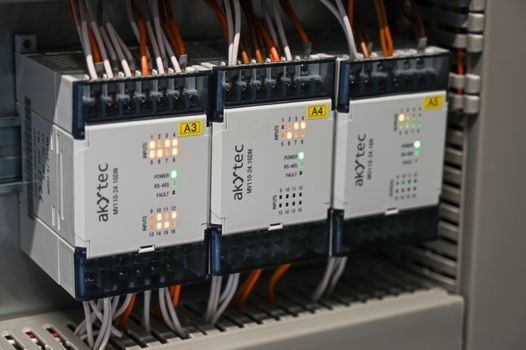
Cyber-physical systems (CPS) are the layer most specifiers mis-buy. Industry 4.0's fourth industrial revolution leverages cyber-physical systems, embedded computing, and Internet of Things technologies, with the third industrial revolution having established the digital baseline through machine tool numerical control, programmable logic controllers, direct digital control, and enterprise resource planning [S1]. The right CPS architecture in 2026 has three tiers: safety-rated PLC hardware for SIL-2/SIL-3 loops, edge controllers for protocol translation, and a cloud or on-prem historian for model training.
Servo motor and industrial valve selection both shift under this lens. A Industry 4.0-grade servo spec now demands EtherCAT or PROFINET IRT with cycle times down to 62.5 µs, plus an integrated energy-monitoring profile (CiA 402 / CiA 406) so the drive publishes its own kWh and torque data into the MES layer. A smart industrial valve requires a pressure sensor package, a positioner with HART 7 or IO-Link, and a NAMUR NE 107 diagnostic profile so valve health is observable from the control room rather than by walking the plant.
Foundry 4.0 and Sourcing: Standards and Stack
Greenfield Industry 4.0 builds pull from the same standards library as conventional automation — IEC 61131-3 for PLC programming, IEC 62443 for industrial cybersecurity, ISA-95 for the MES hierarchy, and NAMUR NE 131 for field device naming — but the validation burden is heavier because each layer must be audited for interoperability. Foundry-specific deployments additionally need the AI/ML metamodel training pipeline tied into the DOE and ICME stack, and that pipeline must produce both predictive and prescriptive outputs traceable to specific historical lot data [S3].
For sourcing signal, two trackable nodes: first, follow the International Journal of Metalcasting publication track on AI/ML-driven metamodels — the next extension of Shah and Began's framework into shell molding or investment casting is likely in 2026-2027. Second, watch the Brazilian automotive case follow-ups — the BTSym 2021 baseline paper closed with a practical guide for companies adopting these technologies, and the next wave of sector surveys will quantify the benefit realization rate against the original BDN (Benefits Dependency Network) [S2]. Buyers comparing new GPU process lines should demand vendor proof of a working BDN or equivalent, not just a digital-tour PPT.
For related coverage, see Disc Coupling Sizing and Selection: Torque, Misalignment and Lubrication Bands.