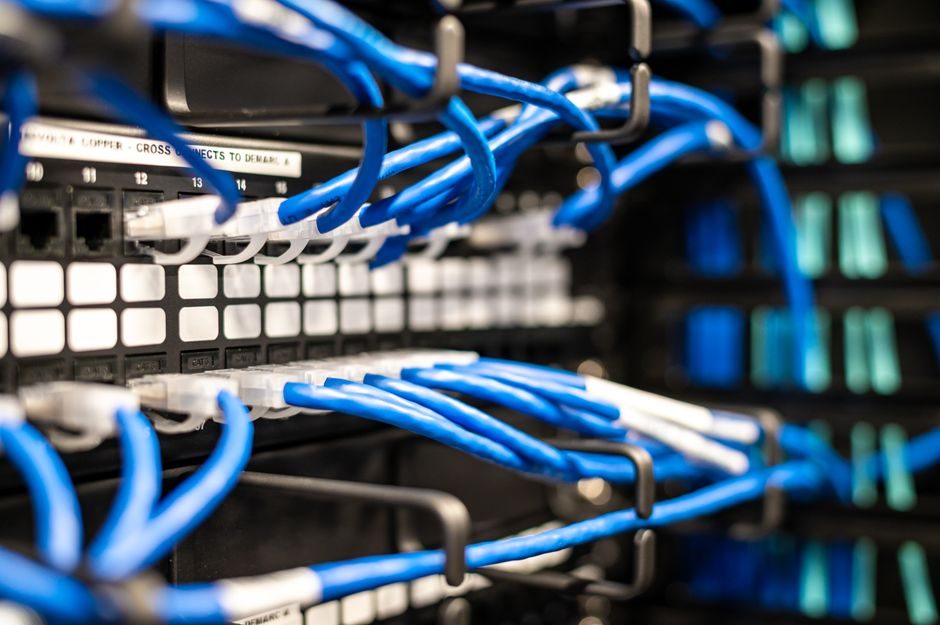
Data center Industry 4.0 programs in mid-2026 are no longer piloted in isolation: hyperscalers and colos are wiring PLC-class edge controllers, flow meter arrays, and pressure transmitter networks into near-real-time digital twins, then closing the loop with AI/ML metamodels that flag drift before chilled-water setpoints move [S3].
The same automation stack is being repackaged as a green-finance eligibility argument, with operators linking IIoT telemetry to verifiable energy, water, and scrap reduction so capex can be financed under sustainability-linked instruments [S1]. For a site engineer, the practical question is which layers of the stack — edge instrumentation, network, data historian, model, control loop — actually move the needle on reliability and PUE, and which are still slideware.
Defining the Stack: Cyber-Physical Systems Above the Rack
Industry 4.0 is best treated as the cyber-physical integration of physical assets, edge instrumentation, and software-defined control, not a marketing label for a vendor dashboard [S2]. In a 2026 data center context that translates into three concrete layers: (a) brownfield and greenfield assets instrumented with pressure sensor manifolds, thermal mass-flow meters, and data logger gateways at the CDU, CRAH, and chiller; (b) a deterministic industrial Ethernet/TSN backhaul (or OPC UA Pub/Sub) that pushes time-synchronised process variables to a historian; (c) AI/ML metamodels that consume the historian and write setpoint corrections back through the PLC layer [S2].
The 2021 bibliometric work made the binding constraint explicit: Industry 4.0 and green-finance programmes share the same objective function — minimum resource input per unit of useful compute, minimum waste, and minimum negative environmental externality [S1]. A data center PUE of 1.10 versus a 2024 baseline of 1.58 is now framed as the same optimisation problem a ductile-iron foundry solves when its AI/ML metamodel replaces 30-year-old statistical-process-control charts, with shrinkage scrap cut by predicting lots before pour [S3].
Selection Criteria: Which Loops to Wire First in 2026 Builds
First-priority loops are the ones where a measurable unit-of-risk attaches to the measurement: chilled-water differential pressure across the CDU, cooling-tower basin level, and the secondary loop flow that drives the economiser. A digital twin of the white-space that omits these is decorative; a twin that closes a control loop on a pressure transmitter reading at 0.5 s update rate is operational [S2].
Second-priority loops are the auxiliary systems that fail expensively: generator fuel, UPS thermal derating, and humidification steam quality. Here, IIoT adoption is constrained by the fact that older assets lack the analog 4–20 mA or digital outputs that retrofittable data logger gateways assume, which is why brownfield projects in 2026 budget for transducer replacement, not just software [S2]. Third-priority loops — rack-level inlet temperature, CRAC damper position, BMS alarm rationalisation — are where AI/ML metamodels deliver the largest statistical lift, because the variance is high and the failure mode (hot-aisle re-circulation) is non-obvious to a human operator [S3].
Who It Is For — And Where It Is Overhead
Industry 4.0 adoption pays back where the process is multivariate, uncertain, and instrumented: think chillers, fuel systems, and the industrial valve trim on economiser bypasses, all of which have historically required an experienced operator to interpret [S3]. It does not pay back in commoditised switchgear, simple on/off industrial valve actuation, or anywhere the failure mode is already covered by a hardwired interlock. The 2021 bibliometric analysis is explicit that adoption is gated by the perceived usefulness and perceived ease-of-use of the technology, not by the existence of the technology itself, which is the same UTAUT framing that determines whether a maintenance tech trusts a metamodel's recommendation [S2].
Two operator profiles are NOT the target. First, single-tenant, sub-2 MW sites with no on-site engineering staff — the cyber-security and model-governance overhead will exceed the energy savings. Second, facilities where the BMS is already a closed proprietary stack with no clean export path; the integration cost of OPC UA bridging routinely exceeds the cost of the sensors themselves [S2].
Options Compared: Three 2026 Reference Architectures
Three reference architectures dominate 2026 specification work, and the choice maps to a small number of decision criteria. A hyperscale greenfield typically picks an air-cooled direct-to-chip design with a vendor-supplied digital twin and a proprietary IIoT bus; a Tier-III colocation retrofit typically picks brownfield-brokered OPC UA over an existing BACnet/Modbus plant; a regulated financial-services build typically picks a fully air-gapped historian with on-prem AI/ML and no external cloud write-back [S2].
On capital cost, the greenfield path scores best because the flow meter and pressure sensor counts are baked into the BoQ. On cybersecurity review cycle time, the air-gapped path scores best because ENISA has repeatedly framed Industry 4.0 cybersecurity as a precondition for adoption, not an afterthought [S2]. On model accuracy, the brownfield-brokered path usually wins, because it has the most years of dirty real-world data to train against — exactly the data regime that the ductile-iron study used to drive metamodel R² above what a DOE-only dataset could achieve [S3].
Failure Modes and Limits: What the Stack Cannot Do

Three failure modes recur in 2026 post-mortems. First, instrument drift: a pressure transmitter zero-shift of 0.3 %/year is invisible to a human but corrupts every downstream metamodel, and the only mitigation is a documented re-zero cadence plus statistical drift detection on the historian side [S3]. Second, model-to-control latency: an AI/ML recommendation that takes 90 s to arrive is useless on a chilled-water loop that needs sub-second correction; the 2024 foundry study flagged this directly — near-real-time means seconds, not minutes [S3]. Third, green-finance attribution: if the metamodel's savings cannot be traced to a specific kWh reduction in a metered feed, the financier will not recognise the saving, which collapses the capex case for the whole programme [S1].
The hard constraint is that an Industry 4.0 retrofit is an instrumentation project first, a software project second. Sites that spec the AI/ML platform before they have audited their flow meter calibration records consistently fail to reproduce the savings their model promised [S3].
Standards, Sourcing, and Cross-References
The sourcing checklist for a 2026 data center Industry 4.0 build is shorter than the marketing implies: OPC UA Companion Specifications for the data model, IEC 62443 for the cybersecurity zones, ISO 50001 for the energy-management system the green-finance instrument hooks into, and a metrology-traceable calibration certificate for every pressure sensor on the loop [S2]. Reference designs across hyperscale and colocation consistently map to that same four-document set, which is why operators resist vendor-specific IIoT stacks that cannot produce the evidence chain [S2].
For adjacent coverage of how this stack is being operationalised inside a 2026 build programme — including MOM, QMS, and IIoT loop specs — see Data Center Build Quality: MOM, QMS, and IIoT Loops Specs in 2026, and for the capacity-planning side of the same question see Data Center Capacity Planning: Six Disciplines, Apsara-Style Automation. The economics of the underlying plant also matter: see Variable Speed Drive Advantages, Limits, and Spec Gates for the chiller-side actuation that the metamodel ultimately writes to.
Trackable next signals: (a) whether OPC UA Companion Specifications for cooling and power are adopted by at least two of the top-five hyperscale operators in 2026 H2; (b) whether AI/ML metamodels trained on brownfield data are published with uncertainty bands as standard, which would be the change that makes the green-finance attribution chain defensible [S1][S3].