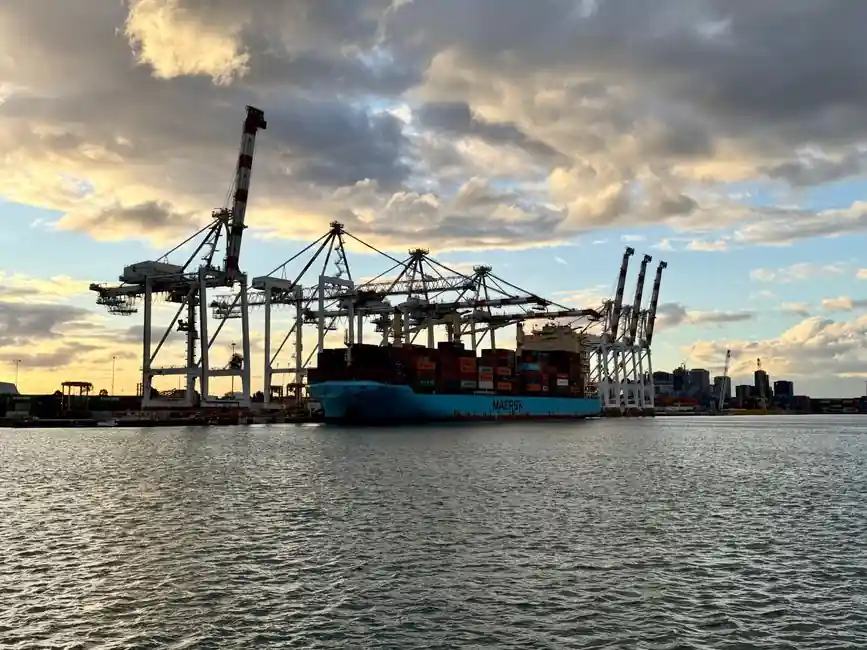
For port and terminal foundation work, the grab vs cutter decision is driven by soil class and panel depth: hydraulic diaphragm wall grabs handle soft-to-medium overburden and panel depths typically under 80 m, while trench cutters take over in hard soil or at greater depths [S1].
The diaphragm wall grab market was valued at $0.99 billion in 2026 and is forecast to reach $1.72 billion by 2035 at a 6.33% CAGR, with port expansion and quay-wall deepening cited as recurring demand drivers [S3].
Why the grab vs cutter call comes first
Tool selection is governed by soil conditions and trench depth, not by contractor preference or machine availability, according to BAUER's published method guidance [S1]. Grab excavation runs in cycles of insert, loosen, and lift under slurry support, which works well in soft to medium soils and standard panel depths [S1]. Cutter excavation is continuous: cutting wheels loosen material, a mud pump anchored in the cutting frame lifts the slurry, and the loaded slurry passes through a desanding plant before being returned to the circuit, which is the productive mode for hard soil and deep panels [S1].
For port quay walls, lock chambers, and container-terminal substructures where depth often exceeds 40-60 m, the practical cut-off is around the 60-80 m band: beyond that, cutter-mounted base carriers such as the Bauer GB 80 S (rated to 80 m) are normally specified [S2]. At 17.3-18.5 m overall machine height, these carriers also dictate site clearance and overhead-line planning for tight terminal yards [S2].
Spec ranges that decide the panel
Bauer's hydraulic DHG-V covers trench lengths of 2,400-3,800 mm and trench widths of 600-1,500 mm, with cylinder clamping force of 1,200 kN standard and 1,800 kN optional, which directly sets the maximum bite per cycle [S2][S8]. The lighter DHG-LT variant runs to 2,800 mm panel length and 800-1,500 mm width with 2 x 450 kN cylinder force, a fit for low-headroom and shallower panels [S2].
Panel geometry is a hard spec, not a preference: a DHG-V with 1,200 kN force can drive a 3,800 mm primary panel in medium clays, but the same grab with the 1,800 kN upgrade is the one to call when the soil profile stiffens or the panel width pushes past 1,200 mm [S2]. For guidance on a related crawler-mounted base machine, see backhoe loader selection for port and terminal work, which sits one layer up the equipment stack.
Guided vs free-hang: verticality and tolerance
Kelly-guided hydraulic grabs (such as Casagrande's offering) are specified when verticality tolerance is tight and panel depth is significant, because the Kelly bar transmits crowd force and keeps the grab on line through the slurry column [S4]. Rope-suspended hydraulic grabs like the DHG-V clamp via a vertically installed cylinder acting through push rods, which is mechanically simpler and easier to maintain but trades some verticality control for cycle speed [S8].
For port projects where wall verticality often has to hold within roughly 1:300 to 1:500 over the full panel depth, the guided configuration is the safer pick, while rope-suspended grabs remain the productivity choice on wider, less critical panels [S4][S8]. A broader equipment-stack view is in truck-mounted crane selection for port and terminal operations, which covers the lifting side of the same work face.
What hydraulic grabs actually beat mechanical grabs at
In bulk-terminal and deep-excavation service, hydraulic diaphragm wall grabs deliver higher clamping force per cycle, finer operator control of bite depth, and easier integration with digital assistance systems than rope-drop mechanical grabs [S2][S7]. Mechanical grabs still earn their place on low-headroom, low-power, low-maintenance jobs, where the absence of a hydraulic power pack cuts daily checks and the unit cost is roughly half a comparable hydraulic rig [S7].
For port and terminal work specifically, the hydraulic grab's higher cylinder force (1,200-1,800 kN on DHG-V) translates directly into fewer cycles per metre of trench and shorter rig-on-site time, which usually matters more than the upfront price difference once the quay-wall programme is on the critical path [S2][S7].
Soil and depth gates you cannot engineer around
Bauer's BC cutter family has recorded trench depths above 250 m in hard soil, a benchmark that defines the upper end of what cutter-mounted equipment can deliver and implicitly the boundary where grabs stop being competitive [S1]. For port projects, the more relevant gates sit lower: above approximately 60 m depth, or in soil classes where SPT N-values regularly exceed 50, cutters become the default and grabs are demoted to trim or panel-closure work [S1].
Diaphragm walls themselves are described as high-stiffness reinforced concrete walls used for excavation support, groundwater cut-off, and permanent retaining applications, which is exactly the structural envelope port quay walls and dry-dock pits sit inside [S5]. Reinforcement cages and stop-end joint elements are lowered into the slurry-supported trench after excavation, and the displaced slurry is recycled through the desander, so panel-cycle time, not raw digging rate, is the real productivity metric [S1].
Selection map: matching tool to project
For a typical container-terminal berth with 30-45 m panel depth in medium clay or sand, a hydraulic DHG-V with 1,200 kN force, 1,000-1,200 mm panel width, and a Kelly-guided rig is the balanced spec [S2][S4]. For a bulk-terminal upgrade where panels run 20-30 m and the headroom under existing gantries is limited, the DHG-LT or a low-headroom GB 50 carrier (17.3 m height, 280-310 kW engine) is a tighter match [S2].
For LNG or oil-jetty foundations where depth reaches 50-80 m and soil includes dense sands or weak rock, switch the specification to a cutter on a GB 80 S carrier, and keep a hydraulic grab on standby for primary panel work and stop-end detailing [S1][S2]. Further reading on equipment pairing for adjacent terminal tasks is in backhoe loader selection for port and terminal work, which covers the support fleet around the main wall rig.
Trackable signals for the next spec cycle
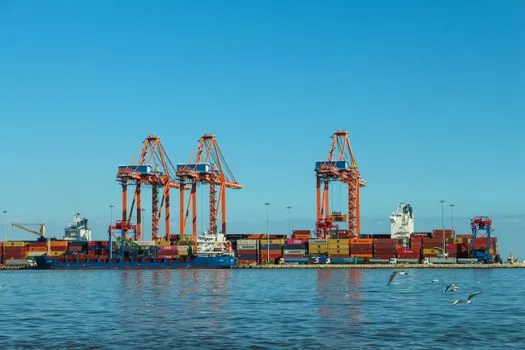
Two signals to watch over the next procurement window: any new release note from the major European grab OEMs extending rope-suspended grab panel length past 3,800 mm, and any project award in Southeast Asian or Middle Eastern deepwater ports where cutter-mounted rigs cross the 100 m panel mark, since both would re-cut the grab vs cutter line that currently sits in the 60-80 m band [S1][S2][S3].
Detailed specification references: diaphragm wall grab, terminal block, and diaphragm pump.