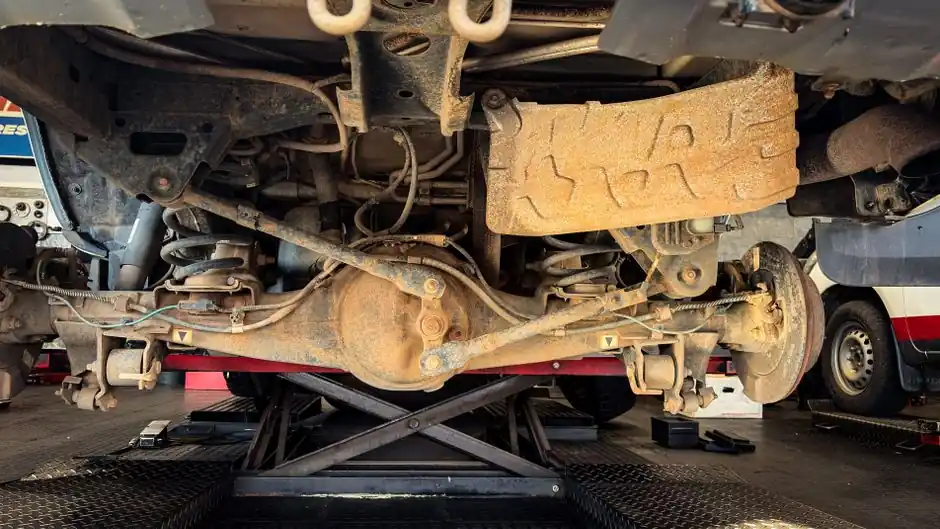
E-axle assembly pricing spans roughly $2,500 to $7,000 per unit, with the e-motor, inverter/DCDC stack, and reduction gearbox absorbing the bulk of the bill of materials, while axle housing, half shafts, and cooling loop add the secondary cost layers [S2].
Within that band, power output is the dominant cost driver: e-motor ratings of 50 to 300 kW map onto the lower and upper end of the price range, and pairing a PMSM with silicon-carbide inverter stages lifts both efficiency and unit cost compared with an induction motor and IGBT inverter [S2].
Motor, inverter, and DCDC: the silicon and magnets
Permanent magnet synchronous motors and induction motors are the two dominant e-motor topologies in series-production e-axles, and modern units routinely reach 90 to 95 percent electrical-to-mechanical efficiency [S2]. A common automotive e-motor envelope sits around 250 mm diameter by 400 mm length, though LCV, bus, and heavy-truck e-axles use physically larger stators to reach the 300 kW end of the band [S2].
Power electronics typically operate across a 300 to 800 V DC bus, covering inverters, DC-DC converters, and the battery management interface, and this sub-assembly alone is quoted at $500 to $2,500 per e-axle depending on voltage class, switching device (IGBT vs SiC MOSFET), and cooling integration [S2]. Choosing SiC over IGBT raises inverter cost per unit but lowers conduction and switching losses, which is why the same voltage class can price anywhere in that $500 to $2,500 spread.
Transmission and gearing: single-speed vs two-speed
Most e-axles use a single-speed reduction gearbox because the motor delivers peak torque at zero rpm, so a single ratio can satisfy launch and top-speed duty cycles without the gear-stacking an ICE gearbox needs [S4]. Where it is fitted, a parallel-shaft or planetary reducer made from high-strength steel or aluminum runs at 97 to 98 percent mechanical efficiency [S2].
Multi-speed e-axle variants (two-speed, occasionally three-speed) carry a price premium but recover 5 to 15 percent driving range by keeping the motor in its efficient operating window at cruising speed, a margin that has become more commercially interesting as electricity prices have moved from around €40/MWh in March 2020 to €160/MWh by March 2022 in the Belgian wholesale market [S4]. Annual maintenance on the reduction and differential stage is small in absolute terms, on the order of $100 to $300 per e-axle per year [S2].
Housing, half shafts, and structural integration

The e-axle housing is no longer a passive beam: it carries the motor, gearbox, and drive axle in one welded or cast enclosure, with the half shafts, wheel-end flanges, and brake mounts integrated into the same load path [S3]. Casting supports complex internal ribbing and high stiffness but carries higher tooling cost and longer cycle time; welded fabricated housings in sheet steel or aluminum cut cycle time and unit cost on lower volumes but require tighter weld qualification and dimensional control [S3].
On the thermal side, a typical e-axle cooling module measures roughly 300 mm by 200 mm by 150 mm and uses a water-glycol coolant with active circulation on higher-power units, a size envelope that grows roughly with peak motor torque rather than with peak rpm [S2]. For an apples-to-apples read on housing cost, a useful parallel is the cost-driver logic in sand casting vs flask-scale foundries, where tooling amortization and batch size swing the unit price by multiples on otherwise similar part geometries.
Bill of materials: where the dollars sit
For a representative passenger-car e-axle, the indicative cost split stacks up as: e-motor and resolver, roughly 35 to 45 percent of the assembly; power electronics (inverter + DCDC + EMC filter + HV harness), roughly 20 to 30 percent; reduction gearbox and differential, roughly 10 to 15 percent; housing, half shafts, and wheel-end hardware, roughly 10 to 15 percent; and cooling loop, seals, and sensors, the residual 5 to 10 percent [S2].
The two single largest levers a buyer can pull are motor power class (a 150 kW unit is materially cheaper than a 250 kW unit, even at the same supplier) and inverter semiconductor choice (IGBT vs SiC), and the third is whether to accept a single-speed reducer or pay the premium for a two-speed unit to claw back range [S2][S4]. Permanent-magnet content, typically NdFeB, is exposed to rare-earth price volatility, so a PMSM spec carries an indirect commodity risk that an induction motor largely avoids.
Total cost of ownership: not just the purchase price

For fleet operators, the purchase price is only one line on the e-axle TCO; electricity cost, maintenance, and residual drivetrain life dominate over a 10-year amortization. At a charging tariff moving from €0.35/kWh (March 2020) toward a modelled €0.65/kWh, a 5 to 15 percent efficiency gain from a two-speed e-axle translates into a non-trivial kWh saving per year [S4].
On the maintenance side, the motor itself is rated for around 10 years of service, extendable to 15 years with disciplined cooling-loop and bearing service, while the gearbox contributes the $100 to $300 per year maintenance line item and the inverter is effectively service-free unless subjected to overtemperature or coolant contamination events [S2]. The same TCO framing that drives stainless steel pipe procurement in 2026 applies here: install price looks similar across vendors, but lifetime energy and service cost move the answer.
Selection criteria and who e-axles are for
An e-axle is the right architecture for any battery-electric or range-extended EV that needs an integrated motor-gear-axle module, from light commercial vans to 18-tonne distribution trucks and city buses, and the centralized versus distributed drive choice is a packaging decision rather than a cost one [S3]. It is not the right choice for very high-speed, sustained-high-rpm applications where a separate engine and transmission layout still wins on NVH and bearing life.
When comparing two quotes, normalize on five numbers before price: peak motor power (kW), peak torque (Nm), DC bus voltage (V), reducer ratio and number of gears, and cooling interface (liquid flow rate and pressure drop). Two units quoted at the same $X,000 can sit at very different points on the cost curve if one is a 100 kW induction motor with IGBT inverter at 400 V and the other is a 200 kW PMSM with SiC inverter at 800 V, so the BOM logic from lithium-ion cell bill-of-materials work translates almost directly: spec the active materials, then read the price.
Trackable signals for 2026 procurement
Three signals to watch over the next two quarters: rare-earth (NdFeB) spot pricing, which moves PMSM e-axle quotes within the existing $2,500 to $7,000 band; SiC MOSFET wafer capacity announcements, which determine how fast 800 V e-axle inverter pricing converges toward 400 V IGBT pricing; and any new fleet-operator RFPs that explicitly accept a two-speed e-axle premium in exchange for kWh-per-100-km guarantees [S2][S4].
For the relevant spec sheets and selection criteria, see additive manufacturing material, pressure transmitter, and flow meter.