
Select a chemical-service electric ball valve by verifying the exact fluid, concentration, temperature, pressure class, torque demand, and fail position before comparing valve architecture.
The assembly must combine a compatible body, ball, stem, seats, seals, electric actuator, mounting interface, wiring, and enclosure protection as one engineered package.
Define the chemical-service envelope before selecting a valve
Chemical compatibility cannot be established from the chemical family name alone. The selection data should include the exact chemical, concentration, temperature, pressure, contamination level, and whether the fluid contains solids or crystallizing compounds [S3].
Pressure class, operating temperature, and compatibility between the body and seat materials are the primary mechanical boundaries [S4]. A material that performs adequately in a dilute chemical at ambient temperature may not perform acceptably at a higher concentration or temperature [S3].
Electric ball valves serve automated shutoff, tank transfer, flow routing, batch control, dosing, and safety isolation in chemical plants [S1]. They are appropriate where remote operation, repeatable sequencing, and reduced exposure to corrosive or hazardous fluids justify an automated assembly [S1].
The process question is not simply whether the valve opens and closes. It is whether the complete package remains operable, leak-tight, and compatible for the specified fluid and operating cycle. Additional information on the wider selection framework appears in Ball Valve Selection for Chemical Processing.
Compare floating, trunnion, and three-way electric ball valves
Floating ball valves use differential pressure to move the ball against stationary seats. They are common for solvents, treatment chemicals, and additives, and are often selected below ANSI Class 600; specially engineered floating designs can reach 2 inches and 2,500 psi [S4].
Trunnion-mounted ball valves support the ball on a trunnion while the seats move toward it during closure. They are the preferred architecture above ANSI Class 600 and for pipeline diameters exceeding 4 inches [S4]. Compared with floating designs, this arrangement reduces the torque burden that must be transferred to the electric actuator [S4].
Three-way electric ball valves automate flow diversion, mixing, or switching between process lines [S1]. They add internal flow-path and actuator requirements, so a two-way isolation package should not be treated as an equivalent substitute.
Match wetted materials to the process fluid

No single metal, polymer, or elastomer is suitable for every chemical. The body, ball, stem, seats, O-rings, gaskets, and any lining must all be evaluated as a wetted-material system [S3].
Carbon steel is suited to noncorrosive hydrocarbon service. Type 316 stainless steel and duplex alloys provide greater resistance to chloride-induced corrosion in chemical-handling applications [S4]. Acids, caustics, oxidizing chemicals, solvents, and reactive compounds require compatibility review against each candidate material rather than a generic stainless-steel designation [S3][S4].
PTFE is commonly used for general-service seats, while PEEK is considered where temperature and pressure exceed the practical limits of PTFE [S2]. This distinction is a starting point for material review, not permission to omit checks against the exact chemical, concentration, and temperature [S2][S3].
Elastomer seals can swell or degrade, and deposits or crystals can form in the valve cavity [S3]. Chemical compatibility documentation should therefore cover seals and gaskets, not merely the pressure-containing body. The relevant metal-seated ball valve option may be evaluated where elastomer sealing is unsuitable, subject to the documented chemical and pressure limits.
Size actuator torque from pressure, seat design, and valve geometry
Electric ball valves use an electric actuator to rotate the ball through a 90-degree quarter-turn stroke to open or close the valve. This controlled stroke can reduce abrupt fluid deceleration compared with an instantaneous closure, but sizing must still use the valve manufacturer’s maximum torque requirement.
Actor torque depends on pressure differential, ball and seat design, stem loading, seal friction, valve size, and service condition [S2]. An actuator rated below the required break-to-open or end-position torque can stall partway through travel. The selected package should also have a defined operating duty cycle rather than an unspecified “continuous” label [S1][S2].
The valve and actuator commonly connect through an ISO 5211 mounting interface, which standardizes the bolt pattern and stem-drive dimensions for compatible assemblies [S2]. Confirming the ISO 5211 interface helps mechanical interchangeability, but it does not establish that either component is chemically or mechanically suitable without separate torque and material checks.
For comparison, the trunnion ball valve architecture is usually more appropriate for high pressure or larger bore, while the floating ball valve architecture is generally associated with lower-cost, lower-pressure duties. These are selection tendencies, not permission to exceed the certified pressure-temperature limits of the individual valve.
Specify control, fail position, and enclosure requirements
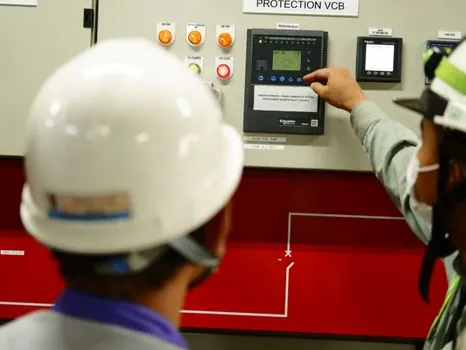
Open-close duty requires a reliable command and position indication, while modulating service requires an actuator capable of controlled positioning and a valve designed for throttling rather than isolation. Electric ball valves may support on-off control, position feedback, remote operation, or proportional control depending on the actuator configuration [S1].
A 4–20 mA input is a standard analog control signal for compatible actuator electronics [S2]. The control strategy must match the actuator input, wiring arrangement, and feedback requirement; it should not be assigned from the valve size alone.
Fail-safe behavior must be stated as a process requirement. Specify fail close, fail open, or fail-in-position for loss of power or control signal, and confirm that the selected actuator can execute that behavior. A manual override should be included where operators must stroke the valve during commissioning or operate it during a power interruption [S2].
Enclosure protection must match the installation environment, including moisture, washdown, dust, and corrosive vapor exposure [S1]. Motor housing protection does not establish corrosion resistance of the exposed actuator, stem, coupling, or external bracket. Those components require a separate environmental suitability review.
Apply service-specific limits and failure controls
Floating ball valves are frequently used for solvents, treatment chemicals, and additives below ANSI Class 600, while trunnion designs are generally preferred above Class 600 or above 4-inch pipeline diameter [S4]. Pressure, temperature, and material limits remain product-specific and take precedence over these application tendencies [S4].
Carbon steel may be appropriate for noncorrosive hydrocarbon service, while Type 316 stainless steel and duplex alloys address chloride exposure more effectively [S4]. Acid, caustic, solvent, oxidizer, and reactive services require exact chemical and concentration checks because the same alloy can behave differently across service conditions [S3][S4].
Do not use a standard electric ball valve as the default for chemical isolation. Floating designs may suit moderate-pressure duties, but trunnion designs are favored for higher pressure and larger sizes; three-way versions are appropriate only when diversion, mixing, or switching is the actual duty [S1][S4].
Anti-blowout stems, firesafe construction, antistatic features, and stem-area belleville spring washers may be relevant for volatile chemical environments [S4]. Fugitive-emission validation can be addressed through API 641 where applicable to the specified valve category [S4]. This selection framework can be adapted for Electric Ball Valve Selection for Desalination, but salinity, chloride concentration, and oxidant exposure must be re-entered as separate service inputs.
Build the purchase specification and verification checklist
Require the exact chemical, concentration, operating and design temperature, design pressure, minimum and maximum differential pressure, flow direction, solids content, valve size, connection method, and required end function [S1][S3]. These inputs define both the wetted-material selection and the actuator load.
For the valve, request body, ball, stem, seat, seal, and gasket grades, pressure-temperature ratings, torque data, seat leakage criteria, stem construction, testing provisions, and coating or lining details [S3][S4]. A generic “316 ball valve” entry does not identify the complete wetted construction.
For the actuator, request rated voltage and frequency, current or power consumption, control signal, protocol, stroke time, duty cycle, torque rating, ISO 5211 interface, limit-switch arrangement, feedback contacts, manual override, fail action, enclosure rating, and ambient-temperature limits [S1][S2].
Documentation should also cover hazardous-area classification where applicable, electrical installation requirements, maintenance access, and the recommended spare-parts strategy. A standard requirement such as API 641 is relevant to fugitive-emission qualification for applicable valve categories [S4]. Inspection records should confirm that the supplied body, ball, seats, seals, actuator, and coupling match the approved data sheet.
The shortlist logic is straightforward: use a floating design for compatible, moderate-pressure service; move to a trunnion design for higher pressure or larger bore; specify a three-way valve only for a defined routing or mixing duty; and reject any package whose chemical compatibility, pressure-temperature rating, torque, fail action, or enclosure cannot be demonstrated from the vendor documentation.